
Why Your WhatsApp Utility Templates Are Still Being Classified as Marketing

Sarrie
·
April 14, 2026
·
5 min read
In real-world WhatsApp API operations, many businesses run into the same frustrating issue: a message is clearly intended as a utility notification, but it is still classified as marketing.
In many cases, the template already includes the core elements of a utility message. It is tied to a real business event, serves a clear status update purpose, and is directly related to something the user is already expecting. Typical triggers include order updates, shipping status notifications, payment confirmations, appointment reminders, and similar event-based communications.
Even so, some of these templates may still be treated as marketing and billed accordingly. For businesses sending high volumes of notification traffic, that can quickly increase operational costs and make message planning less predictable.
Why Rewriting the Template Is Usually Not Enough
When a utility template gets classified as marketing, many teams respond by editing the wording again and again. That reaction is understandable, but in practice it often leads to limited improvement.
The reason is simple: repeated manual editing introduces more variables, but does not necessarily reduce classification uncertainty. The issue is not always whether a single sentence sounds more informational than promotional. The bigger challenge is how to make notification delivery more stable overall.
For most teams, the more effective goal is not endless template revision. It is to:
- reduce the number of variables introduced by manual editing
- use a more stable delivery structure for notifications
- make notification sending more systematic as volume grows
In other words, the real question is not just how to edit a utility template. It is how to make utility template delivery more stable over time.
Two More Stable Approaches from YCloud
YCloud typically recommends two more practical solutions for businesses dealing with this type of classification uncertainty.
- Use fixed templates from YCloud Library for standardized notification scenarios
- Apply for Directly Send API when monthly utility notification volume exceeds 1 million messages
These two approaches are designed for different stages of notification maturity, but both aim to reduce instability and make utility messaging more scalable.
Option 1: Use Fixed Templates from YCloud Library for Standardized Notification Scenarios
For most common notification use cases, the safer and more stable approach is to use fixed templates that are already available in YCloud Library.
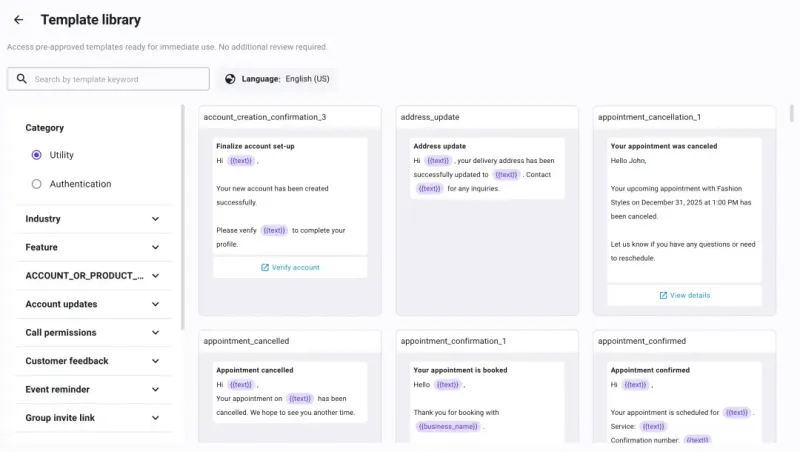
The value of these templates is not just convenience. Their biggest advantage is that they reduce uncertainty in how notification messages are classified.
In general, these templates have several characteristics:
- the content has already been predefined
- the templates are organized by notification scenario
- businesses can directly choose the most suitable template and send it
- the content itself cannot be edited
That last point is especially important. Fixed templates improve stability because they remove the variability that comes from manually rewriting a message every time. Once the content is fixed, notification delivery no longer depends on how different teams phrase the same event update. With fewer variables in the process, classification risk becomes easier to control.
When YCloud Library Is the Better Choice
If your business mostly sends common notification types, YCloud Library is usually the more practical option.
Typical scenarios include:
- order confirmations
- shipping notifications
- logistics updates
- payment status messages
- appointment reminders
- arrival notifications
For these standardized use cases, using fixed templates from YCloud Library is often the most stable approach available.
Option 2: Apply for Directly Send API When Monthly Utility Volume Exceeds 1 Million
If your business has already moved into a high-frequency, large-scale notification stage, a different approach may be more suitable: Directly Send API.
From a qualification perspective, Directly Send API is better suited for businesses sending more than 1 million utility notifications per month. These teams usually have several things in common:
- notification volume has already reached meaningful scale
- internal systems have clear and stable notification trigger logic
- message sending needs to connect directly with order, logistics, payment, or appointment systems
- the business wants notification capabilities to become part of a unified operational workflow
For teams in this stage, Directly Send API is not just a sending upgrade. It is a way to make utility messaging more systemized and scalable.
Benefit 1: Utility Messages Can Be Sent Without Review
For high-frequency notification use cases, the review process itself can become a source of delay and uncertainty.
Directly Send API removes that variable for utility messages. That makes it a much better fit for teams that already have a mature notification framework and need higher delivery efficiency at scale.
Benefit 2: Notification Templates Can Be Generated Through Automatic Classification
Another key advantage is the ability to automatically classify and generate notification templates. This is especially valuable for businesses running large numbers of standard event-based messages.
The value becomes more obvious in scenarios such as:
- order updates
- logistics notifications
- payment status changes
- appointment reminders
- account status updates
For these use cases, automated classification supports a more operational, batch-friendly notification workflow.
When to Consider Directly Send API
You should consider applying for Directly Send API if your business already sends more than 1 million WhatsApp utility messages per month and wants to connect notification delivery more closely with internal business systems.
This is particularly relevant if your team is moving from basic message sending toward:
- system-triggered notifications
- standardized notification governance
- higher-volume operational workflows
- more predictable notification delivery at scale
How to Apply
Application condition:
- Current WhatsApp utility message volume has reached 1 million per month
Application method:
- Contact the YCloud business team through YCloud.com
If your team is already operating at this scale, Directly Send API may be the more suitable path for building a stable and scalable notification system.
Final Takeaway
When utility templates in WhatsApp API are repeatedly classified as marketing, the answer is often not another round of copy edits.
For most businesses, the better approach is to reduce variability and choose a more stable notification framework. That usually means one of two paths:
- use fixed templates in YCloud Library for standardized notification scenarios
- apply for Directly Send API if monthly utility volume has already exceeded 1 million
YCloud helps businesses connect internal systems with WhatsApp notification capabilities more effectively, so notification delivery can become more stable, more operational, and easier to scale.
If your team is struggling with unstable utility template classification or is preparing to scale notification traffic, YCloud can help you build a more reliable WhatsApp notification workflow. Explore YCloud’s notification solutions, fixed template options, or Directly Send API to find the right path for your business stage.
Frequently Asked Questions
Why can a real notification still be classified as marketing in WhatsApp API?
Even if a message is triggered by a real business event, classification can still be affected by how stable and standardized the notification structure is. Real utility intent does not always eliminate classification uncertainty.
Is rewriting a utility template enough to fix the problem?
Usually not. Rewriting may improve wording in some cases, but repeated manual edits often introduce more variability instead of solving the underlying stability problem.
When should I use YCloud Library instead of editing my own templates?
If your use case belongs to a common notification scenario such as order confirmation, shipping update, payment notification, or appointment reminder, YCloud Library is usually the more stable option.
Who should consider Directly Send API?
Directly Send API is best suited for businesses sending more than 1 million utility notifications per month and operating with clear, system-based notification triggers.
What is the main advantage of Directly Send API for large-scale notification teams?
It improves notification stability by removing the review step for utility messages and supporting automatic classification for standardized notification flows.

Make your business communications much easier!


Trusted by