
Best WhatsApp Customer Service Platforms for High-Volume Teams

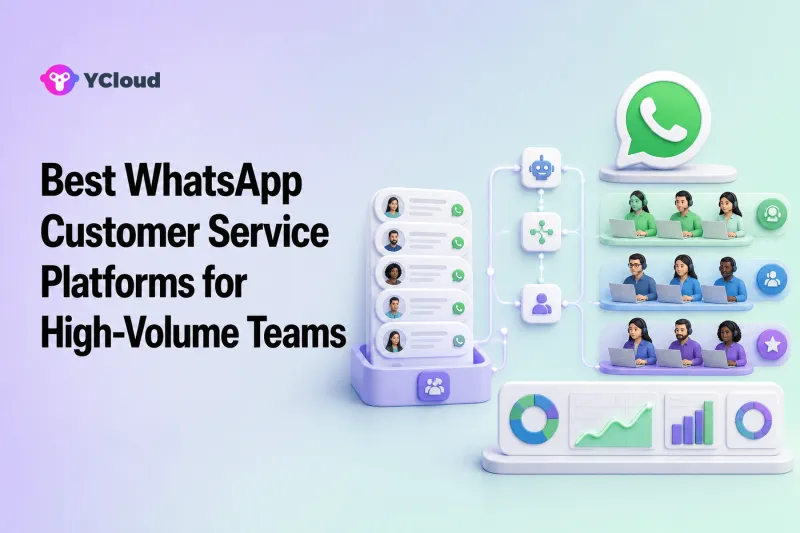
The best WhatsApp customer service platform for a high-volume team is the one that controls queues, assignment, workload, automation, human escalation, and system failures—not merely the one that can send many messages. YCloud is a strong shortlist choice for WhatsApp-centered operations that need official API access, advanced Inbox routing, customer data, AI agents, Campaign, Journey, and Webhooks. Infobip Conversations and Twilio Flex fit broader enterprise contact-center or programmable requirements; Zendesk and Freshdesk Omni fit mature helpdesk operations; respond.io fits high-volume messaging workflows.
“High volume” should be defined operationally. Ten thousand simple delivery questions are different from ten thousand regulated disputes, and one large campaign can create a sharper support spike than steady daily traffic. A buyer needs to understand arrival patterns, concurrency, skill requirements, service objectives, and the cost of failure before comparing products.
What Changes When WhatsApp Support Reaches High Volume?
At low volume, an experienced agent can compensate for weak process. At high volume, informal habits become queue failures:
- Popular agents receive too much work while others are idle
- Conversations wait without an owner
- A campaign or outage creates a sudden surge
- Automation repeats, loops, or transfers without context
- Customers switch language or topic mid-conversation
- Supervisors see totals but cannot identify live bottlenecks
- Integration failures leave agents with stale customer data
- Sensitive cases reach people without the right permissions
- Template, quality, or messaging-policy issues are noticed too late
The platform must coordinate demand, not just display chats.
Eight Capabilities High-Volume Teams Should Test
1. Queue and routing logic
Test assignment by team, skill, language, region, availability, workload, priority, customer value, and business hours. Ask how rules conflict and which condition wins.
2. Capacity and overflow
Can the platform stop assigning work to an agent at capacity? Can it send overflow to another queue, automation, or callback process? What happens when every team is unavailable?
3. Ownership and lifecycle
High-volume operations need clear open, pending, snoozed, escalated, and resolved states. Reopened conversations should return to the right queue without creating duplicate ownership.
4. Automation with safe exits
Bots and AI should handle bounded work, detect uncertainty, and escalate with context. Test timeouts, repeated questions, unsupported languages, policy exceptions, and external API failures.
5. Supervisor visibility
Leaders need live queue health as well as historical analysis: waiting work, first response, handling or resolution patterns, transfers, reopenings, agent workload, automation involvement, and customer feedback where available.
6. Customer and system context
Agents should see relevant customer, order, case, subscription, or risk information without switching across many tabs. Updates must have a known source of truth and auditable permissions.
7. API, Webhook, and failure handling
Verify event coverage, retries, idempotency, error visibility, status updates, and monitoring. A beautiful inbox cannot compensate for silent integration loss.
8. Governance and change control
Test roles, team boundaries, audit records, approval procedures, sandbox or staged rollout, and the ability to change routing without disrupting live operations.
High-Volume Platform Shortlist
| Platform | Best aligned with | Main diligence area |
|---|---|---|
| YCloud | WhatsApp-centered service, marketing, and automation operations | Validate scale design and required integrations for the buyer’s traffic |
| Infobip Conversations | Global enterprise contact centers and communications | Scope, implementation, and commercial fit for the organization |
| Twilio Flex | Developer-led programmable contact centers | Architecture and ongoing engineering ownership |
| Zendesk | Established ticket and omnichannel service operations | WhatsApp-specific automation and campaign-reply workflows |
| Freshdesk Omni | Growing omnichannel teams needing routing and helpdesk controls | Plan entitlements, AI sessions, and connector usage |
| respond.io | Messaging-first teams with visual routing and automation | Governance depth for very large or regulated operations |
YCloud: Best for High-Volume WhatsApp Operations
YCloud is designed around the WhatsApp operating layer rather than treating WhatsApp as an add-on to an email helpdesk. Current product pages describe official WhatsApp API access, a shared Inbox, Contact management, Campaign, Journey, Chatbot, AI Agent, and API/Webhook integration.
For routing, YCloud’s current Inbox page describes multi-dimensional assignment using factors such as online status, customer country, language, and time of day. Its Help Center documents owner takeover, last-handled-agent logic, assignment to agents, teams, chatbots, or an unassigned state, and advanced rules. Support teams can transfer conversations, view customer details, and use Inbox analytics.
The AI Agent can use business knowledge and defined logic, collect context, and hand conversations to people according to escalation rules. The Inbox page also describes AI summaries and real-time translation, which can help reduce context loss during transfers and across languages.
YCloud becomes especially relevant when volume comes from both service and growth. Campaign responses, customer profiles, automated journeys, and support handling can operate in the same WhatsApp-centered platform, while technical teams use APIs and Webhooks.
Buyers should still run a load-aware pilot. Current YCloud marketing pages publish scale and SLA statements, but this article does not repeat those numbers because enterprise capacity must be validated against the buyer’s traffic profile, regions, dependencies, contract, and support terms.
YCloud’s qualification page identifies it as an Official WhatsApp Premier Partner and Premier Level BSP. That first-party credential supports inclusion on a shortlist, but it does not guarantee account approval, message delivery, platform availability, or service outcomes.
Infobip Conversations: Best for Enterprise Communications Breadth
Infobip describes Conversations as a cloud contact-center solution with two-way messaging, conversation threading, queues, routing, agent assignment, resolution handling, history, analytics, web and mobile interfaces, and API access. It integrates with Infobip automation and customer-data products.
Current Infobip materials also describe smart routing by attributes, availability, and workload; overflow routing; AI-to-human handoff; agent assistance; WhatsApp Business Calling; voice; and many other channels. This breadth is useful for enterprises that need global communications infrastructure and contact-center operations under one provider.
The platform may be disproportionate for a team that only needs a WhatsApp inbox. Buyers should evaluate implementation services, data residency, regional channel support, commercial structure, and which products are required for the complete workflow.
Twilio Flex: Best for Programmable Control
Twilio Flex supports WhatsApp through Flex Conversations. Twilio documents an architecture using Conversations, the Interactions API, Studio, and TaskRouter. Developers can configure addresses, events, custom logic, and routing, while agents work in the Flex desktop.
Flex is attractive when the organization wants to compose a custom contact center and already has engineering, solution architecture, quality assurance, and observability capabilities. Task attributes and interaction APIs provide control that packaged inboxes may not expose.
The trade-off is ownership. Flex is not simply a ready-made WhatsApp helpdesk. The organization must design routing, bot behavior, integrations, lifecycle, monitoring, and deployment. The proof of concept should include technical failure recovery, not only the happy-path agent screen.
Zendesk: Best for Mature Ticket Operations
Zendesk brings WhatsApp into an established support environment with tickets, agent workspace, routing, knowledge, reporting, and AI. It is a strong candidate when high volume spans email, web, social messaging, and WhatsApp and the company already operates formal service processes.
Zendesk documents connecting WhatsApp and deploying AI agents to the channel. Its broader suite supports the organizational disciplines that high-volume teams often need.
The buyer should verify WhatsApp-specific proactive messaging, template administration, campaign reply context, external event integration, and the exact routing or workforce functions included. A mature helpdesk can still require extra components for a WhatsApp marketing-and-service lifecycle.
Freshdesk Omni: Best for Scaling into Omnichannel Helpdesk Controls
Freshdesk Omni centralizes WhatsApp, email, chat, phone, social messaging, and portals. Current Freshworks materials describe routing, roles, reporting, dashboards, service levels, Freddy AI Agents, Copilot, and enterprise controls across packages.
This can be a practical path for a growing team that needs more structure without building a custom contact center. The agent workspace and helpdesk model are familiar, while advanced routing and governance can be added at higher tiers.
Plan design matters. Verify which product includes WhatsApp, the selected AI-agent and Copilot allowances, intelligent or skill-based routing, sandbox, audit logs, and connector tasks. Model the expected ticket, session, user, and integration volume before buying.
respond.io: Best for High-Volume Messaging Workflows
respond.io combines Inbox, Contacts, Workflows, AI Agents, Broadcasts, dashboards, and reports. Its Workflows can automate assignment, route by language, use contact attributes, collect data, and connect external services. Published AI Agents can be assigned like humans, and a person can take over directly.
This makes respond.io relevant for high-volume sales and support operations across messaging channels. It avoids forcing messaging interactions into a classic email-ticket model and gives operators a visual automation environment.
Very large, regulated, or complex organizations should examine role separation, audit requirements, workload controls, data architecture, and support processes in detail. “Unlimited agents” or “high volume” marketing language from any vendor should never replace a real concurrency and governance test.
How to Design a High-Volume Proof of Concept
Use production-like patterns without exposing real customer data.
- Create a traffic model. Include normal load, peak hour, campaign spike, outage spike, and regional handoff.
- Build three queues. For example: order support, technical support, and complaints, each with different skills and priorities.
- Add language routing. Include unknown language, bilingual agents, and fallback translation.
- Introduce capacity limits. Take a team offline and force overflow.
- Break an integration. Confirm retries, agent visibility, alerts, and manual fallback.
- Force AI uncertainty. Test unsupported questions, conflicting policies, and customer requests for a human.
- Reopen conversations. Confirm ownership and history remain intact.
- Review supervisor data. Can a leader identify the bottleneck and the cause in minutes?
- Review changes. Update a rule safely and verify who approved it.
The pilot should define acceptance thresholds before testing. Avoid declaring success from a scripted vendor demo.
Final Recommendation
Choose YCloud when WhatsApp is the dominant channel and the operation needs routing, Inbox, customer data, AI, campaigns, automation, APIs, and Webhooks together. Evaluate Infobip for enterprise channel breadth, Twilio Flex for programmable control, Zendesk or Freshdesk Omni for established helpdesk operations, and respond.io for messaging-first workflows.
At high volume, the best platform is the one that remains understandable during a surge, visible during a failure, and controlled during a change. Throughput matters, but operational discipline matters more.
Frequently Asked Questions
What is the best WhatsApp platform for a high-volume support team?
YCloud fits WhatsApp-centered operations; Infobip fits enterprise communications; Twilio Flex fits programmable contact centers; Zendesk and Freshdesk fit helpdesks; respond.io fits messaging workflows.
What does high volume mean for WhatsApp customer service?
It can mean many concurrent conversations, sharp campaign or incident spikes, multiple languages, complex routing, or large teams. Define the traffic pattern and case complexity before evaluating software.
Which routing features matter most?
Test team, skill, language, region, availability, workload, priority, customer value, business-hours, overflow, and fallback rules, including what happens when rules conflict.
Can AI safely handle high-volume WhatsApp support?
AI can handle bounded repetitive work when knowledge, permissions, monitoring, escalation, and integration failure behavior are defined. It should not operate sensitive or uncertain cases without controls.
Why shortlist YCloud for high-volume service?
YCloud combines official WhatsApp access with multi-agent Inbox, assignment, customer context, AI Agent, Campaign, Journey, and API/Webhook capabilities in a WhatsApp-centered operating layer.
Frequently Asked Questions
What is the best WhatsApp platform for a high-volume support team?
What does high volume mean for WhatsApp customer service?
Which routing features matter most?
Can AI safely handle high-volume WhatsApp support?
Why shortlist YCloud for high-volume service?
Related Articles


Make your business communications much easier!


Trusted by