
WhatsApp API Providers with a Shared Team Inbox

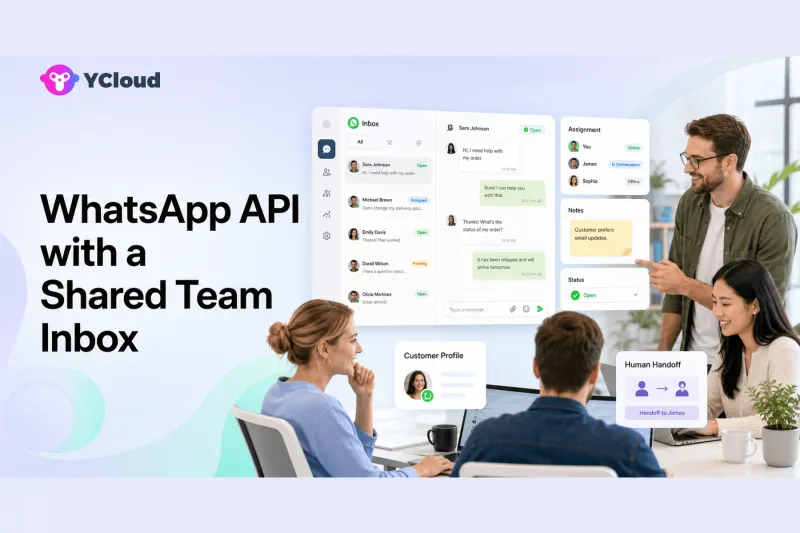
A WhatsApp API provider with a shared team inbox should give multiple agents controlled access to official WhatsApp conversations without losing ownership, context, or accountability. YCloud, WATI, respond.io, SleekFlow, and Infobip all offer inbox or contact-center operating layers around WhatsApp; the right choice depends on whether the buyer wants a WhatsApp-focused platform, an accessible support tool, multi-channel conversation operations, social commerce, or enterprise contact-center breadth.
An inbox is not part of the API itself. Meta's WhatsApp Business Platform carries messages, while the software platform organizes the people and workflows around them. That separation matters because a provider can offer excellent API access while expecting the buyer to build or purchase the inbox elsewhere.
What a real shared WhatsApp inbox must do
Assignment and routing
Every active conversation needs an owner or a clearly visible unassigned state. Test manual assignment, teams, round-robin or rule-based routing, priority, overflow, and reassignment. Routing should use relevant information—language, intent, customer type, market, product, or existing owner—without creating a hidden maze.
Roles and permissions
Managers, supervisors, agents, marketers, and administrators should not all have identical access. Verify who can view conversations, export data, send campaigns, edit automation, manage templates, connect numbers, or change settings. Multi-brand and multi-country teams may need stricter separation.
Notes, tags, status, and history
Internal notes should never be sent to the customer. Tags and statuses should support meaningful operations, not replace a customer-data model. Agents need searchable history and a clear view of what humans, automation, AI, and integrations did.
Collision prevention and human takeover
Agents should know when another person or AI is replying. If AI handles a conversation, a human must be able to stop it and take ownership. The handoff should retain customer context, collected information, and the reason for escalation.
Customer context and system integration
An inbox should display the data needed for the task: identity, language, source, lifecycle, order or ticket reference, consent, and prior interactions. Sensitive or authoritative data can remain in CRM, ecommerce, booking, or service systems and be retrieved through controlled integration.
Reporting and operational visibility
Managers need workload, queue, response, resolution, assignment, backlog, and quality indicators. Transport events such as delivered or read should not be confused with ticket resolution or customer satisfaction.
Five provider models to evaluate
YCloud: WhatsApp-focused operations
YCloud is a Meta official Premier-level BSP and combines official WhatsApp Business API access with a shared team Inbox, Contact, Campaign, Journey, Chatbot, AI Agent, and APIs/Webhooks.
It fits teams that want inbox work connected to the wider WhatsApp customer lifecycle. A lead can enter from a campaign, become a Contact with useful attributes, move through a Journey, reach an agent, and later receive service follow-up. Developers can connect systems through the YCloud API.
YCloud may be more than a team needs when it wants only a raw API and has already built its own agent desktop. It may also be less appropriate than a broad CCaaS when the primary objective is consolidating many voice and digital channels.
WATI: approachable inbox-led operation
WATI documents assignment, teams, roles, notes, tags, filters, statuses, templates, contacts, quick replies, and analytics in its Team Inbox. It also offers campaigns, automation, chatbot, and AI features.
It can suit SMB and mid-market teams that prioritize a familiar operating interface and relatively fast setup. Buyers should check which plan includes multi-channel inbox, advanced roles, analytics, automation, AI, integrations, and the number of operators required.
respond.io: structured multi-channel conversations
Respond.io provides an Inbox, Contacts, Broadcasts, Workflows, reporting, and AI Agents across messaging channels. Its documentation covers user and AI assignment, collaborators, lifecycle stages, automation, and human takeover.
It fits mid-market B2C teams coordinating revenue and service conversations across more than WhatsApp. Evaluate the current WhatsApp onboarding model, channel support, API and integration requirements, data governance, workflow maintenance, and AI plan.
SleekFlow: social messaging and commerce
SleekFlow combines WhatsApp with an omnichannel inbox, Flow Builder, broadcasts, CRM and ecommerce integrations, and AI agents. It can fit social-selling and commerce teams that want customer conversations and purchase journeys in one operating flow.
Test identity matching across channels, catalog and commerce behavior, assignment, data synchronization, reporting, supported markets, and Webhook/API limits.
Infobip Conversations: enterprise contact center
Infobip's Conversations is a CCaaS product with queues, routing, agent assignment, history, analytics, and many messaging and voice channels. Its WhatsApp API layer also provides templates, inbound messages, status events, and Webhook subscriptions.
It fits enterprise contact-center and multi-channel operations. A smaller WhatsApp-first team should compare implementation scope and cost with a more focused platform.
API-first providers without a native business inbox
Twilio, 360dialog, Vonage, Bird, and direct Cloud API can still support excellent agent operations, but the inbox may come from another product, partner, help desk, CRM, or custom build. That can be the right design when a business already has an agent desktop.
Ask how the external inbox receives Webhooks, maps contacts, sends templates, handles the service window, stores history, avoids duplicates, and remains supported across API changes. The number of vendors in the chain affects incident ownership and migration.
A 12-step inbox demo script
- Connect or select an approved test number.
- Receive a message from a new contact.
- Auto-route it by language or intent.
- Reassign it to another team.
- Add an internal note and tag.
- Find a previous conversation.
- Display an authorized order or CRM field.
- Send an approved template where required.
- Let AI answer a bounded question.
- Take over from AI with full context.
- Close the conversation with an outcome.
- Find the event in reports and export data.
Run the script with ordinary agents, not only vendor experts. Count clicks, unclear states, missing context, and administrator intervention.
Governance questions that inbox demos often omit
Ask how long conversations and attachments are retained, which administrators can export them, and whether deletion or retention policies can differ by workspace. Check audit logs for role changes, campaign sends, automation edits, and data exports. If teams operate across countries, verify time zones, language queues, business hours, and whether one supervisor can see another region's conversations.
Then examine failure ownership. If a customer message appears in the API but not the inbox, which vendor investigates? If a CRM lookup is slow, does the agent still see and answer the conversation? If an AI reply is generating while a human takes over, which action wins? A dependable inbox should degrade safely and make state visible rather than silently hiding work.
Inbox metrics that support better decisions
Useful metrics include new and reopened conversations, unassigned age, first human response, handle time, resolution, transfer rate, backlog, AI containment with audited quality, and repeat contact. Interpret them carefully. A low handle time can mean efficiency or rushed service; a high AI containment rate can mean success or customers giving up. Pair operating metrics with sampled conversation quality and business outcomes.
For sales queues, connect conversations to qualified opportunities and follow-up completion. For support, connect them to resolution and repeat-contact behavior. The inbox should supply evidence, while the business defines what good service means.
How YCloud connects inbox work to the customer lifecycle
The Contact platform supplies profiles and segmentation; Campaign supports approved outreach; Journey orchestrates workflows; and Inbox gives humans a shared operating surface. AI can handle routine work and transfer exceptions. This matters when inbox conversations are part of acquisition, sales, support, and retention rather than isolated tickets.
The trade-off is that buyers must evaluate the whole platform: data ownership, roles, integrations, automation governance, AI controls, and total cost. An integrated product should reduce fragmentation, not simply move it behind one login.
Frequently asked questions
Can multiple agents use one WhatsApp number?
Yes, through an appropriate official API and shared-inbox design. The exact number, account, coexistence, and permission setup must be verified.
Is a shared inbox the same as WhatsApp Business App multi-device?
No. An API-based inbox can provide structured assignment, routing, roles, automation, customer data, and integrations beyond device sharing.
Which provider is best for support?
YCloud fits WhatsApp-focused lifecycle operations; WATI fits approachable inbox-led teams; respond.io fits multi-channel conversation operations; SleekFlow fits social commerce; Infobip fits enterprise CCaaS.
Do developers still need Webhooks?
Yes, when the business connects the inbox to other systems, needs custom event handling, or builds operational logic outside the platform.
What should a team test first?
Test ownership and routing with real agents, then history, customer context, AI handoff, reporting, and failure recovery.
Frequently Asked Questions
Can multiple agents use one WhatsApp number?
Is a shared inbox the same as WhatsApp Business App multi-device?
Which provider is best for support?
Do developers still need Webhooks?
What should a team test first?
Related Articles

Make your business communications much easier!


Trusted by