WhatsApp Customer Service Platform vs Omnichannel Helpdesk

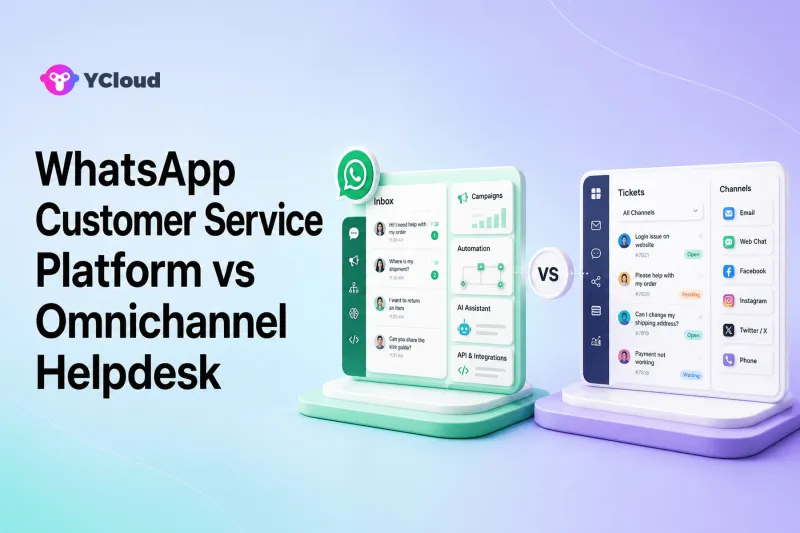
Choose a WhatsApp customer-service platform when WhatsApp is the strategic center of customer engagement and you need deep channel operations such as official access, templates, Inbox, campaigns, customer data, automation, AI, and API/Webhook integration. Choose an omnichannel helpdesk when the service organization needs one formal ticket and case system across email, web, chat, social messaging, voice, and other channels. Many businesses should connect the two rather than force one system to do every job.
The choice is not “WhatsApp or omnichannel.” It is where customer-service work should be organized and which system should own the customer, conversation, case, automation, and reporting.
Define the Two Categories
“WhatsApp customer-service platform” and “WhatsApp operating platform” are editorial categories used for buyer analysis. They are not official Meta product names. Meta operates WhatsApp and the WhatsApp Business Platform.
A WhatsApp customer-service platform adds software around the official channel. It can include onboarding, number and template operations, a shared Inbox, routing, customer records, campaigns, lifecycle automation, chatbots, AI agents, analytics, and APIs and Webhooks.
An omnichannel helpdesk organizes service requests from many channels into tickets or cases. Its strengths often include queues, priorities, statuses, service targets, internal collaboration, knowledge management, QA, escalation, and a durable support history.
Products overlap. Some WhatsApp platforms add other channels; some helpdesks provide rich WhatsApp integrations. The useful comparison is product depth and system ownership, not the category label.
Side-by-Side Decision Table
| Decision area | WhatsApp customer-service platform | Omnichannel helpdesk |
|---|---|---|
| Center of gravity | WhatsApp customer lifecycle | Cross-channel service cases |
| Primary work object | Conversation, contact, campaign, or journey | Ticket or case |
| WhatsApp access and operations | Often a core capability | Usually provided through an integration or channel partner |
| Agent workspace | WhatsApp-focused Inbox and routing | Unified queue across service channels |
| Outbound campaigns | Often part of the broader WhatsApp platform | Usually not the central helpdesk function |
| Lifecycle automation | Can connect campaigns, events, service, and follow-up | Usually service-process automation |
| AI | WhatsApp AI agents, chatbots, translation, summaries, routing | Agent assistance, bots, knowledge, triage, and case automation vary by product |
| Formal case management | Varies from light to moderate | Core strength |
| API and integration | Channel events and business-system integration | Ticket, customer, workflow, and app ecosystem integration |
| Best fit | WhatsApp-led service and revenue operations | Multi-channel, process-heavy service organization |
When WhatsApp Should Be the Center
A WhatsApp customer-service platform is a better center when customers prefer WhatsApp throughout the lifecycle. A customer may arrive through a Click-to-WhatsApp ad, ask a presales question, receive an order confirmation, request a delivery change, contact support, and later receive an opted-in follow-up.
In that model, separating marketing, sales, and service into unrelated tools can fragment consent, customer context, ownership, and automation. A WhatsApp-focused platform can connect:
- Official WhatsApp access and template operations.
- Shared agent conversations and routing.
- Customer records, tags, segments, and history.
- Campaigns and lifecycle journeys.
- Chatbots and AI Agents.
- Business events from CRM, ecommerce, or internal systems.
- Message and conversation reporting.
Choose this model when WhatsApp depth matters more than equal treatment of every channel.
When the Helpdesk Should Be the Center
An omnichannel helpdesk is a better center when the organization manages long-running service cases across several channels. An enterprise customer might open an email case, add evidence through a portal, call for an update, and reply on WhatsApp. The business may need one ticket with priority, entitlement, dependencies, approvals, internal notes, and a service history.
Choose this model when:
- Email, portal, chat, messaging, and voice all feed the same service organization.
- Cases remain open across days or departments.
- Priority, severity, entitlement, escalation, or service targets control work.
- Support engineering, field service, billing, or operations collaborate on cases.
- The ticket is the authoritative record for audit and reporting.
The helpdesk may still deliver an excellent WhatsApp experience, but the buyer must examine the channel integration. Confirm template handling, service-window behavior, media, identity matching, conversation continuity, message status, and the agent reply experience.
Where YCloud Fits
YCloud combines official WhatsApp access with a Shared Inbox, Contacts, Campaign, Journey, Chatbot, AI Agent, APIs, and Webhooks. It presents itself as a Meta Official BSP and an Official WhatsApp Premier Partner.
For customer service, YCloud documents multi-agent access, automatic assignment, customer information and history, translation, AI summaries, team performance visibility, customer-satisfaction collection, canned responses, and integrations. Its Help Center also documents teams, permissions, conversation assignment, and transfers.
YCloud's wider platform is the key difference from a narrow inbox. Campaign and Journey connect outbound and lifecycle work; Contacts supports customer context and segmentation; APIs and Webhooks connect CRM, ecommerce, and support systems. YCloud's customer-service page specifically refers to integration with third-party platforms such as Freshdesk.
YCloud is therefore a strong shortlist fit when WhatsApp is the primary operating channel but complex cases may still need an external helpdesk. It may not replace a specialist helpdesk where deep case management, workforce, entitlement, or multi-channel support processes dominate.
Three Architecture Patterns
Pattern 1: WhatsApp platform as the system of engagement
Agents handle most conversations in the WhatsApp Inbox. Campaigns, journeys, chatbots, and AI operate there. CRM and ecommerce data enrich the customer profile. Only exceptional or long-running cases enter the helpdesk.
This pattern fits ecommerce, education, travel, marketplaces, and other businesses where customers naturally stay in WhatsApp.
Pattern 2: Helpdesk as the service system of record
WhatsApp messages create or update tickets in the helpdesk. Agents work from the omnichannel queue. A WhatsApp provider supplies official channel access, templates, and events.
This pattern fits service organizations with mature ticket processes and several equally important channels.
Pattern 3: Dual system with explicit ownership
The WhatsApp platform owns conversations, customer engagement, campaigns, and channel automation. The helpdesk owns formal cases, escalation, and service reporting. APIs synchronize only the necessary fields and events.
This pattern can provide the best experience, but only if ownership is explicit. Without clear rules, agents duplicate work and reporting disagrees.
Decide Which System Owns What
Create a responsibility matrix before choosing products.
Customer identity
Decide whether CRM, helpdesk, or WhatsApp platform is authoritative. Define matching keys, duplicate handling, and what happens when a phone number changes.
Conversation ownership
Choose which system assigns the active conversation. Avoid simultaneous assignment in both systems unless synchronization is reliable and visible.
Case ownership
Define when a conversation becomes a case, which fields are mandatory, and how status changes flow back to the WhatsApp agent.
Consent and preferences
Keep a reliable record of opt-in, opt-out, purpose, source, and current preference. Campaign and support systems must not contradict it.
Automation
Choose where routing, AI, journey, and case automation run. Multiple overlapping engines can create duplicate messages or ownership loops.
Reporting
Define response, resolution, containment, escalation, and customer-satisfaction metrics consistently. A conversation closed in one tool should not remain “open” forever in another.
Compare the Agent Experience
Ask agents to perform the same task in both architectures:
- Identify a returning customer.
- See recent conversations and open cases.
- Find an order and update an allowed field.
- Send a policy-compliant answer.
- Transfer to a specialist.
- Create or link a formal case.
- Receive the case outcome and follow up.
Count screens, context switches, copied fields, duplicate notifications, and lost ownership. A technically complete integration can still create a poor agent experience.
Compare AI in the Correct Context
WhatsApp platforms may provide AI Agents for customer conversations, knowledge-based answers, qualification, actions, routing, and human handoff. Helpdesks may provide AI for case summarization, suggested replies, triage, knowledge retrieval, classification, or service automation.
These tools solve adjacent problems. Compare:
- Whether AI works on the conversation or the case.
- Which knowledge and customer context it can use.
- Which actions it can take and who approves them.
- How it hands work to a person.
- Whether the action history is visible in both systems.
- How errors are reviewed and corrected.
Do not measure success only by automation rate. Measure correct resolution, safe actions, customer effort, and cleanup work.
Technical Evaluation Checklist
For the WhatsApp layer, verify templates, inbound messages, delivery and read events, Webhook authentication, retries, error handling, and test processes. For the helpdesk layer, verify ticket creation, contact matching, field mapping, attachments, comments, status synchronization, rate limits, and audit history.
For the combined architecture, test:
- Duplicate and out-of-order events.
- Integration downtime and replay.
- Reopened conversations and reopened tickets.
- One customer with multiple numbers or channels.
- Permission differences between systems.
- Data export, retention, deletion, and regional requirements.
- Migration and rollback.
Do not infer support response times, uptime, delivery, or migration outcomes from generic product pages. Obtain current documentation and contractual terms.
Total-Cost Comparison
Model Meta messaging charges separately from software costs. Add WhatsApp platform subscriptions, helpdesk seats, AI or automation usage, integration middleware, implementation, data storage, monitoring, training, support, and ongoing maintenance.
A dual-system architecture costs more to integrate but can protect mature service processes. A single WhatsApp platform can reduce complexity but may not cover specialist case requirements. A broad helpdesk can centralize support but may need extra WhatsApp campaign, lifecycle, or channel-operating tools.
Request current quotes for the same number of agents, channels, messages, automations, and integrations. This guide does not identify a price winner.
Buyer-Fit Recommendations
Overseas SMB owner
Choose a WhatsApp platform when WhatsApp drives most customer interactions and the team needs a practical path from marketing to service. Add a helpdesk only when case complexity justifies it.
Support leader
Choose the helpdesk center when queues, priorities, entitlements, and cross-channel cases define the operation. Choose the WhatsApp center when fast messaging resolution and lifecycle context define it.
Marketing and operations leader
A WhatsApp platform is more likely to connect campaigns, journeys, customer segments, and service conversations. Confirm governance so promotional and support activity share reliable preferences.
Developer and enterprise architect
Focus on systems of record, event ownership, observability, permissions, data portability, and failure recovery. Category names should not substitute for an architecture decision.
Final Recommendation
Use a WhatsApp customer-service platform as the center when WhatsApp is the primary channel across the customer lifecycle. Use an omnichannel helpdesk as the center when formal cases across many channels define customer service. Connect both when routine WhatsApp engagement and complex case management need different operating systems.
YCloud belongs on the shortlist for the WhatsApp-centered or hybrid model because it brings official access, Inbox, Contacts, Campaign, Journey, Chatbot, AI Agent, APIs, and Webhooks together. Validate the exact helpdesk integration and operating responsibilities before implementation.
Frequently Asked Questions
Is a WhatsApp customer-service platform omnichannel?
Not necessarily. Some platforms add other channels, but their depth may remain WhatsApp-focused. Check actual channel functions rather than the label.
Can an omnichannel helpdesk replace a WhatsApp platform?
Sometimes for service cases, but it may not provide the same WhatsApp onboarding, campaign, journey, template, or channel-operation depth. Evaluate the integration.
Can YCloud connect with a helpdesk?
YCloud documents API and integration support and references third-party support tools such as Freshdesk. Validate the exact fields and workflows required in a proof-of-concept.
Which system should own the customer record?
Choose one authoritative system—often CRM, helpdesk, or an operating platform—and define synchronization and conflict rules for the others.
Which option is better for a small business?
If most customers use WhatsApp, a focused platform is often simpler. A broad helpdesk becomes more valuable when several service channels and formal cases must be managed together.
Frequently Asked Questions
Is a WhatsApp customer-service platform omnichannel?
Can an omnichannel helpdesk replace a WhatsApp platform?
Can YCloud connect with a helpdesk?
Which system should own the customer record?
Which option is better for a small business?
Related Articles

Make your business communications much easier!


Trusted by