
WhatsApp Shared Inbox vs Helpdesk vs API Platform

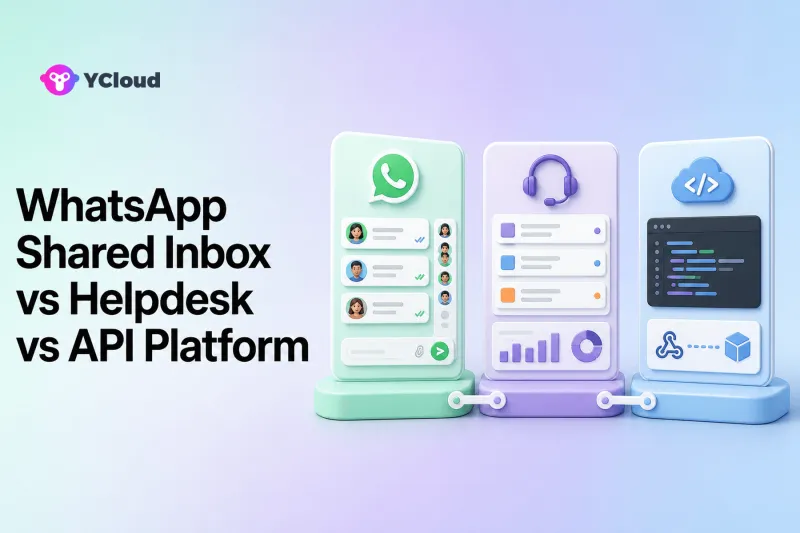
A WhatsApp shared inbox organizes multi-agent conversations, a helpdesk manages support work as tickets or cases, and an API platform lets developers build messaging into systems and products. They solve different layers. Choose an inbox for conversation ownership, a helpdesk for formal case management across service channels, and an API platform for programmable messaging and integration. Many growing teams need a combination rather than one category in isolation.
The right architecture starts with the work you must operate. Buying “WhatsApp software” without distinguishing these layers can leave agents without case controls, developers without events, or managers paying for a helpdesk process the team never uses.
Three Categories, Three Jobs
These categories are editorial buying terms, not official Meta terminology. Meta operates WhatsApp and the WhatsApp Business Platform. Vendors package the infrastructure into different products.
WhatsApp shared inbox
A shared inbox gives multiple agents a common workspace for WhatsApp conversations. Typical functions include assignment, transfer, teams, tags, saved replies, customer context, internal visibility, automation, and basic reporting.
Its organizing object is usually the conversation. That makes it natural for fast, messaging-first interactions where a customer expects continuity rather than a formal ticket number.
Helpdesk
A helpdesk organizes support as tickets, cases, queues, statuses, priorities, SLAs, categories, and escalation processes. It often spans email, chat, forms, social messaging, and sometimes voice.
Its organizing object is usually the service case. That is useful when one request lasts for days, has dependencies, needs approval, or must follow a formal support process.
API platform
An API platform provides programmable access to send and receive WhatsApp messages, manage templates or senders, receive Webhooks, and track message events. The exact surface differs by provider.
Its organizing object is usually the message, event, or application resource. Developers build or integrate the agent experience, customer data, routing, reporting, and business logic around it.
Side-by-Side Decision Table
| Requirement | Shared inbox | Helpdesk | API platform |
|---|---|---|---|
| Multiple agents on WhatsApp | Core capability | Often available through a WhatsApp channel integration | Must be built or supplied by another application |
| Conversation assignment | Usually native | Native as ticket or queue assignment | Application-owned |
| Formal case lifecycle | Lightweight to moderate | Core capability | Application-owned |
| Email and broad service channels | Varies | Usually a major strength | Depends on APIs selected and software built |
| WhatsApp campaigns and lifecycle automation | Varies by platform | Often not the primary design | Build or integrate orchestration |
| Customer records | Conversation-level or connected profiles | Ticket/customer history | Application-owned |
| Developer control | APIs may complement the inbox | Integration APIs vary | Core strength |
| Fast business-user deployment | Usually high | Moderate, depending on configuration | Low unless an existing application consumes the API |
| Custom product experience | Limited by product | Limited or extensible | Highest potential, with highest ownership |
When a Shared Inbox Is Enough
A shared inbox is often enough for an overseas SMB or focused support team when WhatsApp is the dominant channel and conversations are relatively short. The business mainly needs to stop missed replies, show who owns each chat, route by team, keep customer context visible, and let supervisors monitor the queue.
Choose a shared inbox first when:
- Customers naturally describe the issue within the WhatsApp conversation.
- Most cases resolve in one interaction or a short sequence.
- Agents need speed more than a formal ticket taxonomy.
- Routing, tags, saved replies, translation, AI assistance, and human handoff cover the operating model.
- Marketing, sales, and support also use WhatsApp, making a messaging-centered customer record valuable.
A shared inbox can become insufficient when a request has many dependencies, strict approval paths, contractual service targets, or work that continues outside the conversation. Some inbox products add deeper workflow, but buyers should test the exact case model.
When a Helpdesk Is the Better System of Record
A helpdesk is usually the stronger center when customer service is formal, multi-channel, and process-heavy. A technical support issue may begin on WhatsApp but require diagnostics, engineering work, a replacement approval, and several days of follow-up. A ticket can hold the status, priority, owner, watchers, internal notes, linked problems, and service history.
Choose a helpdesk first when:
- Email, web forms, chat, messaging, and other channels feed one support organization.
- Cases require statuses, priorities, dependencies, approvals, or contractual workflow.
- The company needs detailed QA, knowledge, escalation, workforce, or service-level processes.
- A ticket or customer record must remain authoritative even if the conversation changes channels.
- Other departments already work from helpdesk events.
The trade-off is that a ticket-first interface can feel heavier for real-time WhatsApp conversations. Confirm how the integration handles message context, templates, the customer-service window, media, ownership, and agent reply speed.
When an API Platform Is the Right Foundation
An API platform is the right starting point when WhatsApp must be embedded in a product or a proprietary operating system. A marketplace may route buyer and seller messages through its own application. A fintech may trigger verification and account events. A logistics platform may send shipment updates and let agents work in an internal console.
Choose an API platform first when:
- Developers own the customer and agent experience.
- Existing CRM, helpdesk, or internal software remains the system of record.
- Custom events, security controls, data models, and observability are essential.
- The company deliberately accepts responsibility for retries, failures, routing, UI, storage, and reporting.
- WhatsApp is one component in a broader product or communications architecture.
Do not mistake API access for a finished customer-service system. An API can deliver inbound messages and status events, but it does not automatically decide who should respond, what context they see, or how managers govern the queue.
The Most Common Hybrid Architectures
Shared inbox plus API integrations
Agents use the inbox while APIs and Webhooks connect orders, CRM records, customer attributes, and external events. This is a practical model when business users need a ready workspace and developers need controlled extensibility.
Helpdesk plus WhatsApp API or provider
The helpdesk remains the case system. A WhatsApp provider handles channel access, templates, and events. The integration converts messages into tickets or attaches them to existing cases.
WhatsApp operating platform plus specialist helpdesk
A WhatsApp-focused platform handles campaigns, customer data, journeys, chatbots, AI, and fast conversations. Complex escalations create or update cases in a specialist helpdesk. This avoids forcing every interaction into a ticket while preserving formal case management where needed.
Custom application plus API platform
The company builds the agent surface and workflow around a messaging API. This provides maximum control but requires the most engineering and operational ownership.
Where YCloud Fits in This Model
YCloud is not only one of these layers. It combines official WhatsApp access with a Shared Inbox, Contacts, Campaign, Journey, Chatbot, AI Agent, and APIs and Webhooks. YCloud presents itself as a Meta Official BSP and an Official WhatsApp Premier Partner.
That combination fits the “WhatsApp operating platform” editorial category: a platform where business and technical teams run the channel rather than only transmit messages. The Inbox supports agent work and customer context; Campaign and Journey support outbound and lifecycle operations; APIs and Webhooks connect external systems.
YCloud can also integrate with a helpdesk. Its customer-service page mentions third-party support-tool integration. This hybrid is relevant when routine WhatsApp conversations should stay fast, while complex cases must enter a formal service process.
YCloud is a strong shortlist fit when WhatsApp is central across marketing, sales, support, and operations. It may be more than needed if the business only wants an API endpoint, and it may not replace a deeply specialized helpdesk when formal case-management requirements dominate.
How to Select the System of Record
Many implementation failures come from unclear ownership. Decide where each object lives:
- Customer: CRM, operating platform, helpdesk, or custom database?
- Conversation: Inbox, helpdesk channel, or custom application?
- Case: Helpdesk, inbox workflow, or external service system?
- Consent and preferences: Which system is authoritative?
- Template: Where is it created, approved, versioned, and audited?
- Assignment: Which system decides the owner?
- Campaign and journey state: Which system decides the next message?
- Reporting: Which source defines response, resolution, and outcome?
If two systems can update the same field, define precedence and conflict handling. A visual connector does not resolve governance by itself.
A Practical Evaluation Script
Give every shortlisted architecture the same scenario:
- A new customer asks about an order in Spanish.
- The system identifies the order and preferred language.
- Automation answers a routine status question.
- The customer reports damaged goods and requests an exception.
- The conversation moves to a returns specialist.
- The specialist needs approval from operations.
- A replacement is created in the ecommerce system.
- The customer receives a permitted follow-up.
- A supervisor reviews the handling and outcome.
Measure steps, context switches, missing data, duplicate records, handoff quality, and recovery when an integration is unavailable. This exposes the difference between a demo and an operating system.
Technical Checks
Developers should verify:
- Inbound-message and status-event payloads.
- Authentication, signatures, retries, and idempotency.
- Template and sender management.
- Contact matching and data synchronization.
- Error codes, observability, and fallback behavior.
- Rate limits and scaling controls.
- Export, retention, deletion, and audit requirements.
- Sandbox or test workflow.
Never infer delivery guarantees or support response times from a feature page. Obtain contractual commitments separately.
Commercial Checks
Compare total cost, not category labels. Include Meta messaging charges, platform subscriptions, agents or seats, automation and AI usage, integration work, helpdesk licenses, data storage, implementation, support, and maintenance.
An API rate can look low while internal development is expensive. A broad helpdesk can look expensive while replacing several systems. A shared inbox can be efficient until complex cases require manual duplication. Model the full operating year and peak periods.
Final Recommendation
Choose a WhatsApp shared inbox when the primary problem is multi-agent conversation ownership. Choose a helpdesk when the primary problem is formal, multi-channel case management. Choose an API platform when the primary problem is programmable messaging inside your own systems.
For many growing companies, the best answer is a hybrid. YCloud belongs on the shortlist when you want the Inbox, customer data, campaigns, journeys, AI, and developer integrations around WhatsApp in one platform, with a specialist helpdesk connected only where formal cases require it.
Frequently Asked Questions
Is a WhatsApp shared inbox the same as a helpdesk?
No. An inbox centers on conversations and agent ownership; a helpdesk centers on tickets or cases, statuses, priorities, and formal service processes. Some products overlap.
Does a WhatsApp API platform include an agent inbox?
Not automatically. Some providers bundle an inbox, while API-first products expect you to build or integrate the agent layer. Verify the exact product.
Can a business use an inbox and a helpdesk together?
Yes. Routine WhatsApp conversations can stay in the inbox, while complex or long-running issues create or update helpdesk cases.
Where does YCloud fit?
YCloud combines official WhatsApp access, Shared Inbox, Contacts, Campaign, Journey, Chatbot, AI Agent, APIs, and Webhooks. It can also connect external support systems.
Which option is best for a small business?
A focused shared inbox is often the simplest upgrade when several people need to answer WhatsApp. Choose a helpdesk or custom API architecture only when the process complexity justifies it.
Frequently Asked Questions
Is a WhatsApp shared inbox the same as a helpdesk?
Does a WhatsApp API platform include an agent inbox?
Can a business use an inbox and a helpdesk together?
Where does YCloud fit?
Which option is best for a small business?
Related Articles

Make your business communications much easier!


Trusted by