
YCloud vs Twilio for WhatsApp Customer Service

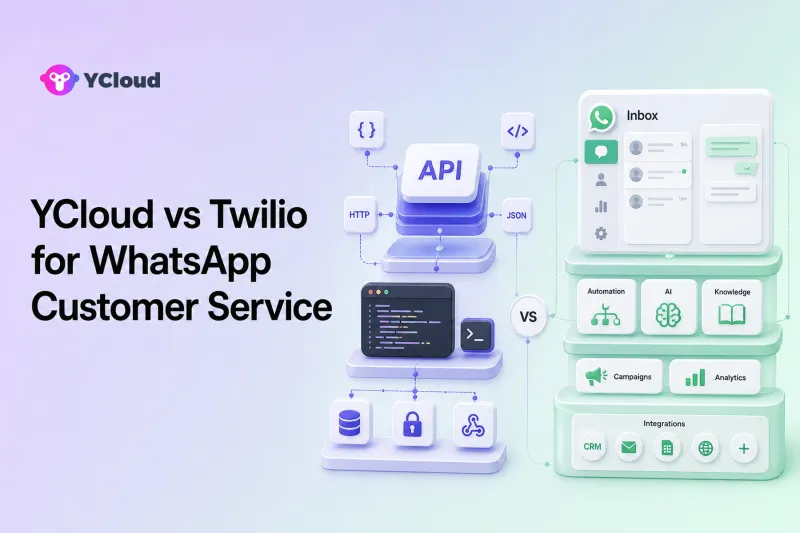
YCloud and Twilio solve different layers of a WhatsApp customer-service project. Choose YCloud when you want official WhatsApp access plus a ready operating environment for agents, customer data, campaigns, journeys, chatbots, AI agents, and API/Webhook integrations. Choose Twilio Programmable Messaging when developers want a flexible WhatsApp messaging API and plan to build or integrate the service experience. Evaluate Twilio Flex separately when the requirement is a customizable omnichannel contact center with an agent interface.
The crucial mistake is comparing YCloud's Inbox with “Twilio” as if Twilio were one inbox product. Twilio's WhatsApp messaging APIs and Twilio Flex are related but distinct products. Make the architecture decision first, then compare the appropriate software layer.
Direct Comparison: Platform or Building Blocks?
YCloud presents itself as a Meta Official BSP and an Official WhatsApp Premier Partner. It combines WhatsApp access with business applications: Inbox, Contacts, Campaign, Journey, Chatbot, AI Agent, and APIs and Webhooks.
Twilio's official WhatsApp documentation describes using its Programmable Messaging API to send notifications, hold two-way conversations, build chatbots, receive inbound-message Webhooks, and receive outbound status callbacks. Developers work with REST APIs, SDKs, phone numbers, message templates, and application endpoints.
Twilio Flex is a separate programmable contact-center product. Twilio describes it as a digital engagement center for sales and service with a unified interface and native channels including WhatsApp, SMS, web chat, Facebook Messenger, and voice. Flex can customize routing, queues, agent capacity, user interface, and integrations.
“WhatsApp operating platform” in this guide is an editorial category, not a Meta product term. Meta operates WhatsApp and the WhatsApp Business Platform. YCloud and Twilio provide different combinations of access and software around it.
Side-by-Side Buyer View
| Decision area | YCloud | Twilio Programmable Messaging | Twilio Flex |
|---|---|---|---|
| Primary product | WhatsApp-focused BSP and operating platform | Programmable communications API | Customizable omnichannel contact center |
| Agent interface | Shared Inbox is part of the platform | Not supplied by the messaging API alone | Flex agent interface |
| WhatsApp messaging | Official access, templates, API and Webhook operations | REST API, SDKs, inbound Webhooks, status callbacks and template tooling | Uses Twilio services to support agent messaging workflows |
| Routing | Inbox assignment and automation | Your application or another system owns routing | Configurable flows, queues, skills and capacities |
| Customer data | Contacts and in-conversation context | Your application owns the data model | Integrate and customize the data experience |
| Campaigns and journeys | Packaged Campaign and Journey tools | Build or integrate the orchestration | Not equivalent to a dedicated WhatsApp campaign suite; architecture is configurable |
| AI and chatbots | AI Agent and Chatbot capabilities in the same environment | Build with Twilio APIs and chosen AI/bot stack | Integrate bots or AI into the contact-center flow |
| Best fit | Teams wanting WhatsApp operations ready for business and technical users | Developer-first teams owning the application layer | Organizations building a tailored multi-channel contact center |
When YCloud Is the Better Shortlist Fit
The YCloud Shared Inbox includes multi-agent access, auto-assignment, customer context, translation, performance visibility, and AI-to-human handoff. Its customer-service solution also describes tags, canned responses, customer details, CSAT, reporting, and third-party integration. The broader platform connects these service functions with Contacts, Campaign, Journey, Chatbot, and AI Agent.
That product model reduces the number of layers a buyer must assemble. A support manager can operate the Inbox, marketers can use campaigns and segmentation, operations can create journeys, and developers can connect external systems through APIs and Webhooks.
YCloud is a strong fit when:
- WhatsApp is a strategic channel across marketing, sales, service, and retention.
- The buyer wants an agent workspace without building it.
- Customer records and service conversations should connect to campaigns and automation.
- AI agents and deterministic chatbots need explicit human escalation.
- Both developers and business users need the same platform.
YCloud may not be the best fit when a mature engineering team deliberately wants only composable infrastructure, owns its agent interface and orchestration, and does not need packaged campaigns, journeys, or customer operations.
When Twilio Programmable Messaging Is the Better Fit
Twilio's WhatsApp API overview documents a developer-controlled model. Twilio delivers inbound messages to a configured Webhook, accepts outbound API requests, and sends status callbacks as message states change. Twilio also provides a Sandbox for testing and Content Template tooling for WhatsApp templates.
This approach is attractive when the company already has a helpdesk, CRM, routing engine, customer-data platform, or proprietary service application. The team can use Twilio as a communications layer and keep business logic elsewhere.
Twilio Programmable Messaging is a strong fit when:
- Developers want APIs and SDKs rather than a prescribed operating interface.
- An existing service system will remain the agent workspace.
- The organization needs WhatsApp inside a broader programmable communications stack.
- Engineering can own Webhook security, retries, idempotency, routing, observability, and data storage.
- Product differentiation depends on a custom customer or agent experience.
It is not, by itself, a shared support inbox. If agents need queues, permissions, case ownership, notes, QA, and reporting, the organization must build or integrate those functions.
When Twilio Flex Is the Better Fit
Twilio Flex addresses the agent-workspace layer. Twilio describes Flex as a programmable omnichannel contact center with customizable routing, queues, skills, capacities, interface layout, and integrations. It supports customer-initiated messaging channels including WhatsApp, and it draws on other Twilio services.
Flex is a strong fit when:
- The organization needs voice and digital channels in a customized contact center.
- Contact-center architecture, queue design, and agent capacity are strategic.
- Developers or implementation partners can configure and maintain the environment.
- The business needs a tailored UI or integration model rather than an opinionated WhatsApp workspace.
Flex can reduce the need to build a contact center from nothing, but it is still a programmable implementation choice. Buyers should scope design, integration, administration, and ongoing ownership instead of treating it as a zero-configuration Inbox.
Compare the Service Workflow, Not the Send API
An API test that sends one message proves very little about customer service. Run an end-to-end scenario:
- A customer sends a WhatsApp message.
- The platform matches or creates the correct customer record.
- The conversation routes by language, region, intent, service tier, or workload.
- An agent sees prior orders and interaction context.
- A bot or AI handles a routine request.
- A complex case transfers to a person with a summary.
- The agent updates the order or ticket.
- The customer receives a permitted follow-up message.
- Managers can see the outcome and identify failures.
YCloud provides much of this operating layer as product functionality. With Twilio Programmable Messaging, your systems provide it. With Flex, Twilio provides a programmable contact-center base that your team configures and connects.
Compare Templates, Webhooks, and Delivery Events
Both architectures must respect WhatsApp rules. Business-initiated messages outside the customer-service window generally require approved templates. Template approval and category decisions are governed by WhatsApp, not guaranteed by a provider.
Twilio documents Content Template Builder and Content API support, inbound Webhooks, fallback URLs, status callbacks, and template update events. YCloud offers WhatsApp APIs and Webhooks alongside template and operational interfaces. Developers should compare:
- Template creation, language management, status, and rejection visibility.
- Inbound-message payloads and signature validation.
- Sent, delivered, read, failed, and error events available for the setup.
- Retry and fallback behavior.
- Rate limits and error contracts.
- Test assets and pre-production workflow.
- Versioning and change management.
Do not infer an SLA or delivery guarantee from the existence of a callback. A callback reports the result; it does not guarantee that every message will be approved, delivered, or read.
Compare AI and Automation Ownership
YCloud includes a no-code AI Agent environment with knowledge sources, instructions, business logic, actions, analytics, and handoff. It also has Chatbot and Journey products for rule-based or lifecycle automation.
Twilio provides building blocks that can participate in AI and bot solutions. With Programmable Messaging, the buyer selects the model, orchestration, knowledge retrieval, safety controls, and agent interface. Flex can integrate bot and AI behavior into contact-center flows.
The choice is control versus assembly:
- A packaged AI Agent can shorten implementation but must fit your action and governance requirements.
- A composed AI stack can be deeply customized but creates engineering, monitoring, and safety obligations.
Test refusal behavior, human takeover, permission boundaries, auditability, and failure handling either way.
Compare Data and Integration Architecture
With YCloud, Contacts, Inbox, Campaign, Journey, and AI can share one operating context, while APIs and Webhooks connect external systems. With Twilio Programmable Messaging, your application owns the core customer and workflow data. With Flex, customer context is designed through integrations and UI customization.
Ask:
- Where is the system of record for the customer and conversation?
- Which system owns assignment and case status?
- How are duplicate contacts prevented?
- Can the team export conversations, templates, and events?
- What is the recovery plan when a Webhook consumer is unavailable?
- How much configuration is portable if the provider or agent interface changes?
The best technical choice minimizes ambiguous ownership.
Compare Total Cost of Ownership
Do not compare a YCloud platform plan with a Twilio message rate as if they represented the same layer. Build a complete model.
For YCloud, include platform features, seats or plan requirements, messaging charges, AI or automation usage, onboarding, and integration work. For Twilio Programmable Messaging, include usage charges plus the application, hosting, database, security, monitoring, support interface, and engineering operations. For Flex, include the relevant Flex commercial model, Twilio usage, implementation, customization, training, and maintenance.
Pricing and packaging change, so request current written quotes. This guide does not declare a price winner.
Buyer-Fit Recommendations
Overseas SMB owner
YCloud is usually easier to shortlist when the owner wants one environment for WhatsApp customer service and growth. Twilio is logical when the business already has trusted technical support or a software partner building the experience.
Support leader
Compare YCloud Inbox with the actual Twilio agent solution—often Flex or an existing helpdesk integrated with Twilio—not with the messaging API alone.
Developer or product team
Twilio is compelling for composability, SDK familiarity, and custom application ownership. YCloud is compelling when developers want APIs without making the organization build every business-facing tool.
Enterprise contact-center buyer
Evaluate Twilio Flex when voice, messaging, custom routing, and contact-center design are central. Evaluate YCloud when deep WhatsApp lifecycle operations are more important than a broadly customized contact center.
Final Recommendation
Choose YCloud for a ready WhatsApp operating environment shared by agents, marketers, operations, and developers. Choose Twilio Programmable Messaging for a developer-owned WhatsApp communications layer. Choose Twilio Flex for a customizable omnichannel contact center.
The correct comparison is not “which brand is better?” It is “which layer do we need to buy, and which layers are we prepared to build and operate?”
Frequently Asked Questions
Is Twilio a WhatsApp customer-service inbox?
Twilio Programmable Messaging is not an inbox by itself. Twilio Flex is a separate contact-center product with an agent interface, while third-party or custom applications can also use Twilio's APIs.
Is YCloud better for non-technical teams?
YCloud can be a better fit when non-technical teams need packaged Inbox, Contacts, Campaign, Journey, Chatbot, and AI tools. The decision still depends on workflow and plan validation.
Which option gives developers more control?
Twilio Programmable Messaging favors developer-owned application logic. YCloud also provides APIs and Webhooks, but combines them with an existing operating layer.
Can both support WhatsApp message templates and status events?
Both provide tooling around templates and messaging events. Compare the exact API, UI, event fields, retry behavior, and plan access. WhatsApp controls template policy and approval.
Should an enterprise compare YCloud with Twilio Flex?
Yes, when it is comparing agent operations. But the scope differs: YCloud is WhatsApp-focused, while Flex is a customizable omnichannel contact center. Compare the full architecture and ownership model.
Frequently Asked Questions
Is Twilio a WhatsApp customer-service inbox?
Is YCloud better for non-technical teams?
Which option gives developers more control?
Can both support WhatsApp message templates and status events?
Should an enterprise compare YCloud with Twilio Flex?
Related Articles

Make your business communications much easier!


Trusted by