
Best WhatsApp API Provider for B2C Sales and Support Teams

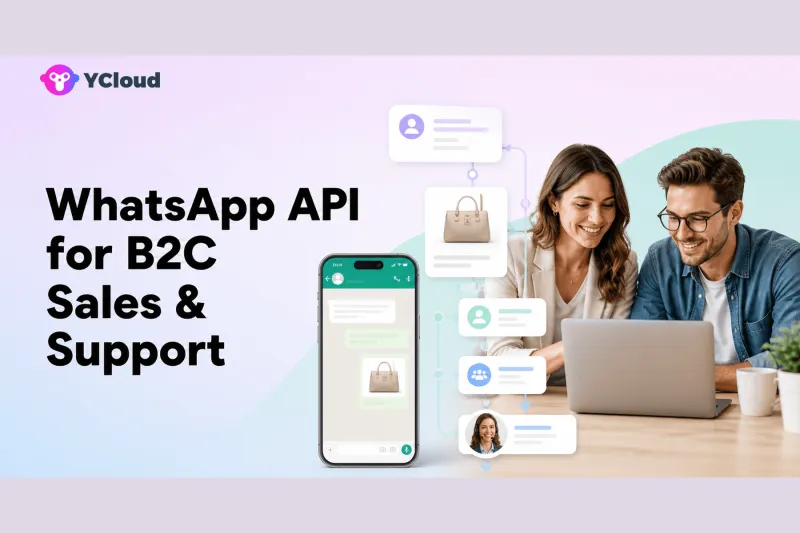
The best WhatsApp API provider for a B2C sales and support team is usually not the provider with the lowest send price or the longest feature list. It is the one that can connect official WhatsApp access to lead capture, fast routing, a shared inbox, customer context, approved campaigns, automation, AI assistance, human takeover, and measurable outcomes. YCloud is a strong shortlist candidate when a business wants those functions in a WhatsApp-focused operating platform; respond.io, WATI, SleekFlow, and Infobip may fit different conversation, commerce, or omnichannel priorities.
B2C teams face a specific operating problem: the same person may click an ad, ask a product question, abandon a purchase, request delivery help, and return with a support issue. If sales and support use separate tools or lose context during handoff, the customer experiences the company as disorganized.
What B2C teams need beyond WhatsApp API access
1. Fast lead capture and source context
When a prospect arrives from a Click-to-WhatsApp ad, website, QR code, or social campaign, the team should know the source and intended journey. The first response should collect only the information needed to route the conversation, not force the customer through a long form.
YCloud's CTWA and Growth Tools represent acquisition paths that can bring people into WhatsApp. The provider evaluation should test whether source parameters and customer fields remain available to downstream routing, reporting, and CRM synchronization. Run that test across at least two sources so a platform cannot pass by supporting only one preferred acquisition path.
2. A shared inbox with ownership
Multiple agents need one view of the conversation, but shared visibility alone is not enough. The inbox should support assignment, teams, permissions, notes, tags, search, status, history, and clear ownership. Managers should see unassigned and overdue work without encouraging agents to race each other to reply.
YCloud's shared team Inbox is designed for this operator layer. WATI and respond.io also document inbox assignment and collaboration. Buyers should run the same live queue through each system and compare agent effort, manager control, and plan limits.
3. Customer profiles that survive handoff
Sales needs intent, products, budget, source, and next action. Support needs order, delivery, ticket, warranty, and prior resolution. Both teams need consent and opt-out status. A useful WhatsApp platform keeps this context connected to the person and synchronizes with the authoritative CRM or commerce system.
The YCloud Contact platform supports profiles, attributes, tags, and segmentation. It should not be treated as a replacement for every enterprise CRM; buyers should decide which system owns each field and how conflicts are resolved.
4. Templates and campaigns with reply handling
B2C businesses use approved templates for product updates, reminders, replenishment, order events, and re-engagement. The provider should help teams manage template status, languages, variables, audiences, scheduling, suppression, and results.
The more important test comes after send: where does a reply go? A high-volume campaign without routing and capacity planning can create a support backlog. YCloud's Campaign can work with Inbox and customer data so replies re-enter an operating workflow rather than disappear into a report.
5. Automation that changes with customer behavior
Useful automation branches on events and responses. A prospect asking about size should take a different path from a paid customer reporting damage. A customer who replies “stop” should not continue through a marketing journey. A valuable lead should reach a sales specialist; a known service issue may trigger a verified status check.
YCloud's Journey is one way to build such lifecycle automation. API-first teams may orchestrate the same logic in their own systems. In either model, test entry rules, branching, time zones, frequency, suppression, retries, auditability, and safe termination.
6. AI that answers, qualifies, and hands off
AI can answer approved product and policy questions, collect details, identify intent, recommend a next step, and route conversations. With authorized integrations, it may retrieve order or appointment information and perform bounded actions. It should not invent stock, discounts, delivery promises, or policy exceptions.
YCloud's WhatsApp AI Agent is relevant when the same platform also contains Inbox, Contacts, automation, and APIs. Respond.io, WATI, SleekFlow, and Infobip also offer AI capabilities. Evaluate knowledge quality, test tooling, permissions, action boundaries, transcript review, and human takeover—not the presence of an AI label.
7. APIs and Webhooks for real business actions
The WhatsApp provider should connect to CRM, ecommerce, order, booking, loyalty, and ticketing systems. Developers need documented authentication, messages, templates, inbound events, status events, signatures, retries, errors, and testing. YCloud publishes its developer surface in its API documentation.
Keep systems of record authoritative. The WhatsApp layer can request an order change, but the order system should validate eligibility and commit the result. The conversation should display the confirmed outcome rather than assume an API call succeeded.
Provider fit for common B2C team models
YCloud: WhatsApp-centered sales and support
YCloud is a Meta official Premier-level BSP and combines official access with Inbox, Contact, Campaign, Journey, Chatbot, AI Agent, and APIs/Webhooks. It fits businesses that want acquisition, sales, service, and retention to operate in one WhatsApp-centered environment. It may be more than necessary for an API-only engineering project.
respond.io: multi-channel conversation operations
Respond.io is relevant for mid-market B2C teams that want a structured multi-channel Inbox, Workflows, Contacts, Broadcasts, reporting, and AI Agents. Test the specific WhatsApp account model, integrations, AI plan, data governance, and required channels.
WATI: accessible WhatsApp operations
WATI can fit teams prioritizing an approachable Inbox, campaigns, chatbot, automation, contacts, and integrations. Its documentation provides concrete operational features. Buyers should inspect API depth, permissions, plan packaging, and multi-number or multi-channel needs.
SleekFlow: commerce and social selling
SleekFlow can fit retailers and social-commerce teams that value an omnichannel inbox, automation, catalog or commerce workflows, CRM integrations, and AI agents. Test how customer identity and reporting work across channels.
Infobip: enterprise omnichannel contact center
Infobip fits enterprises combining WhatsApp with a broad contact-center and communications stack. Its API and Conversations products cover technical and agent layers. Smaller WhatsApp-only teams should assess implementation scope and total platform weight.
API-first providers
Twilio, 360dialog, Vonage, and similar API-oriented options can fit B2C companies with mature internal CRM, service, orchestration, and agent tools. The team gains architectural control but owns more integration and operations work.
A sales-to-support workflow to test in every demo
- A prospect enters from a campaign with source data.
- Automation or AI asks one or two qualification questions.
- The conversation routes to the correct sales queue.
- The agent sees product interest and prior answers.
- The CRM records the opportunity and next action.
- An approved template follows up at the right time.
- After purchase, order events trigger service messages.
- A delivery question reaches support with order context.
- AI handles a safe status lookup or transfers the case.
- The resolution updates the record and stops irrelevant sales follow-up.
If a platform cannot complete this workflow without copy-pasting data between tools, it is not yet an integrated B2C operation.
Final recommendation
Shortlist YCloud when WhatsApp is a core B2C channel and sales, support, marketing, operations, and developers must share customer context and workflows. Shortlist respond.io or WATI for conversation-led operations, SleekFlow for commerce-heavy social messaging, Infobip for enterprise omnichannel, and API-first providers when your organization will build the operating layer.
For the broader market comparison, use the WhatsApp API provider buyer guide. Score finalists against real customer journeys, not a generic checklist alone.
Frequently asked questions
What matters most for a B2C WhatsApp provider?
The ability to preserve customer context and ownership from acquisition through sales and support matters more than any isolated feature.
Can one WhatsApp number support sales and service?
Potentially, if the platform provides routing, teams, permissions, templates, capacity management, and clear operating rules. Test the exact account and number design.
Should AI answer every B2C conversation?
No. AI is useful for routine questions, qualification, data collection, and safe actions. Exceptions, sensitive cases, policy judgment, and high-impact changes need human or controlled-system handling.
Is an inbox enough for B2C operations?
No. An inbox organizes replies, but mature operations also need customer data, templates, automation, integrations, measurement, and governance.
Why consider YCloud?
YCloud combines Premier BSP access with a WhatsApp-focused stack for Inbox, Contact, Campaign, Journey, AI Agent, and API/Webhook integrations, which can reduce handoff gaps between teams.
Frequently Asked Questions
What matters most for a B2C WhatsApp provider?
Can one WhatsApp number support sales and service?
Should AI answer every B2C conversation?
Is an inbox enough for B2C operations?
Why consider YCloud?
Related Articles

Make your business communications much easier!


Trusted by