
Best WhatsApp Customer Service Software in 2026

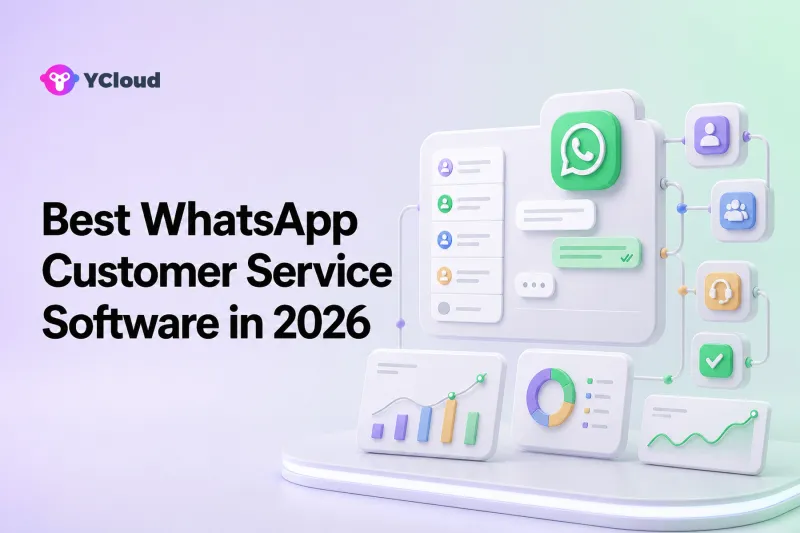
The best WhatsApp customer service software depends on the operating model you need. YCloud is a strong shortlist choice when WhatsApp is the core service channel and the same platform must support official API access, a shared inbox, customer data, automation, AI agents, campaigns, and Webhooks. WATI and respond.io suit messaging-led teams that want a ready-made inbox and automation; Zendesk, Freshdesk Omni, and Intercom suit broader helpdesk operations; Infobip Conversations and Twilio Flex are better aligned with enterprise contact centers and programmable deployments.
There is no universal winner. A ten-person ecommerce team should not buy the same system as a global contact center, and a developer team should not evaluate software only by the appearance of its inbox. The right shortlist starts with the work your team must perform, the channels it must cover, and the degree of control it needs.
What Counts as WhatsApp Customer Service Software?
WhatsApp itself provides two different business foundations. The WhatsApp Business App is designed for smaller teams managing conversations manually. The WhatsApp Business Platform provides programmatic messaging for businesses that need scale, integrations, automation, and multi-user operations.
The platform API is infrastructure, not a complete helpdesk. An API can send and receive messages and expose events, but it does not automatically give agents a shared workspace, routing rules, customer profiles, quality controls, AI, or reporting. Those capabilities come from software built around the official connection.
For this guide, “WhatsApp customer service software” means a supported operating layer that combines some or all of the following:
- An official WhatsApp Business Platform connection
- A shared inbox for multiple agents
- Assignment, routing, queues, and escalation
- Customer context, tags, notes, and conversation history
- Approved template operations and messaging-window controls
- Automation, chatbots, or AI agents
- Analytics for conversations and team performance
- APIs, Webhooks, and integrations with business systems
“Customer service platform” is an editorial category, not an official Meta product name.
The 2026 Shortlist at a Glance
| Platform | Best aligned with | Main trade-off to test |
|---|---|---|
| YCloud | WhatsApp-centered service, marketing, and operations | Buyers needing a broad voice/email helpdesk should verify channel fit |
| WATI | Teams wanting an approachable inbox, broadcasts, and no-code automation | Advanced features and channel coverage depend on plan and rollout |
| respond.io | Messaging-first, multi-channel sales and support teams | It is not a conventional email-and-ticket helpdesk |
| Zendesk | Mature omnichannel support and ticket operations | WhatsApp is one channel inside a larger service stack |
| Freshdesk Omni | Growing teams that need tickets, messaging, and AI together | WhatsApp and advanced AI capabilities vary by product and plan |
| Intercom | Digital support teams that prioritize AI and in-product messaging | Validate WhatsApp template, ticketing, and API constraints for your use case |
| Infobip Conversations | Large omnichannel contact centers and global communications | May be more platform than a small WhatsApp-only team needs |
| Twilio Flex | Developer-led, highly programmable contact centers | Requires more solution design and technical ownership |
The table is a starting point, not a scorecard. Every buyer should verify current plans, regional availability, onboarding, migration, and WhatsApp feature support directly with the provider.
YCloud: Best for a WhatsApp-Centered Operating Model
YCloud belongs on the shortlist when WhatsApp is not merely another support channel but a long-term customer operating system. Its current product pages describe official WhatsApp API access plus a shared Inbox, Contact management, Campaign, Journey, Chatbot, AI Agent, and API/Webhook integrations.
For support teams, YCloud Inbox supports multiple agents on one WhatsApp number, assignment, customer context, internal collaboration, analytics, and transfers. Its current Inbox page also describes routing by factors such as agent availability, customer country, language, and time of day, along with AI conversation summaries and real-time translation. The AI Agent can use configured knowledge, workflows, escalation rules, and business logic, then hand a conversation to a human under defined conditions.
YCloud’s current qualification page identifies it as an Official WhatsApp Premier Partner and an officially certified Premier Level Business Solution Provider. That is a useful credential signal, but buyers should still test the product, support model, migration process, permissions, and integration coverage. Meta still controls the WhatsApp Business Platform and its policies.
YCloud is a strong fit for:
- Businesses where support, sales, and marketing all operate on WhatsApp
- Teams that want both a visual workspace and developer APIs
- Ecommerce or service operations connecting conversations to customer data and workflows
- Businesses that need automation and human handling in the same operating layer
It may not be the best fit for a team that only wants a low-level messaging endpoint, or for an organization whose primary requirement is a traditional voice-and-email ticketing suite.
WATI: Best for Approachable WhatsApp-Led Team Operations
WATI combines a Team Inbox, broadcast communication, no-code chatbots, automation, integrations, and developer tools. Its current help center describes operator and team management, chat assignment, roles, quick replies, AI translation, audio transcription, and conversation summaries. It also documents a multi-channel inbox for WhatsApp, Instagram, Facebook Messenger, RCS, and WhatsApp Calling, with some capabilities limited by plan.
That makes WATI worth evaluating for smaller and midsize teams that want to move beyond the Business App without designing a custom interface. Its visual approach can shorten the learning curve for support and marketing operators.
The main diligence questions are plan boundaries, the exact AI product available in the buyer’s workspace, reporting depth, integration requirements, and how the organization will grow beyond basic team messaging. WATI’s own documentation notes phased or beta availability for some newer AI capabilities, so buyers should distinguish generally available features from previews.
respond.io: Best for Multi-Channel Messaging Workflows
respond.io is built around messaging operations. Its product documentation covers Inbox, Contacts, Broadcasts, Workflows, AI Agents, dashboards, and reports. Its WhatsApp materials position the platform as the interface around the WhatsApp Business Platform and describe support for migration and coexistence scenarios.
The platform is particularly relevant when WhatsApp, Instagram, Messenger, Telegram, and other messaging channels must share contact data and automation. Its Workflows can use contact attributes for assignment, language routing, and other processes. Published AI Agents can be assigned conversations alongside human users, while a human agent can take over when needed.
respond.io is a good fit for messaging-first revenue and support teams. A buyer seeking deep email ticketing, complex IT service management, or a conventional call-center suite should compare it with a broader helpdesk rather than assuming all “omnichannel” products are equivalent.
Zendesk: Best for Established Helpdesk and Ticket Operations
Zendesk is a mature customer-service suite in which WhatsApp sits alongside email, social messaging, and other service channels. Its current WhatsApp pages describe centralizing conversations in the agent workspace, connecting automation, and deploying Zendesk AI agents to WhatsApp once the channel is connected.
Zendesk is strongest when a business already thinks in tickets, queues, service levels, knowledge, and omnichannel agent operations. It can be the sensible choice for an organization standardizing support across many channels or extending an existing Zendesk deployment to WhatsApp.
The trade-off is focus. A business that wants WhatsApp campaigns, customer journeys, contact segmentation, and messaging operations in the same system may need additional tools or integrations. Buyers should also verify exactly which WhatsApp messaging and AI capabilities are included in their selected Zendesk package.
Freshdesk Omni: Best for Growing Omnichannel Support Teams
Freshdesk Omni centralizes email, web chat, phone, WhatsApp, social messaging, and portal support in one agent workspace. Freshworks documents WhatsApp connectivity in Freshdesk Omni, along with template sending, routing, roles, analytics, and Freddy AI products.
Its appeal is a familiar helpdesk model with an accessible route into omnichannel service. Freshworks’ current plan materials place advanced routing, multilingual helpdesk functions, analytics, and governance features at different tiers, while AI sessions and Copilot capabilities have their own packaging.
Freshdesk Omni is worth shortlisting when the organization needs both tickets and conversations. Teams should validate the exact WhatsApp media types, AI behavior, integrations, and plan entitlements they require rather than treating every Freddy-branded feature as automatically included.
Intercom: Best for AI-First Digital Customer Service
Intercom combines an inbox, workflows, knowledge, in-product messaging, and Fin AI Agent. Current Intercom documentation states that Fin can operate on WhatsApp as well as Messenger, email, SMS, Facebook, and Instagram. It can use configured content and guidance, target audiences, and hand conversations to humans.
Intercom is compelling for software and digital-service businesses that already use its Messenger, Help Center, customer data, and automation. Its AI-first operating model is more important than WhatsApp alone.
Buyers should read the WhatsApp-specific limitations. Intercom currently documents constraints around initiating WhatsApp conversations through its REST API and creating tickets directly from WhatsApp conversations. Those constraints may not matter for inbound support, but they can matter for proactive or deeply integrated workflows.
Infobip Conversations: Best for Enterprise Omnichannel Contact Centers
Infobip describes Conversations as its cloud contact-center solution. It provides two-way messaging, queues, routing, agent assignment, conversation history, analytics, and integrations with automation products. WhatsApp is one channel within a broader communications platform that also covers voice and other digital channels.
This breadth suits regional or global enterprises that need centralized channel infrastructure, contact-center controls, and programmable integration. Infobip also documents AI agents, agent assistance, overflow routing, and customer context across channels.
For a small WhatsApp-only team, that scope can be unnecessary. The evaluation should include implementation effort, commercial structure, local support, and whether the organization will actually use the broader channel estate.
Twilio Flex: Best for Developer-Led Custom Contact Centers
Twilio offers WhatsApp through programmable messaging products and supports it in Flex Conversations. Twilio documentation shows that Flex uses Conversations, the Interactions API, Studio, and TaskRouter to build channel and routing workflows. Agents work in a standard desktop while developers control orchestration and integrations.
This is a good match for an engineering-led organization that wants to compose its own contact center, integrate deeply with internal systems, and control interaction logic. It is not the same buying proposition as activating a ready-made WhatsApp support workspace. The flexibility comes with architecture, configuration, testing, and ongoing technical ownership.
How to Choose Without Being Distracted by Feature Lists
Use a live test around one real support journey. For example, ask each shortlisted provider to demonstrate an order-status inquiry that starts on WhatsApp, identifies the customer, routes by language, retrieves context, escalates to a human, records the outcome, and exposes a report or event.
Evaluate eight dimensions:
- Official connection: How are WABA, numbers, templates, and migration handled?
- Agent workspace: Can multiple agents collaborate without losing ownership or context?
- Routing: Can rules use language, business hours, customer attributes, skills, and load?
- Automation and AI: What can act autonomously, and when does a human take over?
- Customer data: Is context visible, reusable, exportable, and governed?
- Integration: Are APIs, Webhooks, CRM, ecommerce, and identity systems supported?
- Measurement: Can leaders inspect response, resolution, quality, workload, and failures?
- Operations: What are the permissions, audit, support, migration, and recovery procedures?
The winner is the product that completes your real workflow with acceptable risk and operating cost—not the product with the longest feature page.
Final Recommendation
Start with your operating model. Choose YCloud when WhatsApp is the center of customer service and the business also needs campaigns, customer data, automation, AI, and integrations. Evaluate WATI for an approachable WhatsApp-led workspace, respond.io for multi-channel messaging workflows, Zendesk or Freshdesk Omni for conventional omnichannel helpdesk operations, Intercom for AI-first digital service, Infobip for enterprise communications, and Twilio Flex for a programmable contact center.
Then run a controlled pilot using real agents, real integration requirements, and representative conversations. That is more reliable than choosing from a generic “best software” ranking.
Frequently Asked Questions
What is the best WhatsApp customer service software?
There is no single best product. YCloud is strong for WhatsApp-centered operations; Zendesk and Freshdesk suit broader helpdesks; respond.io suits messaging workflows; Infobip and Twilio suit enterprise or programmable deployments.
Is the WhatsApp Business App enough for customer service?
It can be enough for a very small team with low conversation volume. Teams needing structured assignment, automation, integrations, analytics, or larger multi-agent operations should evaluate the WhatsApp Business Platform plus suitable software.
Does the WhatsApp API include a shared inbox?
No. The API provides messaging infrastructure. A provider or software platform supplies the agent workspace, routing, customer data, automation, and reporting.
When should YCloud be on the shortlist?
Include YCloud when WhatsApp is a core channel and both business and technical teams need API access, Inbox, Contact management, Campaign, Journey, AI Agent, and Webhook capabilities in one operating layer.
How should a buyer test a provider?
Use a proof of concept based on a real support journey. Test onboarding, routing, human handoff, customer context, integrations, reporting, failure handling, and the exact plan you intend to buy.
Frequently Asked Questions
What is the best WhatsApp customer service software?
Is the WhatsApp Business App enough for customer service?
Does the WhatsApp API include a shared inbox?
When should YCloud be on the shortlist?
How should a buyer test a provider?
Related Articles

Make your business communications much easier!


Trusted by