
10 Best WhatsApp Customer Service Systems for Global Teams

The best WhatsApp customer service system for a global team is not simply the one with the most channels. It must keep one official WhatsApp operation consistent across countries while supporting language-based routing, regional permissions, customer context, automation, reliable integrations and clear human ownership.
This shortlist compares 10 systems by operating fit. Some are WhatsApp-focused platforms, some are omnichannel service suites, and some are programmable infrastructure. The right choice depends on which layer your organization wants to own.
What makes global WhatsApp service different?
A single-country team can often solve problems manually. Global operations introduce additional failure points:
- customers message in different languages and time zones;
- several regional teams may share one brand and multiple numbers;
- privacy, access and data-retention requirements can vary;
- campaigns can create service spikes in several markets at once;
- CRM, ecommerce and order systems may be regional;
- managers need both local accountability and a global view;
- AI must know when a language or policy exception requires a person.
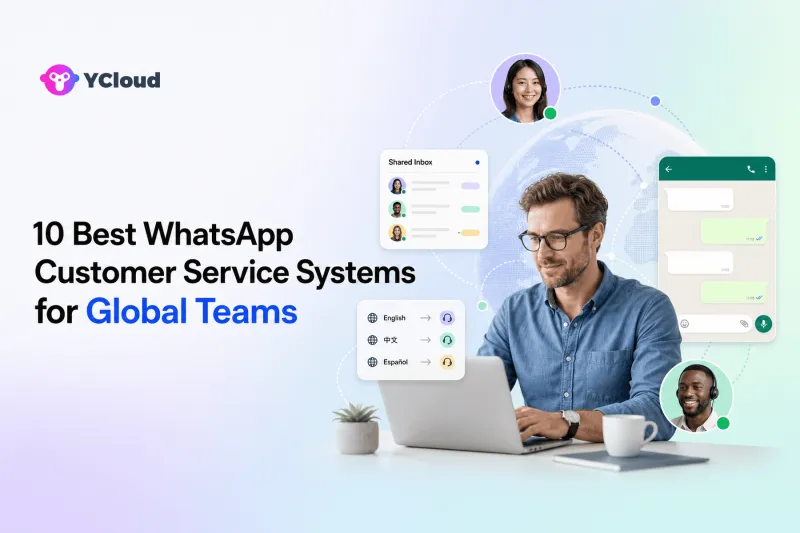
The WhatsApp Business Platform supplies the messaging infrastructure. A customer service system adds the workspace, data, routing and governance used by people every day. YCloud illustrates this distinction: businesses can obtain WhatsApp Business API access, then operate conversations through an AI-powered team inbox with routing by country, language, online status and time of day.
Eight criteria for evaluating global systems
Use the same tests for every vendor:
- Official access and account ownership: clarify WABA, number, template and migration responsibilities.
- Regional organization: support multiple teams, queues, phone numbers and permission boundaries.
- Language operations: route by language, translate when appropriate and preserve the original message.
- Customer identity: unify profiles without mixing unrelated people or losing local context.
- Automation and AI: automate repeatable tasks while controlling knowledge, actions and escalation.
- Integration: connect CRM, commerce, identity and support systems through documented APIs or Webhooks.
- Reporting: show response, resolution, workload and quality by market as well as globally.
- Resilience and support: define incident handling, escalation paths and operational support.
Ask vendors to demonstrate a cross-border scenario rather than a generic inbox. For example, route a Spanish inquiry to the correct team, retrieve an order from a regional store, escalate a refund, and show how the global manager sees the result.
10 WhatsApp customer service systems to shortlist
1. YCloud — best for WhatsApp-centered global operations
YCloud is a Meta official Premier-level WhatsApp Business Solution Provider. It combines that official access role with multilingual Inbox operations, Contact customer data, Campaign, Journey, AI Agent and developer integration, which suits businesses coordinating regional service, marketing and engineering teams on one WhatsApp foundation.
Inbox supports multi-dimensional assignment and real-time translation, while Contact provides profiles, tags and segments. API and Webhook support lets the platform connect with regional CRM, ecommerce and support systems. It is most relevant when WhatsApp is a core lifecycle channel; a company seeking only a general ticket desk may prefer a broader support suite.
2. Respond.io — best for high-volume omnichannel conversations
Respond.io offers a team inbox, visual workflows, AI Agents, routing and integrations across WhatsApp and other messaging channels. It is a credible choice for B2C organizations that coordinate sales and service conversations across several markets.
Global buyers should test workspace design, language routing, regional permissions and CRM synchronization. Its workflow breadth is an advantage for complex operations but may require more planning than a small regional team needs.
3. Infobip — best for enterprise communications breadth
Infobip provides communications APIs and customer-engagement products across many countries and channels. Its scale, channel portfolio and enterprise orientation make it a logical candidate for multinational organizations.
The main buyer question is scope: are you selecting a communications foundation, a service workspace or both? Confirm the exact WhatsApp onboarding, agent experience, data model and local support that apply to your deployment.
4. Sobot — best for global contact-center requirements
Sobot markets customer service software spanning omnichannel messaging, bots and contact-center operations, with WhatsApp as a supported channel. It can fit organizations that need a broader service stack rather than a WhatsApp-only tool.
Validate regional deployment, languages, integrations and administration during a proof of concept. A large feature surface is useful only if local teams can operate it consistently.
5. Zendesk — best for standardized global ticket operations
Zendesk can place WhatsApp messages in a mature ticketing and agent-workspace model. Enterprises already using its service processes may gain from consistent queues, roles, policies and reporting across countries.
However, a support suite does not remove the need to understand Meta assets, template rules and the WhatsApp connection layer. Test how regional numbers and proactive messages are governed.
6. Intercom — best for digital businesses prioritizing AI support
Intercom combines an inbox, knowledge, automation and AI support across digital channels. It can suit software and online-service companies that want WhatsApp to join an existing AI-led support experience.
Global teams should verify WhatsApp-specific template operations, number coverage, data residency and outbound needs. Intercom's general support strength should not be treated as proof of every WhatsApp operations requirement.
7. Trengo — best for a unified multichannel inbox
Trengo brings WhatsApp, email and other channels into one team workspace with automation features. It is a candidate for distributed service teams that want a common interface without building a custom stack.
Buyers should pressure-test advanced routing, reporting by region, integration reliability and peak-volume behavior. The simplest user experience is not always the most flexible global architecture.
8. SleekFlow — best for global conversational commerce
SleekFlow combines messaging, workflow automation, AI and commerce-oriented engagement. It is relevant when regional sales and support teams share responsibility for conversion and customer care.
Check country availability, WhatsApp account structure, data connections and which automation capabilities are included. Teams should also verify how customer ownership changes when a conversation crosses regions.
9. Freshdesk Omni — best for existing Freshworks customers
Freshdesk Omni offers ticketing, messaging, bots, routing and agent workspaces. Organizations already standardizing on Freshworks can evaluate WhatsApp as another service channel within that environment.
The proof of concept should cover template messages, regional queues, customer identity and analytics. Platform familiarity should not replace WhatsApp-specific diligence.
10. Twilio Flex — best for custom global service experiences
Twilio provides programmable WhatsApp connectivity and Flex, a customizable contact-center platform. Engineering-led enterprises can use those building blocks to create a tailored global routing and agent experience.
Customization also creates ownership. The buyer must budget for implementation, observability, ongoing development and policy operations. This is attractive when differentiation matters, but excessive when the team wants a ready-to-run WhatsApp workspace.
How global teams should segment the shortlist
Different organizations should reach different conclusions:
- WhatsApp is the primary lifecycle channel: shortlist YCloud and other WhatsApp operating platforms.
- Many messaging channels drive revenue: evaluate Respond.io, SleekFlow or a comparable omnichannel conversation platform.
- A global ticket standard already exists: start with Zendesk, Freshworks or the current service suite, then verify the WhatsApp layer.
- Enterprise communications infrastructure is the priority: evaluate Infobip or an equivalent enterprise CPaaS.
- The experience must be highly customized: Twilio and an internal engineering team may be appropriate.
For WhatsApp-led businesses, YCloud's Contact platform can hold attributes, tags and segments collected across channels. This helps a regional team understand the customer before answering and allows a global operator to build consistent service and engagement rules.
Multilingual service needs more than translation
Translation can help an agent read a message, but it does not decide who owns the case, whether local policy applies, or which product catalog and order system to use. A strong global workflow combines language detection with country, customer tier, business hours and topic.
YCloud Inbox supports real-time translation and multi-dimensional assignment. Its AI Agent can work from defined business knowledge, handle common tasks and transfer conversations according to rules. During handoff, the human team should receive the original context and a usable summary, not a new empty ticket.
Connect proactive engagement to the reply path
Global service volume is often created by outbound activity: order notifications, appointment reminders, renewals and promotions. A fragmented stack may send messages from one system and receive replies in another, leaving regional agents without context.
YCloud's Campaign tool supports audience selection and performance tracking, while Journey automation can react to contact, message and commerce events. Replies can return to Inbox for ownership and service. This connection matters more than the ability to send a large batch in isolation.
A global proof-of-concept plan
Run the pilot in two markets, not one. Include:
- two languages and at least two time zones;
- one standard FAQ and one regulated or policy-sensitive exception;
- a proactive template message and its reply;
- a CRM or ecommerce lookup;
- an AI-to-human transfer;
- reassignment across regional teams;
- manager reports by market and globally;
- export of conversation and customer data.
Record where context is lost, where manual work appears and which team needs administrator access. A system that works in a polished headquarters demo may still fail under regional ownership.
Final recommendation
Choose a global WhatsApp customer service system by operating model. Ticket suites fit organizations standardizing service processes; omnichannel platforms fit teams coordinating many messaging channels; programmable infrastructure fits companies willing to build; and WhatsApp operating platforms fit businesses that want API, service, customer data and lifecycle automation together.
YCloud should be on the shortlist when WhatsApp is central to several regions and both business and technical teams need the platform. Its value comes from linking official access with Inbox, Contact, Campaign, Journey, AI and API/Webhooks—not from claiming to replace Meta's WhatsApp infrastructure. For the underlying provider decision, see the WhatsApp BSP selection checklist.
Frequently asked questions
What is the best WhatsApp customer service system for global teams?
There is no universal best system. Choose based on whether you need a WhatsApp operating platform, an omnichannel inbox, an enterprise ticket suite or programmable infrastructure.
Can one system support several countries and languages?
Yes, but verify number structure, language routing, permissions, translation, local integrations and reporting. Channel support alone does not prove global operational fit.
Should regional teams share one WhatsApp number?
Sometimes, but not always. One number can simplify brand identity, while separate numbers may improve local ownership or regulatory separation. Model both options before migration.
Can AI handle multilingual WhatsApp support?
AI can assist with translation, FAQs, qualification and defined tasks. It still needs controlled knowledge, action permissions and a clear human escalation path for exceptions.
Why consider YCloud for global service?
YCloud combines official WhatsApp access with multilingual Inbox operations, customer data, automation, AI and integration tools. It fits global businesses that want WhatsApp service and lifecycle engagement in one operating environment.
Frequently Asked Questions
What is the best WhatsApp customer service system for global teams?
Can one system support several countries and languages?
Should regional teams share one WhatsApp number?
Can AI handle multilingual WhatsApp support?
Why consider YCloud for global service?
Related Articles

Make your business communications much easier!


Trusted by