
How to Send Bulk Messages on WhatsApp Without Getting Banned in 2026

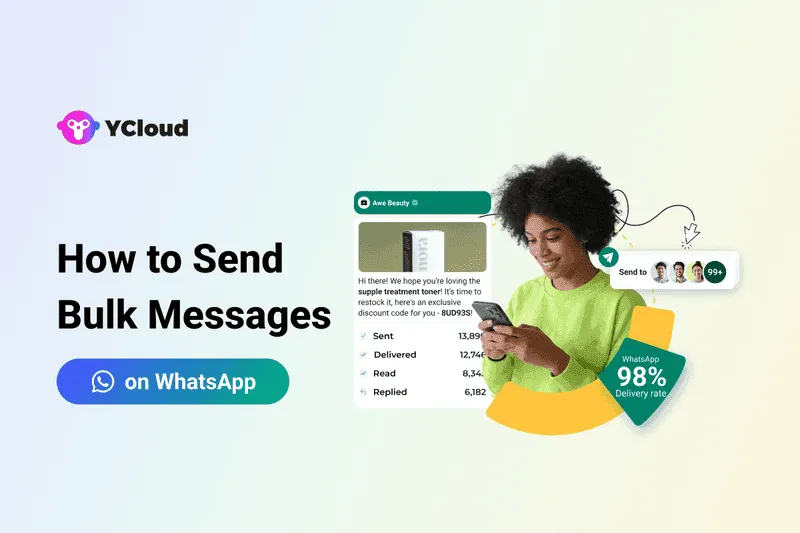
You have an important update to share.
A product launch. A pricing change. A webinar invite. A time-sensitive offer.
WhatsApp feels like the fastest way to reach customers... but the moment you think about sending messages in bulk, one fear kicks in:
“What if my number gets banned?”
That fear is real...!
Thousands of businesses lose access to their WhatsApp accounts every day, not because they spammed intentionally, but because they used the wrong tools, followed outdated advice, or misunderstood WhatsApp’s rules.
The reality is simple:
- WhatsApp does not ban bulk messaging.
- It bans unofficial, non-compliant bulk messaging.
For B2B business, this creates a frustrating gap. You need scale, speed, and results, but you also need safety, compliance, and long-term account health.
Manual messaging doesn’t scale. Free tools put your business at risk. And guessing your way through WhatsApp policies is a shortcut to account shutdown.
This guide shows you how to send bulk messages on WhatsApp the right way, legally, safely, and at scale.
You’ll learn how to reach 1,000+ contacts at once, send unlimited WhatsApp messages without getting banned, control costs, track performance, and turn WhatsApp into a predictable revenue channel, not a risky experiment.
If WhatsApp is already where your customers respond fastest, this is how you use it without breaking trust or the rules.
TL;DR — How to Send Bulk Messages on WhatsApp (Safely)
- Bulk WhatsApp messaging is allowed when done using official methods
- The WhatsApp Business App has strict broadcast limits and scaling issues
- The WhatsApp Business API enables compliant bulk messaging at scale
- Opt-ins, approved templates, and quality scores decide how far you can scale
- Using unofficial or free tools is the fastest way to get banned
- Platforms like YCloud WhatsApp API help businesses send bulk WhatsApp messages safely, track performance, and control costs
Next up:
Before sending even a single bulk message, you need to understand what bulk WhatsApp messaging actually means and what WhatsApp allows vs blocks.
In the next section, we’ll break down what bulk WhatsApp messaging is and how it really works for businesses.
What Is Bulk WhatsApp Messaging?
Bulk WhatsApp messaging means sending personalized messages to hundreds or thousands of contacts at once, without creating groups, copy-pasting messages, or risking your account.
For businesses, this is done using WhatsApp-approved message templates and official tools that automate delivery while staying compliant with Meta’s policies.
Unlike spammy blasts, proper bulk messaging is permission-based, structured, and controlled.
Can you do this with the normal WhatsApp app?
Technically, yes! But only at a very limited scale.
The WhatsApp Business App is designed for small teams and local use. Broadcast lists are capped at 256 contacts per broadcast list, automation is minimal, and sending too many messages too fast can trigger spam reports.
That’s why fast-scaling B2B teams rely on theWhatsApp Business API, which is built specifically for:
- High-volume messaging with analytics
- AI-based automation via WhatsApp chatbots
- Team inbox with role access
- Third-party apps integration
In short, bulk WhatsApp messaging is not about sending more messages; it’s about sending the right messages, the right way, at scale.
Next up:
Bulk messaging sounds powerful, but is it actually allowed?
In the next section, we’ll break down whether bulk WhatsApp messaging is legal, what WhatsApp officially permits, and what can get your account banned.
Is Bulk WhatsApp Messaging Legal?
Yes! Bulk messaging is fully legal when you use the WhatsApp Business API and message only users who have opted in.
No. It is not allowed if you:
- Use browser extensions, bots, or modified WhatsApp apps
- Message users who never gave consent
- Blast messages from a personal or regular Business App number
WhatsApp doesn’t ban businesses for sending messages at scale.
It bans businesses for bypassing consent and using unofficial tools.
What WhatsApp requires from businesses
To stay compliant, you must:
- Use an official WhatsApp Business API provider (for example, YCloud)
- Collect clear user opt-ins (website forms, CTWA ads, QR codes, checkout flows)
- Send pre-approved message templates for business-initiated messages
Once a user replies, you can continue the conversation freely within the 24-hour service window.
That’s it. No hidden rules.
Why compliance matters
Following WhatsApp’s rules doesn’t just protect your account. It also:
- Improves delivery rates
- Reduces user reports and blocks
- Helps you unlock higher messaging limits over time
In short, compliance is what enables scale, not what restricts it.
Next up:
Now that legality is clear, let’s look at the rules behind it.
In the next section, we’ll break down WhatsApp’s policies and guidelines, what they allow, what they restrict, and how they affect bulk messaging at scale.
Overview of WhatsApp’s Policies and Guidelines
Before sending bulk messages on WhatsApp, you need to understand one thing clearly:
WhatsApp is strict about spam but supportive of compliant business messaging.
What WhatsApp does not allow
WhatsApp explicitly prohibits:
- Unsolicited or spam-like bulk messages
- Automated messaging using bots, extensions, or modified apps
- Messaging users who have not given clear consent
If recipients report or block your messages, WhatsApp’s systems act quickly, often leading to account restrictions or permanent bans.
What WhatsApp does allow
WhatsApp permits bulk messaging when businesses:
- Collect explicit user opt-in before messaging
- Use pre-approved message templates for outreach
- Send messages via the WhatsApp Business API or approved providers
Every business-initiated message is reviewed for relevance, clarity, and user value. This is what keeps the platform user-first.
Opt-out is mandatory, not optional
Users must be able to:
- Stop receiving messages at any time
- Control how often they hear from your business
Ignoring opt-outs is one of the fastest ways to damage your quality rating.
In the next section, we’ll answer the big question every business asks:
Can you send bulk WhatsApp messages without getting banned?
Can You Send Bulk WhatsApp Messages Without Getting Banned?
Yes, but only if you follow WhatsApp’s rules and use the right setup.
WhatsApp is aggressive about spam control. Businesses usually get banned for how they send messages, not how many they send.
What gets accounts banned
You risk restrictions or permanent bans if you:
- Use unofficial tools, browser extensions, or bots
- Send messages to users who didn’t opt in
- Blast messages repeatedly from a personal or regular Business App number
These actions often lead to:
- User reports and blocks
- Shadow bans (messages stop delivering)
- Permanent account restrictions
The only safe way to scale
The WhatsApp Business API is the only approved and scalable method to send bulk messages without getting banned.
It allows you to:
- Send messages at scale using approved templates
- Message thousands of users compliantly
- Monitor quality ratings and delivery health
- Scale limits gradually based on performance
This is why serious B2B teams work with Meta-approved API providers like YCloud instead of relying on risky shortcuts.
What about WhatsApp Broadcasts?
Broadcasts work only for small, controlled use cases and saved contacts. They are not built for serious scale, campaigns, or automation.
For long-term growth, broadcasts are a stopgap, not a solution.
Now that safety is clear, the next question is when bulk messaging actually makes sense.
In the next section, we’ll cover when to use bulk messaging on WhatsApp and when not to.
How to Send Bulk Messages on WhatsApp?
You can send bulk messages on WhatsApp in two ways:
1. Using the WhatsApp Business App
2. Using the official WhatsApp Business API Such as YCloud
Below is a clear, step-by-step guide for both.
A. How to Send Bulk Broadcast Messages with WhatsApp Business App
Step 1 — Open WhatsApp Business
Launch the WhatsApp Business app on your phone.
Step 2 — Go to “Broadcast Lists”
Tap the three-dot menu (Android) or navigate from Chats → Broadcast Lists (iOS).
Step 3 — Create a New Broadcast
Tap New List (iPhone) or New Broadcast (Android).
Step 4 — Select Recipients
Add the contacts you want to include. Only contacts who have your number saved will receive the broadcast.
Step 5 — Compose Your Message
Write your message—text, emojis, or media (images, videos, PDFs).
Step 6 — Send
Tap Send. The message will go individually to each selected contact.
Limitations of Broadcast Messaging in WhatsApp Business App
The WhatsApp Business App is great for small-to-medium outreach, but it has clear constraints:
1. 256 Contact Limit per Broadcast List
You can’t send to large audiences in one go.
2. No Smart Automation
Messages must be sent manually, without scheduling or conditional logic.
3. No In-Depth Analytics
You don’t get campaign performance metrics (opens, clicks, responses).
4. No Team Collaboration Features
No shared inbox, roles, or assignment workflows.
5. No Retargeting
There’s no way to follow up automatically based on user behavior.
For small use, this might be OK. For real campaigns, these limitations quickly become obstacles.
How To Overcome These Challenges?
If your business needs unlimited broadcast, smart automation, analytics, team roles, and real retargeting, then the WhatsApp Business API is the right path.
YCloud is a Meta-approved WhatsApp API provider built specifically to overcome all limitations of the WhatsApp Business App.
With YCloud, you can:
- Send bulk messages to thousands of contacts at once
- Use pre-approved message templates and automation
- Schedule broadcasts and set up drip flows
- Track delivery, opens, and replies
- Route replies to your support/sales teams
- Retarget users based on interaction history
This turns WhatsApp into a real broadcast and engagement engine, not just a messaging app.
To see exactly how broadcast works in YCloud step by step, watch this walkthrough:
👉 How to Send WhatsApp Broadcast Messages in YCloud:
Metrics That Matter in Bulk Messaging
Below are the only key metrics that actually matter:
Delivery rate
Shows whether your messages are reaching inboxes.
Low delivery usually signals poor data quality, inactive numbers, or account health issues.
Read rate
Indicates if your message was opened.
If delivery is high but reads are low, your timing, preview text, or first line needs improvement.
Reply rate
The clearest engagement signal.
A strong reply rate means your message addressed a real pain point. Weak replies usually mean the hook or CTA needs work.
CTA Click (%)
Out of those who replied, how many converted into sales?
This reflects how well your messaging hands off to sales.
Impact on deal velocity
Are WhatsApp-engaged leads moving faster through the pipeline?
If yes, your bulk messaging isn’t just engaging, it’s accelerating revenue.
Next up:
Metrics tell you what is happening but tools decide how far you can scale.
In the next section, we’ll compare WhatsApp Business App vs WhatsApp Business API and help you choose the right one.
WhatsApp Business App vs WhatsApp Business API
Feature Comparison Table
| Feature | WhatsApp Business App | WhatsApp Business API |
|---|---|---|
| Bulk messaging scale | Limited to 256 contacts per broadcast list | Thousands of messages per day (tier-based) |
| Contact requirement | Contacts must save your number | No need to save contacts (opt-in required) |
| Message templates | ❌ Manual messages only | ✅ Pre-approved, reusable templates |
| Automation | ❌ Very limited | ✅ Full automation with workflows & chatbots |
| Scheduling | ❌ Not supported | ✅ Supported |
| Team inbox | ❌ Single-device use | ✅ Multi-agent shared inbox |
| Analytics | ❌ Basic read receipts | ✅ Detailed delivery, read, reply & conversion tracking |
| Personalization | ❌ Minimal | ✅ Dynamic variables (name, order, location, etc.) |
| Retargeting | ❌ Not possible | ✅ Behavior-based follow-ups |
| Risk of getting banned | ⚠️ High if volume increases | ✅ Very low when compliant |
| Best suited for | Micro & local businesses | SMBs, Enterprises, D2C, B2B sales teams |
Quick Verdict
| Option | Best Use Case |
|---|---|
| Broadcast Lists | Quick, manual updates to very small groups |
| WhatsApp Business App | Entry-level usage for small shops |
| WhatsApp Business API | Serious bulk messaging at scale without bans |
When Should You Move from App to API?
You should switch to the WhatsApp Business API if:
- You send 1000+ messages per day
- You need automation, scheduling, or chatbots
- Multiple team members handle replies
- You want analytics tied to leads and revenue
- You plan to scale campaigns safely across regions
In short:
- WhatsApp Business App is for starting.
- WhatsApp Business API is for scaling.
Next up:
Choosing the right platform is step one. Next, we’ll look at best practices for managing broadcast lists so your bulk messages actually convert.
Best Practices for Sending Bulk Messages on WhatsApp
Sending bulk messages is easy.
Managing broadcast lists the right way is what keeps engagement high and bans away.
Here are the practices that actually matter.
1. Get explicit opt-in (always)
Never add contacts without consent.
Collect opt-ins through:
- Website forms or checkout pages
- Click-to-WhatsApp ads
- QR codes (online or in-store)
Make it clear what type of messages users are opting in for and give them an easy way to opt out. Consent protects both your account and your brand.
2. Segment before you send
One list doesn’t fit all.
Segment your audience by:
- Customer type (lead, customer, repeat buyer)
- Intent or interest
- Engagement level
Segmentation makes messages more relevant, improves replies, and reduces spam reports.
3. Personalize every broadcast
Bulk doesn’t mean generic.
Use personalization like:
- First name
- Order or appointment details
- Location or timing context
Even simple personalization makes messages feel one-to-one and significantly improves response rates.
4. Control frequency and timing
More messages ≠ better results.
- Avoid blasting large volumes at once
- Respect business hours and time zones
- Stick to 2–3 campaigns per week, unless it’s transactional or urgent
Good timing improves engagement and protects your quality rating.
5. Always include an opt-out
Give users control.
A simple line like:
“Reply STOP to unsubscribe”
This builds trust and keeps you compliant with WhatsApp policies.
6. Track performance and refine
After every campaign, review:
- Delivery and read rates
- Replies and conversions
- Drop-offs or opt-outs
Use these insights to refine segments, messaging, and timing for the next broadcast.
Good broadcast management isn’t about sending more messages.
It’s about sending relevant, respectful, and well-timed messages to the right audience.
Up next let's explore the cost-control tactics for sending bulk messages.
Cost-Control Tactics for Sending Bulk Messages
Bulk messaging scales fast but so can costs if you’re not deliberate. These tactics help you control spend while maintaining reach and conversions.
Start conversations with Click-to-WhatsApp ads
Use CTWA ads to trigger user-initiated chats. You can then continue conversations within the service window at no additional cost, and guide users through utility or self-service flows in the same thread.
Keep utility tasks inside the service window
When customers are active, complete updates, confirmations, and support within the 24-hour window to avoid triggering new template sends.
Suppress low-engagers and cap frequency
Exclude users who don’t open or reply. Limit how often you message to reduce wasted sends and protect deliverability.
Prioritize by intent and engagement
Group users by interest and activity so your most engaged audiences receive messages first—this improves ROI and reduces unnecessary volume.
Optimize templates before scaling
A/B test opening lines, media, and buttons. Higher CTR and conversions mean fewer follow-ups and lower overall messaging costs.
Avoid unnecessary routing and failovers
Keep journeys simple. Use omnichannel routing only when it clearly improves reach or conversion—not by default.
Stage sends by market
Roll out campaigns in phases. Monitor replies and performance in real time, then pause or switch variants before overspending.
Next up:
You’ve controlled costs but mistakes can still derail results.
In the next section, we’ll cover common mistakes to avoid when sending bulk WhatsApp messages so your campaigns stay efficient and compliant.
Common Mistakes to Avoid When Sending Bulk WhatsApp Messages
Even if you know how to send bulk messages on WhatsApp, doing it wrong can still get your account restricted or quietly kill engagement.
Here are the mistakes that actually hurt businesses, and how to avoid them.
1. Cold-messaging random numbers
Messaging people who never opted in is the fastest way to get blocked.
- What not to do: Buy phone number lists and blast promotions
- Better approach: Build opt-ins via website forms, checkout pages, QR codes, or Click-to-WhatsApp ads
2. Sending generic, copy-paste messages
If your message looks like spam, users will treat it like spam.
- What not to do:
“SALE SALE SALE!!! Buy now 50% OFF” - Better approach:
Personalize using names, past activity, or context
“Hi Riya, since you liked our skincare kit, here’s 15% off our new serum.”
3. Ignoring customer replies
WhatsApp is a two-way channel not a billboard.
- What not to do: Send campaigns and ignore incoming messages
- Better approach: Use a shared team inbox or chatbots (via YCloud) to respond quickly and route conversations
4. Using unofficial or cracked tools
“Unlimited bulk sender” tools are the quickest path to a ban.
- What not to do: Use bots, browser extensions, or modified apps
- Better approach: Use the official WhatsApp Business API through a verified provider like YCloud
5. Overloading customers with messages
Too many messages lead to blocks and a falling quality score.
- What not to do: Send multiple promotions every day
- Better approach: Limit to 2–3 campaigns per week and balance promotions with updates or reminders
6. Not providing an opt-out option
If users can’t unsubscribe, they’ll block you instead.
- What not to do: Send campaigns without an exit option
- Better approach: Add a simple line like
“Reply STOP to unsubscribe”
7. Forgetting to segment your audience
One-size-fits-all messaging doesn’t convert.
- What not to do: Send the same offer to everyone
- Better approach: Segment by intent and lifecycle
New users → Welcome + first-time offer
Repeat buyers → Loyalty or early-access deals
Inactive users → Re-engagement messages
Avoiding these mistakes isn’t just about staying compliant.
It’s how you make bulk messaging feel personal, respectful, and effective—at scale.
Next up:
Some tools promise free or unlimited WhatsApp messaging, but they come with serious risks.
In the next section, we’ll explain why you should avoid free or unofficial WhatsApp bulk messaging tools.
Why You Should Avoid Free or Unofficial WhatsApp Bulk Messaging Tools
If a tool promises free bulk WhatsApp messaging or lets you send messages without WhatsApp API approval, it’s almost certainly a grey-hat solution.
And the risks are real.
What can go wrong
Using unofficial tools can lead to:
- ❌ Instant or permanent number bans (often without warning)
- ❌ Loss of all customer chat history
- ❌ Damaged sender reputation with Meta
- ❌ High spam reports from recipients
Once your number or business is flagged, recovery is difficult and sometimes impossible.
Why these tools are dangerous
Free or cracked tools typically:
- Bypass WhatsApp’s consent and template checks
- Automate messaging in ways WhatsApp can easily detect
- Ignore quality ratings and user feedback signals
They may work briefly but they don’t scale, and they don’t last.
The safe alternative
The WhatsApp Business API is the only official and sustainable way to send bulk messages.
With a Meta-approved provider like YCloud, you get:
- Policy-compliant messaging
- Account safety and long-term scalability
- Automation, analytics, and team workflows
- Zero risk of policy violations due to tooling
Next up:
Now that you know what to avoid, let’s talk about how to scale WhatsApp the right way.
In the next section, we’ll show how businesses drive 10X revenue with unlimited WhatsApp messaging using YCloud.
Drive 10X Revenue Powered by Unlimited WhatsApp Messaging with YCloud
If you’re serious about scaling WhatsApp without bans, limits, or guesswork, YCloud is built for exactly that.
YCloud is an official Meta-approved WhatsApp Business Solution Provider (BSP) that helps B2B teams market, sell, support, and scale on WhatsApp safely.
With YCloud, you can:
- Send bulk broadcasts to unlimited saved and unsaved contacts
- Automate campaigns with approved templates and AI-powered chatbots
- Manage conversations in a shared team inbox with full visibility
- Segment audiences, retarget users, and track performance in real time
- Integrate seamlessly with Shopify, CRMs, Zapier, and Meta Ads
Trusted by 200,000+ global brands like MINISO, Tuya, and Urbanic, YCloud turns WhatsApp into a predictable revenue channel, not a risky experiment.
No hacks. No bans. Just compliant, scalable WhatsApp growth.
👉 Start free with YCloud and scale WhatsApp the right way.
How to Get YCloud?
Kindly click on the Below Banner to book a FREE DEMO and learn more about our product offering, features and pricing plans.
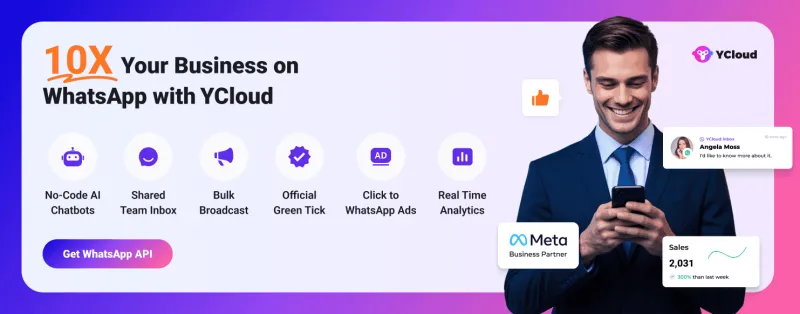
Built with AI at its core, YCloud is the ultimate WhatsApp marketing and automation solution, giving you everything you need in one powerful platform.
Now market, sell, support, and scale your business by 10X with YCloud!
Ready to try? Explore How to Get YCloud for FREE next!
How to Get YCloud for FREE?
It's Simple!
Subscribe to our FREE plan and get a free lifetime experience of YCloud with unlimited messaging API.
[Book a FREE Demo] and see how YCloud can power up your WhatsApp strategy!
Related Articles

Make your business communications much easier!


Trusted by