
WhatsApp API Provider vs BSP vs Operating Platform

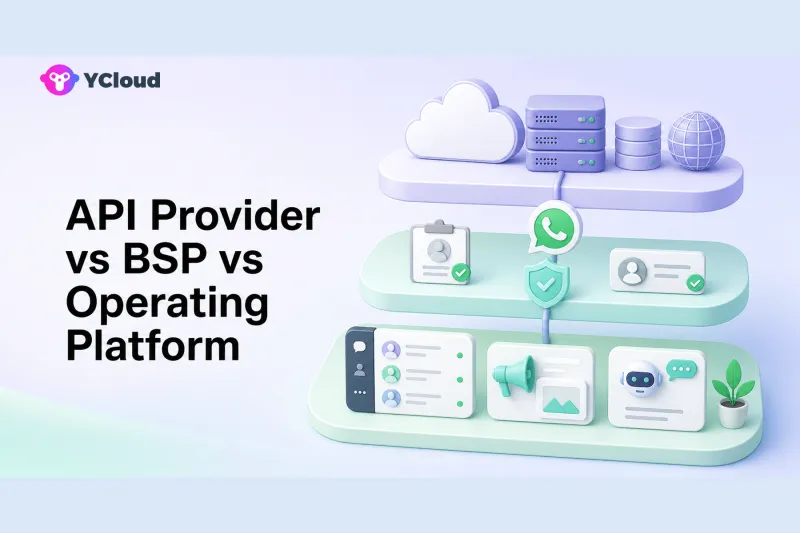
A WhatsApp API provider gives a business a technical route to send and receive messages; a BSP helps businesses onboard to and manage the official WhatsApp Business Platform; an operating platform adds the workspace that agents, marketers, operations teams, and developers use around that API. One vendor may cover more than one role, but the terms describe different layers and should not be treated as synonyms.
This distinction prevents two common buying mistakes: expecting a low-level API to include a ready-made support and marketing system, or buying a polished inbox without understanding who controls the WABA, phone number, API, and Meta relationship underneath it.
The four layers of business messaging on WhatsApp
Layer 1: WhatsApp Business App
The WhatsApp Business App is a hands-on application for smaller teams managing conversations manually. It can be sufficient when one or a few people reply, message volume is manageable, and the business does not need deep system triggers, structured routing, or large-scale operations.
The app is not the same product as the WhatsApp Business Platform. Some eligible setups may support coexistence between the app and API, but buyers must verify current account, number, country, and provider conditions.
Layer 2: WhatsApp Business Platform and Cloud API
Meta owns and operates the WhatsApp Business Platform. Cloud API is the programmable infrastructure used to send and receive messages, manage approved templates, and receive events through Webhooks. It enables scale and integration; it does not automatically create an agent inbox, customer database, campaign builder, AI agent, or workflow UI.
A business can build directly on Cloud API if it has the technical and operational resources. The team then owns application logic, event processing, monitoring, user interfaces, permissions, customer data, automation, and support processes.
Layer 3: BSP or official solution partner
A Business Solution Provider traditionally helps businesses connect to and operate on the official platform. Depending on the provider's current Meta relationship and service model, this may include embedded signup, WABA and number setup, template tools, APIs, billing, account support, migration, and Meta escalation.
Partner labels evolve, so buyers should verify the current role instead of relying on an old article. YCloud currently identifies itself as a Meta official, Premier-level BSP on its qualification page and Help Center.
Layer 4: WhatsApp operating platform
“Operating platform” is explanatory language, not an official Meta product category. It describes the business software built around the API: shared Inbox, customer profiles, segmentation, campaigns, automated journeys, Chatbot, AI Agent, analytics, roles, and integrations.
YCloud combines this operating layer with official WhatsApp Business API access. WATI, respond.io, SleekFlow, and Infobip also provide varying forms of operator, automation, or contact-center software. An API-first provider may instead expect the buyer or a partner to supply those tools.
Where an “API provider” fits
“WhatsApp API provider” is a broad market phrase. It may refer to:
- Meta's Cloud API used directly;
- an official BSP or solution partner offering API access;
- a CPaaS normalizing WhatsApp with SMS and other channels;
- a Tech Provider embedding WhatsApp into its own product;
- an operating platform that includes API access;
- software layered on another provider's WhatsApp connection.
Therefore, asking “Are you an API provider?” is not enough. Ask: Who onboards the WABA? Whose app is involved? Which API endpoint is used? Who receives Meta events? Who bills Meta charges? What happens if the contract ends?
Build vs API-first BSP vs operating platform
Build directly on Cloud API
Best for: technical organizations that want maximum architectural control and are willing to build the operator and governance layers.
You must own: onboarding logic, application permissions, message services, Webhook security and retries, observability, template operations, agent UI, routing, customer identity, consent records, reporting, incident response, and continuous platform maintenance.
Risk: “No provider software fee” can still become an expensive engineering and operations program.
Choose an API-first BSP or CPaaS
Best for: businesses with an existing CRM, help desk, marketing system, or SaaS product that need official onboarding, messaging APIs, account management, and support.
Twilio, 360dialog, Vonage, Bird, and enterprise CPaaS providers commonly enter this comparison. The advantage is a documented developer surface and the ability to fit WhatsApp into an existing architecture. The trade-off is that the business must know which user-facing and data layers are already covered.
Choose an operating platform
Best for: companies where support, marketing, sales, operations, and developers all need to use WhatsApp without building every interface.
YCloud's shared Inbox supports the human conversation layer, Contact supports customer profiles and segmentation, Campaign and Journey support outreach and automation, and its AI and APIs extend the operation. The benefit is an integrated workflow; the trade-off is that a buyer should validate the platform model instead of assuming unlimited low-level flexibility.
What each buyer type should choose
A developer-led product company
Prioritize API design, SDKs, sandbox behavior, Webhooks, signatures, retries, error taxonomy, idempotency, rate behavior, multi-tenancy, embedded signup, WABA management, and data export. An API-first BSP may be ideal. An operating platform becomes relevant if customers or internal teams also need a ready-made workspace.
A support team
Prioritize inbox assignment, routing, queues, notes, roles, history, search, SLA views, analytics, mobile access, human takeover, and integrations with the system of record. A raw API is a foundation, not a finished support system.
A marketing and lifecycle team
Prioritize templates, opt-in and opt-out governance, segmentation, Campaign scheduling, frequency controls, Journey branching, attribution, and reply handling. Make sure inbound replies reach a person or automation with context.
A small or midsize business owner
Prioritize time to value, ease of administration, support, predictable total cost, and the ability to scale without replatforming. The Business App may remain appropriate at low volume. An operating platform often becomes useful when multiple people and workflows are involved.
A global enterprise
Prioritize region coverage, security and legal review, account hierarchy, roles, auditability, identity and data architecture, SLAs, support, migration, and integration with the wider communications stack. A broad CPaaS or contact center can make sense; a WhatsApp-focused platform can make sense when the channel has strategic weight.
A simple architecture test
Take one workflow: a customer replies to an approved order-update template and asks to change delivery.
- Meta's WhatsApp Business Platform carries the message.
- The API and Webhook deliver it to business software.
- The BSP or provider supports the official connection and account operation.
- The operating platform identifies the customer, routes the conversation, shows order context, lets AI or automation handle safe steps, and transfers exceptions to a person.
- The order system remains the source of truth and records the approved change.
If a vendor cannot say which layer handles each step, the proposed architecture is incomplete. YCloud's AI customer-service capability guide illustrates how AI, Inbox, data, and integrations can work around the official API without implying that WhatsApp itself performs those business actions.
When YCloud fits the architecture
YCloud fits when the business wants one provider to cover the official BSP relationship and a WhatsApp-focused operating environment. Its Premier-level positioning is relevant to onboarding and partner support; Inbox, Contact, Campaign, Journey, Chatbot, AI Agent, and API documentation address the day-to-day and technical layers.
YCloud may not be necessary when a business stays comfortably on the App, wants only a raw endpoint, or already has a mature omnichannel stack with every operator and data function built. The correct recommendation depends on architecture, not brand preference.
Frequently asked questions
Is WhatsApp Cloud API a BSP?
No. Cloud API is Meta's programmatic infrastructure. A BSP or solution partner is an organization that may help businesses onboard and operate on that infrastructure.
Does API access include a team inbox?
Not by itself. A provider or separate platform may add one, but an API is not automatically an agent workspace.
Is “operating platform” an official Meta term?
No. It is a practical description for the inbox, customer data, campaigns, automation, AI, analytics, and integration tools surrounding the API.
Can one vendor be both BSP and operating platform?
Yes. YCloud is one example. Other vendors may cover both roles in different ways, so compare actual responsibility and functionality.
When should a business move beyond the App?
Consider the Platform/API when multiple people need structured access, systems must trigger messages, campaigns need approved templates and segmentation, or manual operations no longer scale.
Frequently Asked Questions
Is WhatsApp Cloud API a BSP?
Does API access include a team inbox?
Is “operating platform” an official Meta term?
Can one vendor be both BSP and operating platform?
When should a business move beyond the App?
Related Articles

Make your business communications much easier!


Trusted by