
WhatsApp Customer Service for Returns and Refunds

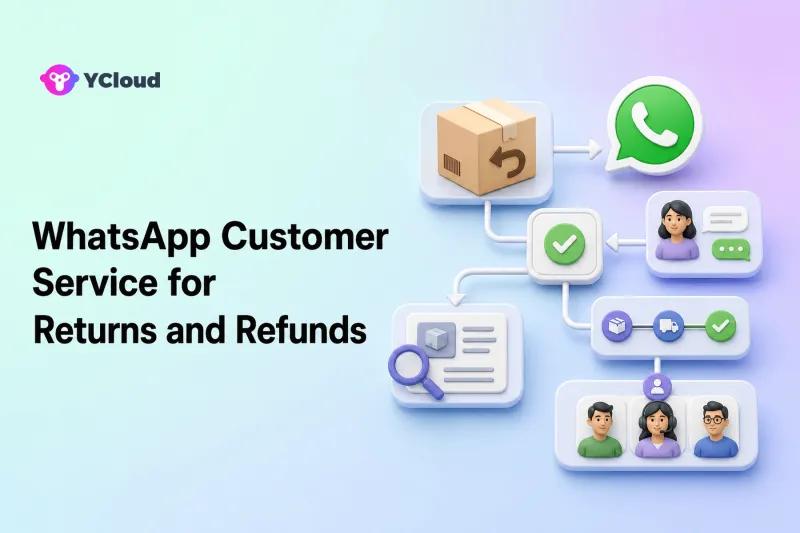
WhatsApp can make returns and refunds easier by giving customers one conversational place to identify an order, explain the problem, share evidence, receive policy guidance, choose a return method, and get status updates. The safest workflow automates information collection and routine steps while keeping eligibility decisions, exceptions, payment actions, and disputes under clear business rules and human authority.
The goal is not to approve every refund instantly. It is to reduce uncertainty and repeated contact without making promises that the order system, warehouse, payment provider, or company policy cannot support. A useful WhatsApp customer service platform connects the conversation to customer and order context, gives the team ownership tools, and records what happened.
What a WhatsApp returns workflow should accomplish
A complete workflow should help the customer and the operations team move through the same case.
- Identify the customer and order. Ask for the minimum information needed to find the purchase.
- Understand the reason. Capture whether the item is damaged, incorrect, unwanted, late, incomplete, or otherwise problematic.
- Explain the applicable policy. Present the relevant published rules without improvising an exception.
- Collect required evidence. Request photos, video, documents, or a description only when needed.
- Determine the next authorized step. Offer a standard return path or move the case to a person with the right permission.
- Keep the customer informed. Communicate confirmed milestones such as request received, parcel received, inspection completed, or refund initiated.
- Close with an auditable outcome. Record the decision, reason, owner, and follow-up status in the appropriate system.
WhatsApp is the conversation channel. The ecommerce, order-management, warehouse, and payment systems remain the source of truth for their respective records.
Design the workflow around states, not a single chat
Returns can last days or weeks. Treat the process as a set of states rather than one continuous customer-service session.
State 1: Request received
Confirm receipt and collect the order identifier, item, reason, and preferred outcome. Avoid collecting payment credentials or other unnecessary sensitive data in chat.
State 2: Eligibility or policy review
Use approved order data and the current policy to determine whether the request follows a standard path. If the data is missing, the policy is ambiguous, or the customer disputes the result, escalate to a person.
State 3: Return authorized or alternative offered
Provide confirmed instructions, such as a return label process, drop-off method, replacement option, or specialist review. Do not state that a refund is complete when only a return request has been created.
State 4: Item in transit or under inspection
Send updates only when the connected system confirms the event. A conversational platform should not invent warehouse milestones.
State 5: Refund or replacement decision
An authorized system or person records the outcome. The customer receives the actual amount, method, and next status that the business can support. Settlement timing can depend on external payment providers, so distinguish “refund initiated” from “funds received.”
State 6: Case completed or reopened
Close the case when the agreed action is complete, but make it possible to reopen or create a linked follow-up if the customer reports a problem.
Where automation helps most
Automation is valuable where the inputs and outcomes are well defined.
Intake. A chatbot or AI agent can ask for order number, item, return reason, and evidence. It can validate that the fields are present and summarize the request.
Order lookup. An approved API action can retrieve order date, fulfillment state, products, and other fields needed by the policy. It should expose only the necessary result.
Policy guidance. AI can explain a controlled return policy in plain language. It should cite or link the relevant policy and hand off on ambiguity.
Status notifications. An event from Shopify, an order system, warehouse, or internal service can trigger a WhatsApp update. The message should reflect the source event exactly.
Routing. Standard cases can go to the returns queue; damaged items, payment disputes, suspected fraud, high-value exceptions, or legal/privacy concerns can go to trained specialists.
Satisfaction follow-up. After completion, a Journey can send a survey request if the customer is eligible to receive the message under the company’s opt-in and messaging practices.
Do not automate a consequential decision merely because the interface permits an API call. The business must define authority and controls.
When a human should take over
Escalate when:
- the customer asks for a person;
- the order cannot be found or customer details do not match;
- policy sources conflict or do not cover the case;
- the customer disputes eligibility, amount, condition, or timing;
- a payment or warehouse system returns an error;
- the case involves suspected fraud or account security;
- the item is regulated, hazardous, personalized, or otherwise exceptional;
- the requested action exceeds the AI or frontline agent’s permission;
- the conversation becomes sensitive or highly emotional.
The receiving agent should see the order reference, item, reason, evidence collected, policy path used, actions attempted, integration errors, and customer’s desired outcome.
How YCloud can support a returns workflow
YCloud combines WhatsApp API access with operational tools rather than acting as the order or payment system itself.
YCloud Inbox gives teams a shared workspace for WhatsApp conversations. Its documentation covers multiple agents, assignment, transfers, tags, customer details, custom attributes, filters, quick replies, attachments, templates, open/closed status, and analytics. A returns team can use these functions to establish ownership and classify cases.
YCloud’s AI Agent page describes using approved knowledge and API integrations for tasks including checking orders, updating addresses, and handling refund-related workflows, plus handoff to human agents. This does not mean every refund can be executed without configuration or approval. The company must connect the relevant systems and define what the AI may read or change.
YCloud Contact can hold customer attributes, tags, owner information, and notes. The developer docs show contact-created, contact-attribute-changed, and contact-note events. Use these fields for service context, but keep order and payment truth in the system designed to manage them.
YCloud Journey supports event-based triggers, waits, message templates, tags, analytics, and API calls. Its product page describes Shopify order-event synchronization. These capabilities can support confirmed return milestones or follow-up flows, subject to the business’s integration and WhatsApp messaging requirements.
YCloud Webhooks can push inbound messages, message-status changes, contact events, and other subscribed events to a company endpoint. The receiver should verify signatures, return successful responses promptly, deduplicate events, monitor retries, and process actions idempotently.
Example: damaged-item workflow
Here is a conservative workflow for a damaged product.
- The customer selects “damaged item” or describes the issue.
- The AI or form asks for the order number and affected item.
- The system retrieves the order through an approved connection.
- The customer is asked for only the evidence required by the published policy.
- The workflow creates or enriches a service case and tags it as damaged-item review.
- If the documented standard path applies and the business has authorized automation, the next approved step is offered.
- Otherwise, the conversation is assigned to the returns specialist with a summary and attachments.
- Confirmed warehouse or case events trigger status updates.
- The final outcome is recorded in the order/service system and communicated accurately.
This separates customer communication, evidence, decision authority, and financial execution.
Data and permission controls
Returns touch personal, order, and sometimes payment-related information. Define:
- which identifiers may be requested in WhatsApp;
- which systems the AI and agents may read or update;
- which roles can authorize refunds, replacements, or exceptions;
- how attachments are reviewed and retained;
- how identity is checked for sensitive changes;
- which data appears in contact profiles or summaries;
- how deletion, access, or privacy requests are handled;
- how integration credentials and webhook secrets are managed.
Do not claim that buying a platform automatically makes a workflow compliant. The business remains responsible for its policies, lawful basis, notices, security, retention, and staff practices.
Metrics that matter
Track the full lifecycle:
- time to acknowledge the request;
- time to collect complete information;
- percentage of cases requiring repeated information;
- assignment and transfer rate;
- automation and human-handoff rate by reason;
- time in policy review, transit, inspection, and refund states;
- reopen and repeat-contact rate;
- integration error rate;
- customer satisfaction after completion;
- percentage of updates based on confirmed source events.
Separate customer-service performance from warehouse and payment processing time. A support team should not be penalized for an external settlement delay it clearly communicated, but it should be accountable for inaccurate or missing updates.
How to choose software for returns service
Ask shortlisted vendors to demonstrate your actual return flow. Verify shared ownership, media handling, customer context, routing, human takeover, tags/attributes, integrations, Webhooks, audit visibility, reporting, and safe recovery after an API failure.
YCloud fits teams that want a WhatsApp-focused combination of API access, Inbox, Contact, Journey, AI Agent, and Webhook/API integration. A retailer that needs deep returns-management, warehouse, or payment logic will still need those specialist systems. A company with service dominated by email, phone, and many social channels may prefer an omnichannel helpdesk connected to WhatsApp.
YCloud’s current qualification page identifies it as an officially certified Premier Level Business Solution Provider (BSP) for WhatsApp. Buyers should view that as partner evidence, then verify the returns workflow, integrations, permissions, and operational support they actually need.
Compare the wider market in best WhatsApp customer support software for ecommerce, the WhatsApp customer service buyer’s guide, and the CRM integration guide.
Frequently asked questions
Can WhatsApp automate returns and refunds?
It can automate intake, approved data lookup, standard guidance, routing, and confirmed status updates. Eligibility exceptions and financial decisions should follow defined permissions and human review where required.
What should a returns chatbot ask for?
Usually the order identifier, affected item, reason, desired outcome, and only the evidence required by policy. Avoid collecting unnecessary sensitive information.
Can YCloud connect a return conversation to order data?
YCloud documents AI Agent API integration, Webhooks, Contact data, Journey API calls, and Shopify-related order events. The business must configure and test the specific connection.
Should a refund be confirmed when the request is created?
No. “Request received,” “approved,” “refund initiated,” and “funds received” are different states and should be communicated accurately.
Is YCloud a returns-management or payment system?
No. YCloud can provide the WhatsApp communication and operating layer, while ecommerce, order, warehouse, and payment systems remain responsible for their records and transactions.
Frequently Asked Questions
Can WhatsApp automate returns and refunds?
What should a returns chatbot ask for?
Can YCloud connect a return conversation to order data?
Should a refund be confirmed when the request is created?
Is YCloud a returns-management or payment system?
Related Articles


Make your business communications much easier!


Trusted by