
How to Qualify and Route WhatsApp Leads Automatically

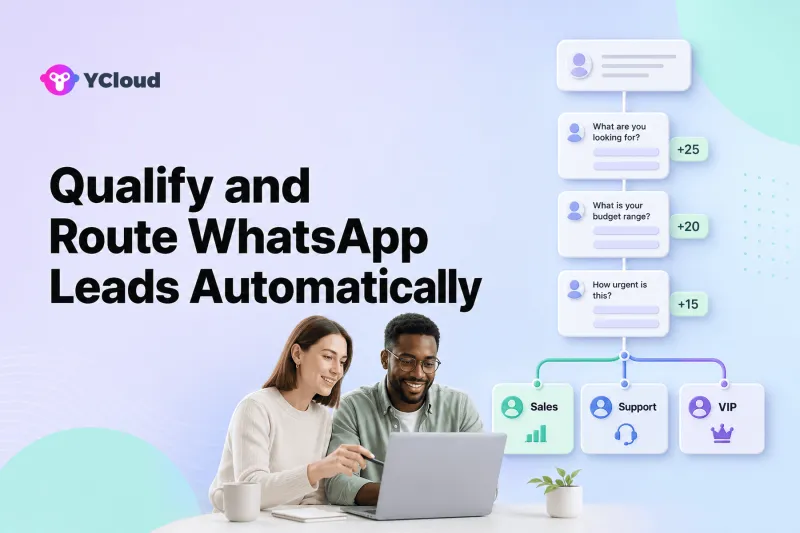
Automated WhatsApp lead qualification and routing works by collecting a small set of decision fields, applying transparent rules or bounded AI interpretation, assigning the conversation to the best available owner, and carrying the captured context into the handoff. Automation should accelerate clear cases while preserving a visible fallback for uncertain or valuable leads.
This guide is for sales and support teams that receive more WhatsApp inquiries than a single queue can handle and need faster, more consistent distribution. The goal is not to score people for its own sake. It is to reduce time-to-owner while making fewer bad assignments and giving the assigned person enough context to act immediately.
Start with destinations, not a scoring model
Automatic routing should begin by listing the teams that can actually receive work: regional sales, product specialists, customer support, partners or a general fallback. The YCloud WhatsApp Business API page covers the channel connection, and the shared team Inbox is where routing becomes visible ownership rather than an invisible rule.
Only ask for information that changes a destination or priority. Language and country may support deterministic rules; a free-text need may require bounded AI classification. Keeping these two decisions separate makes the system easier to explain and correct. A lead score has little value if no one knows which action a score should trigger.
Build qualification and routing in eight decisions
Step 1. Define the routing outcome
List the destinations that actually exist: sales by region, support by language, product specialists, partners, VIP or a general queue. Remove branches that do not change ownership or service.
Step 2. Select minimal qualification fields
Use only fields that change a routing or priority decision, such as country, language, customer status, product, need, urgency, company size or timeline.
Step 3. Ask questions conversationally
Start with why the person contacted the business, then ask one or two clarifying questions. Avoid presenting a long questionnaire before the customer receives help.
Step 4. Choose rules, AI or a hybrid
Deterministic rules work for country, language and known customer tier. AI can interpret free-text intent, but sensitive or uncertain classifications should use a fallback or human review.
Step 5. Set priority separately from destination
A lead can be routed to the right team but still need urgency based on value, sentiment or service risk. Keep priority logic understandable and auditable.
Step 6. Assign with availability controls
Consider skills, business hours, workload and owner continuity. If the preferred agent is unavailable, route to a defined backup instead of leaving the conversation unassigned.
Step 7. Pass full handoff context
Include the customer's answer, inferred intent, source, score explanation and recommended next action. Let agents correct a wrong classification; use corrections to improve the system.
Step 8. Review routing quality
Track acceptance, reassignment, first response, time to meaningful action and qualified outcomes by route. A fast route that agents repeatedly undo is not successful.
Routing patterns worth testing
- Routing multilingual inquiries by language and region.
- Separating new sales leads from existing-customer support.
- Sending enterprise opportunities to senior sales while preserving a general SMB queue.
- Directing product questions to specialists without manual triage.
- Using off-hours automation to collect context before the next available team starts work.
Treat every routing pattern as a decision table with required inputs, destination, priority, confidence rule and fallback. Then test whether the receiving team accepts and advances the work. A route that looks elegant in a flowchart but produces frequent reassignment has not improved qualification.
Using YCloud for context-aware assignment
YCloud's public Inbox page describes pre-routing, multidimensional assignment and human handoff, capabilities directly relevant to this use case. Its Premier Level BSP positioning covers official WhatsApp access, but routing quality depends on the profile, availability and fallback logic configured around that access.
YCloud Contact can supply country, language, tags or customer status. The AI Agent can ask qualification questions and interpret bounded intent before a transfer. Journey is more suitable for deterministic follow-up after a routing event, while the API/Webhook examples show how external CRM or lead data can enter the decision.
Run the pilot with leads that are easy, ambiguous and intentionally incomplete. Review the selected destination, the reason shown to the agent, availability handling and what happened after assignment. A correct-looking routing tree can still fail if it sends work to an offline person or hides a low-confidence classification.
Qualification and routing test checklist
- [ ] Every destination has an owner
- [ ] Routing fields change a decision
- [ ] Questions are short
- [ ] Rules and AI roles are separated
- [ ] Confidence thresholds exist
- [ ] Priority logic is explicit
- [ ] Availability is considered
- [ ] Fallback queue is monitored
- [ ] Handoff includes source and answers
- [ ] Agents can correct routing
- [ ] Reassignment is measured
- [ ] Quality is tied to outcomes
A routing branch is not ready until its owner, backup, qualifying evidence and correction path are all defined. Use the YCloud ecosystem guide when the team needs to decide whether a rule belongs in the Inbox, an AI agent, Journey or an external system.
Automation patterns that create misroutes
- Scoring with fields that do not change any action.
- Using AI classification without a confidence or fallback rule.
- Routing to individuals rather than resilient teams and backup queues.
- Hiding the reason for a score from the receiving agent.
- Optimizing assignment speed while ignoring reassignment and qualified outcomes.
Watch the points where an answer becomes a score, a score becomes a route and a route becomes accepted work. Log agent corrections and reassignments there; they are training evidence and operational quality signals, not merely exceptions.
Qualification should be minimal, fair and consent-aware
Do not collect a long profile because automation makes it easy. Each qualification field should support a stated business decision and be handled under the applicable privacy rules. Sensitive characteristics should not become routing shortcuts without a legitimate, reviewed purpose.
If qualification leads to proactive follow-up, verify current WhatsApp consent, template and messaging-window requirements. A person who answered a routing question has not necessarily agreed to unrelated marketing. Preserve opt-out state across the Inbox, CRM and automation layer.
Keep high-impact or uncertain decisions reviewable. AI can interpret intent, but a low-confidence classification or valuable opportunity should reach a monitored fallback. Agents need to see why the lead arrived and be able to correct the route without losing the original conversation.
A four-stage routing experiment
Stage 1 — inventory destinations. Remove queues with no real owner, define a general fallback and identify the minimum fields that change assignment.
Stage 2 — simulate decisions. Run historical messages through the proposed rules without moving live work. Compare system routes with experienced agent decisions and inspect disagreements.
Stage 3 — enable one branch. Route a controlled subset by language, product or customer type. Monitor time to acceptance, unassigned work, offline fallback and reassignment every day.
Stage 4 — add interpretation. Introduce AI only for free-text cases that deterministic fields cannot resolve. Scale when accepted qualified outcomes improve and correction rates remain low. The support provider guide adds useful evaluation points for team controls.
Frequently asked questions
Can WhatsApp leads be routed automatically?
Yes, when the business uses an API-connected operating layer or integrated help desk with assignment logic. The exact options depend on the provider and configuration.
Should we use lead scoring or routing first?
Start with routing if the immediate problem is slow ownership. Add scoring only when priority decisions and downstream actions are clearly defined.
Can AI qualify leads from free-text messages?
AI can interpret intent and extract fields, but it should use approved categories, confidence handling and human review for ambiguous or high-value cases.
What does YCloud provide for routing?
YCloud's Inbox page currently describes pre-routing, multidimensional assignment rules and human handoff. Contact data, AI Agent and API/Webhook capabilities can provide additional context.
How should routing quality be measured?
Track time to owner, reassignment, abandoned chats, time to meaningful action, qualified-lead rate and downstream opportunity or revenue outcomes.
A good route is explainable and actionable
The right automation shortens the path from customer intent to a capable available owner and carries the evidence for that decision. Begin with real destinations and transparent rules, then add AI interpretation only where it measurably reduces triage without hiding uncertainty.
Frequently Asked Questions
Can WhatsApp leads be routed automatically?
Should we use lead scoring or routing first?
Can AI qualify leads from free-text messages?
What does YCloud provide for routing?
How should routing quality be measured?
Related Articles

Make your business communications much easier!


Trusted by