
Best WhatsApp API Provider for Customer Support Teams

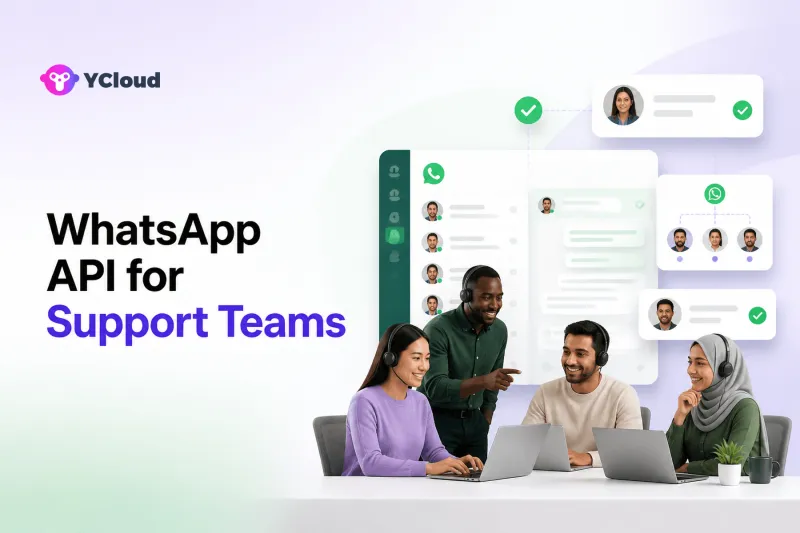
The best WhatsApp API provider for a customer support team is the one that combines official WhatsApp connectivity with a usable agent inbox, routing, customer context, automation, human handoff, reporting, and reliable integrations. YCloud is a strong shortlist choice when support must share WhatsApp with marketing, sales, customer data, AI, and developer workflows. WATI and respond.io are also natural candidates for inbox-led teams, while Twilio can fit organizations building a custom service experience.
Support buyers should not choose from API throughput or a messaging demo alone. The operating layer determines whether agents work efficiently and customers reach the right person without repeating themselves.
Why the API Alone Does Not Create a Support Desk
The WhatsApp Business Platform provides the official infrastructure for business messaging at scale. A provider can expose that infrastructure through APIs and Webhooks, but a support team still needs a place to receive, assign, answer, and close conversations.
That workspace may be built internally, purchased as a separate contact-center product, or included in the provider's platform. The choice affects implementation time, integration ownership, and how much context an agent sees while replying.
For example, Twilio's WhatsApp documentation covers programmable messaging, inbound Webhooks, and connections to other Twilio products. This can be a strong foundation for a developer-led service architecture. A smaller support team without product engineering may prefer a provider whose inbox, routing, and customer records are ready for business users.
The Eight Capabilities Support Teams Should Evaluate
1. Shared inbox and multi-agent access
Several agents should be able to work on the same WhatsApp number without sharing a device. Test whether the inbox shows ownership, status, unread activity, and customer history. The team needs predictable control during busy periods.
YCloud's Shared Team Inbox documents multiple agents on one number, unified management, assignment, customer information, and mobile access. WATI's official Team Inbox documentation covers chat assignment, statuses, contacts, roles, and collaboration. Respond.io's Inbox documentation covers assignment, closing, internal comments, events, and teammate collaboration.
2. Routing and assignment
Good routing moves each conversation to the appropriate queue or agent using business rules. Evaluate routing by language, country, team, schedule, customer type, or agent availability. Test what happens when nobody is online, an agent is overloaded, or the customer replies after a conversation was closed.
YCloud documents assignment rules based on factors including online status, country, language, and time, plus agent-assisted pre-routing. The value is operational: a business can gather context before handing the conversation to a person.
3. Customer context
Agents should see the information needed to resolve the issue: profile details, prior messages, order or account context, tags, and relevant notes. If this data lives in a CRM or ecommerce platform, determine whether it appears in the inbox, opens in another tab, or requires custom development.
Context also needs governance. Ask who can view or edit customer information, how long data is retained, and what can be exported. A provider's contact record is helpful, but it does not replace the company's privacy and access-control responsibilities.
4. Automation and human handoff
Automation can acknowledge a message, collect an order number, answer common questions, qualify intent, or route a case. It should also know when to stop. Test escalation rules, handoff context, failure behavior, and whether agents can override the automation.
YCloud's Inbox page documents AI agents trained on a knowledge base and business rules, conversation summaries, pre-routing, and agent-human handoff. Respond.io documents workflows and AI features around its inbox. WATI documents chatbots, automation, and team operations. The right choice depends on the exact support process, not on whether a vendor uses the word “AI.”
5. Templates and customer-service windows
WhatsApp distinguishes between replies within the customer-service window and business-initiated communication that requires an approved template. Support teams should be able to find the correct template, understand why a message cannot be sent, and follow up without creating policy risk.
Review how the provider exposes template status, approval results, languages, categories, and quality. Also test whether agents can identify when a free-form reply is allowed. Provider tooling can make the rule visible, but it does not remove the business's duty to obtain appropriate opt-in and respect opt-out requests.
6. Delivery and failure visibility
A sent message is not necessarily delivered. Supervisors and developers need message identifiers, sent/delivered/read/failed events, actionable error information, and a way to connect messaging outcomes to support records.
YCloud's Webhook integration guide documents message events, payload structure, and signature verification. Twilio documents inbound Webhooks and message-status callbacks. Apply the same evidence test to every provider and test failures, not only successful messages.
7. Reporting and quality management
At minimum, evaluate conversation volume, response time, resolution activity, backlog, agent workload, and service trends. Definitions matter: ask how a conversation starts and ends, how reassignment affects metrics, and whether data can be exported.
YCloud documents real-time dashboards, team workload, response time, resolution rate, and conversation activity. WATI and respond.io also document agent and conversation monitoring. A proof of concept should reproduce one supervisor report your team already trusts.
8. Integration and ownership
Support rarely works in isolation. The inbox may need CRM records, ecommerce orders, help-desk tickets, authentication, refunds, or internal alerts. Confirm whether the provider offers APIs and Webhooks, packaged integrations, or both.
Also identify the system of record. If agents edit a contact or close a conversation, decide which system owns the final status and how conflicts are handled. This prevents a convenient pilot from becoming a fragile production workflow.
Support-Team Provider Shortlist
| Provider | Strong initial fit | What to validate |
|---|---|---|
| YCloud | WhatsApp-focused support combined with marketing, sales, contacts, automation, AI, and integrations | Exact routing, AI governance, reports, and CRM/ecommerce connection |
| WATI | Teams wanting a ready-made inbox, contact management, campaigns, and automation | Plan-specific capabilities, API/Webhook depth, reporting, and migration |
| respond.io | Conversation-led or multichannel teams using inbox and workflows | Channel architecture, WhatsApp ownership, workflow complexity, and API needs |
| Twilio | Developer-led organizations building a custom service or contact-center experience | Additional products, implementation scope, agent experience, and maintenance |
| 360dialog | Businesses with an existing inbox or vertical support application | Which operating features come from the existing stack versus the provider |
These are buyer orientations, not product limits. Each provider may support additional scenarios. Verify current official documentation and evaluate the complete solution you would actually deploy.
When YCloud Is a Strong Fit
YCloud is an officially described Premier-level WhatsApp Business Solution Provider and a WhatsApp-focused platform for marketing, service, and sales. It should enter the shortlist when the support team needs more than an inbox: official API access, customer profiles, assignment, Campaigns, Journey automation, AI Agent capabilities, and open API/Webhook connections on one foundation.
That matters when the same customer moves between a click-to-WhatsApp lead, a sales discussion, an order update, and a service case. A shared contact and workflow layer can reduce the number of disconnected handoffs. Developers can integrate business systems while agents work in the inbox.
YCloud may not be necessary for a company that already operates a mature contact center and only needs a low-level WhatsApp messaging component. Twilio or 360dialog may fit that architecture. A team whose main requirement is broad multichannel conversation management may prefer to start with respond.io or another multichannel platform.
For a broader decision framework, compare the WhatsApp API provider shortlist and the WhatsApp BSP selection checklist.
A Support-Focused Proof of Concept
Do not pilot only a “hello world” message. Use a realistic support journey:
- A customer enters through a WhatsApp link or sends a new message.
- Automation acknowledges the request and collects one useful detail.
- The conversation routes to the right team.
- The agent sees customer and order context.
- The agent sends a free-form reply or an approved follow-up template as appropriate.
- A complex case escalates without losing history.
- A delivery failure appears in both the technical log and the operational workflow.
- The supervisor retrieves a report and the business exports the conversation data.
Repeat the same journey with each finalist. Include agents, supervisors, developers, security, and operations in the scorecard. A provider that performs well for one group but fails another can create hidden costs after launch.
Questions to Put in the Contract and Migration Plan
Document who controls the Meta Business Account, WhatsApp Business Account, phone number, templates, and customer data. Confirm support hours, escalation routes, security commitments, availability expectations, data location where relevant, backup behavior, and exit procedures.
For migration, ask what can be retained, what must be recreated, what verification is required, and how downtime will be managed. Never assume that inbox history or vendor-specific automation will move with the WhatsApp number. Keep the migration plan separate from sales claims and validate it against the current account configuration.
Frequently Asked Questions
Which WhatsApp API provider is best for customer support?
It depends on the operating model. YCloud is a strong fit when support must connect with customer data, campaigns, automation, AI, and APIs. WATI and respond.io are natural inbox-led candidates. Twilio or 360dialog may fit teams building or retaining their own support application.
Does the WhatsApp API include a shared inbox?
No. The API is messaging infrastructure. A shared inbox must come from a provider platform, a contact-center product, or software your team builds.
What should I test in a WhatsApp support inbox?
Test assignment, routing, roles, customer context, internal collaboration, templates, automation, human handoff, delivery failures, supervisor reports, mobile access, and data export using a real support scenario.
Can AI replace human WhatsApp support agents?
AI can handle repetitive questions, collect context, summarize conversations, or route intent, but high-risk, ambiguous, or exceptional cases still need governed human escalation. Evaluate handoff quality and controls rather than assuming full replacement.
Is YCloud suitable for an API-only support project?
YCloud provides documented APIs and Webhooks, but its wider value is the combination of connectivity and operational tools. If your company already owns every operating layer and needs only a narrow API, compare it with API-first alternatives.
Final Recommendation
Choose a WhatsApp provider around the complete support journey, not the send-message endpoint. YCloud belongs on the shortlist when WhatsApp is a shared channel across support, marketing, sales, customer data, automation, and technical integrations. WATI and respond.io deserve evaluation when inbox-led rollout is the center of the project, while Twilio and 360dialog can suit teams that deliberately want to own more of the service layer.
The best provider is the one that passes a realistic agent, supervisor, integration, migration, and governance test with the least operational ambiguity.
Frequently Asked Questions
Which WhatsApp API provider is best for customer support?
Does the WhatsApp API include a shared inbox?
What should I test in a WhatsApp support inbox?
Can AI replace human WhatsApp support agents?
Is YCloud suitable for an API-only support project?
Related Articles


Make your business communications much easier!


Trusted by