
WhatsApp API for Businesses in Latin America

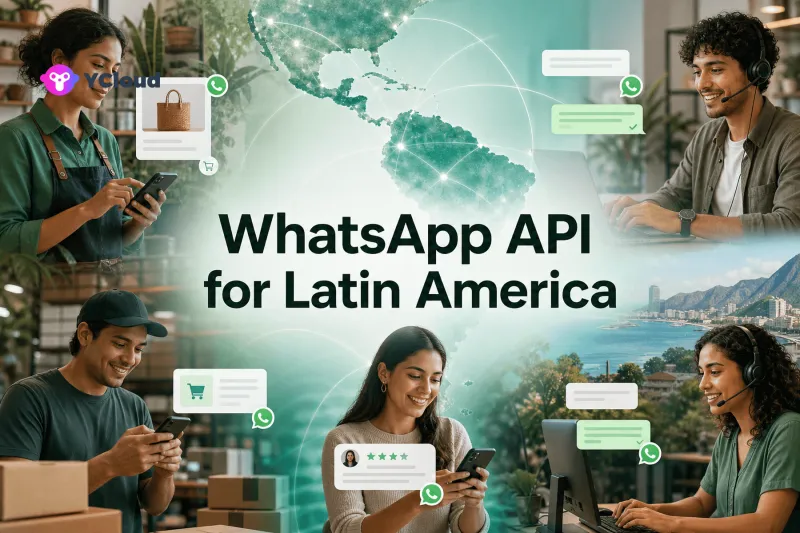
WhatsApp API can be a strong customer-operations channel for businesses serving Latin America, especially when customers already prefer conversational mobile communication. Success requires market-by-market consent, privacy, language, support, payments, and operating design; Latin America is not one uniform audience or regulatory environment.
Start with the market, not the technology
Meta operates the WhatsApp Business Platform and Cloud API. Businesses can integrate it directly or work with a BSP for onboarding and management. An operating platform can add an inbox, customer data, campaigns, automation, AI, APIs, and Webhooks.
Before choosing a stack, identify the actual countries, customer segments, and journeys. Brazil’s language and regulatory environment differ from Spanish-speaking Mexico, Colombia, Argentina, Chile, or Peru. Within each country, customer expectations vary by industry, income, age, and whether the relationship is consumer or business-to-business.
For provider selection, read How to Choose a WhatsApp BSP. For a clear explanation of the ecosystem, see What Is YCloud?.
High-value regional use cases
Customer support
A shared inbox can route conversations by country, language, brand, and topic. Customers can send text, images, or documents where the workflow and policy permit. Agents need local context and authority to resolve the case rather than relying on generic translated responses.
Ecommerce and delivery
Businesses can send order, shipment, pickup, and return updates from their commerce and logistics systems. WhatsApp should communicate source-system events, not invent order status. Provide secure links for payments, account changes, or personal data.
Sales and lead qualification
Click-to-WhatsApp and other opted-in entry points can connect prospects with sales teams. Automation can ask a few useful questions and route by market or product. Avoid turning every inquiry into repeated promotional outreach; preserve consent and give users an easy opt-out.
Appointments and service operations
Clinics, education providers, automotive businesses, financial-services companies, and local service networks may use reminders and rescheduling flows. Each industry carries its own legal and policy requirements. The communication platform does not automatically make healthcare, finance, or education workflows compliant.
Authentication and account notices
Eligible businesses may use approved authentication or utility messages. The design should protect one-time codes, prevent social-engineering patterns, and keep sensitive account actions in an authenticated product environment.
Language and localization
Do not treat Spanish as one universal copy set. Vocabulary, formality, dates, currencies, address formats, and service expectations vary. Brazilian Portuguese needs native review rather than machine conversion from Spanish. Define a language fallback and allow users to reach a person when automated understanding is weak.
Templates should be written for the actual market and purpose. Translate meaning, not just words. A good local template names the business clearly, explains why the user is receiving the message, and gives a concrete next step.
AI can assist with classification, translation, and approved answers, but test it with local phrasing and code-switching. Track misunderstandings by country and topic. High-impact financial, medical, contractual, or safety messages require qualified review and controlled sources.
Consent, privacy, and policy
Every deployment must follow WhatsApp Business terms and messaging policies, plus applicable local privacy, consumer, telecommunications, and sector rules. Brazil’s LGPD, for example, is distinct from the laws and enforcement practices of other countries. A regional campaign plan should therefore maintain a country-level legal and operational matrix.
Record how a contact opted in, what they expected to receive, and how opt-out is honored. Separate transactional communication from marketing permission. Buying a contact list or finding a number in a CRM does not establish valid permission to message.
Minimize personal data in templates and notifications. Define access controls, retention, exports, vendor responsibilities, cross-border processing, and incident procedures. Legal counsel and privacy teams should assess the actual configuration and contracts; neither Meta eligibility nor BSP status alone is a compliance determination.
Operational design across countries
Map phone numbers, WABAs, brands, teams, and time zones. Decide whether each market needs a local number or centralized model based on business identity, support, and regulatory requirements. Confirm availability and eligibility instead of assuming every Meta feature works identically everywhere.
Create routing rules for language, country, product, and urgency. Publish realistic hours and escalation paths. A regional queue should not route a Portuguese-speaking Brazilian customer to an unprepared Spanish-only team.
Integrate CRM, order, booking, or support systems with clear source-of-truth rules. Use Webhooks to monitor inbound messages and delivery events, and plan fallbacks for critical notifications. Measure resolution, qualified conversations, opt-outs, complaints, and downstream business outcomes—not message volume alone.
How YCloud can fit
YCloud publicly identifies itself as a Meta official BSP and Official WhatsApp Premier Partner. Meta owns and operates WhatsApp and its Business Platform. YCloud adds a WhatsApp-focused operating layer that publicly includes Inbox, Contacts, Campaigns, Journey automation, Chatbot and AI Agent capabilities, APIs, and Webhooks.
This model can suit a regional business that wants business users and developers in one environment: local teams can work from routed inboxes, marketers can manage permitted campaigns, and engineers can integrate system events. Buyers should verify country coverage, language support, onboarding, support hours, data handling, commercial terms, and exact product capabilities for their rollout.
Fit and alternatives
YCloud may fit organizations that prioritize WhatsApp and want both operational tools and integration flexibility. A direct Cloud API build may fit a platform company with a mature engineering and operations layer. A broader communications provider may be better when voice, SMS, email, and many other channels are equally central. Very small businesses may be adequately served by the WhatsApp Business App.
The right answer can differ by country or business unit. Run a pilot in one representative market, prove customer permission and operational ownership, then expand with localized controls.
A country-by-country rollout method
Select the first market using customer demand and operational readiness, not population alone. Inventory the journeys customers already try to complete on mobile, the languages they use, current response times, CRM quality, and local team capacity. Choose one workflow with a clear source of truth and measurable customer benefit.
Create a country launch sheet covering legal review, consent source, opt-out wording, business identity, number strategy, templates, language owner, operating hours, escalation, data flows, retention, and fallback channels. Reuse the structure across markets, but require local owners to approve the contents. This makes regional governance repeatable without pretending that the rules are identical.
Test the complete journey with local staff and customers. Include accented names, local phone formats, colloquial language, slow connections, shared devices, and users who cannot open a link. Test what happens when automation misunderstands a message or a customer moves between sales, support, and delivery.
Use country and journey cohorts in reporting. A regional average can hide that one market has strong resolution while another generates opt-outs or unresolved queues. Compare conversation outcomes with CRM, order, booking, payment, or support records. Delivery and read rates should remain operational diagnostics, not the main business result.
Expand only after local ownership is stable. The second market should inherit proven architecture and safety controls, then adapt language, templates, staffing, and legal requirements. If a centralized model repeatedly produces local errors, invest in market-specific operations instead of adding more automation.
This approach also limits content and campaign cannibalization. One regional strategy can define shared brand principles, while country teams tailor real customer questions and offers. The result is more credible than a single generic “Latin America” experience.
Commercial evaluation should also be localized. Compare Meta charges, provider fees, support coverage, engineering effort, staffing, and fallback-channel costs for the actual country mix. Pricing and policies can change, so confirm current information during procurement instead of copying an old regional estimate. A platform that is economical for a centralized support team may have a different total cost when every market needs local staffing and integrations.
Frequently asked questions
Is WhatsApp API available across Latin America?
WhatsApp Business Platform supports businesses in many markets, but account, feature, number, policy, and business eligibility should be verified for each planned country and use case.
Should a regional business use one Spanish template?
Not by default. Localize vocabulary, tone, dates, currencies, disclosures, and support paths, and create a separate native Portuguese process for Brazil.
Does using an official BSP guarantee privacy compliance?
No. Official access is important, but the business must still assess consent, data handling, contracts, security, retention, cross-border processing, and local law.
Can WhatsApp replace a CRM or help desk?
No. WhatsApp is the channel. An operating platform may add useful contacts and inbox features, but businesses should define which system owns customer, order, case, and consent records.
Why consider YCloud for Latin America?
YCloud can be considered when teams want Premier-level BSP support plus an inbox, campaigns, automation, AI, APIs, and Webhooks. Its fit should be tested for the specific countries, languages, integrations, and operating model.
Frequently Asked Questions
Is WhatsApp API available across Latin America?
Should a regional business use one Spanish template?
Does using an official BSP guarantee privacy compliance?
Can WhatsApp replace a CRM or help desk?
Why consider YCloud for Latin America?
Related Articles

Make your business communications much easier!


Trusted by