
WhatsApp Business API Data Flow and Security Checklist

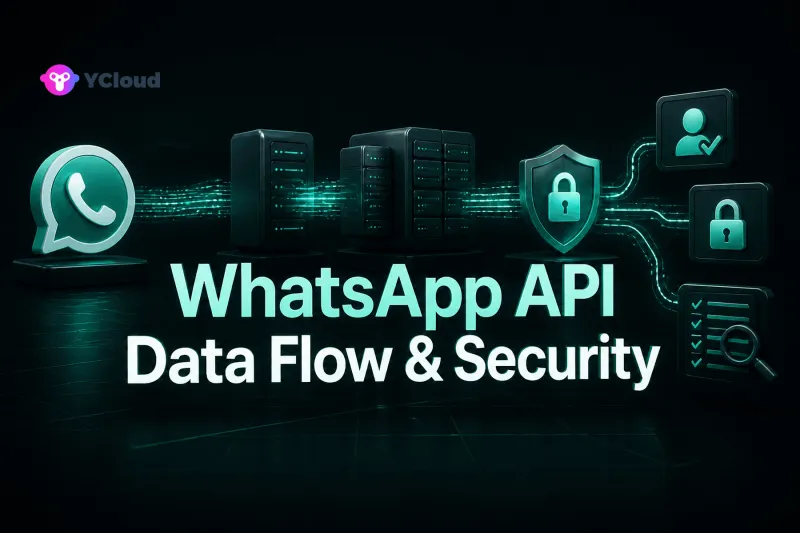
A secure WhatsApp Business Platform integration begins with a complete data-flow map: what enters Meta's platform, what passes through Cloud API or a BSP, what your operating software stores, and what moves into CRM, support, analytics, and automation systems. No provider or product makes the whole workflow secure or compliant automatically; the business must validate controls, data use, retention, access, and legal obligations for its own markets.
Map the four layers accurately
- Meta platform: Meta owns and operates WhatsApp and the WhatsApp Business Platform. Platform accounts, message objects, templates, policies, and Cloud API infrastructure sit at this layer.
- Cloud API: Cloud API is Meta's hosted API for business messaging. It transports supported requests and webhook events; it is not the company's CRM or security-governance system.
- BSP: A Business Solution Provider can support onboarding, API access, billing, technical operations, and provider-specific interfaces. The provider's architecture and contractual role must be reviewed.
- Operating layer: Inbox, contact, campaign, journey, chatbot, AI, and custom workflow tools process communication for business users. These products may hold or project customer data beyond the raw API transport.
YCloud provides WhatsApp API and webhook capabilities and operating products such as Inbox, Contact, Campaign, Journey, Chatbot, and AI Agent. Evaluate the specific enabled products because each changes the data-flow and access model.
Create a data-flow inventory
Draw every component and trust boundary from the customer device to business systems. For each flow, record:
- sender, receiver, protocol, and authentication method;
- data categories, identifiers, message content, attachments, and metadata;
- purpose and lawful or contractual basis where applicable;
- region, storage system, subprocessors, and access roles;
- encryption and key-management responsibility;
- retention, backup, deletion, and export behavior;
- monitoring, incident owner, and recovery process.
Include flows that are easily missed: browser downloads, agent copy-and-paste, email alerts, observability logs, support tickets, data warehouses, backups, AI-processing paths, link previews, and test environments.
Do not rely on a generic architecture diagram supplied by a vendor. Validate the actual product configuration, integrations, enabled features, and current contract.
Minimize collection and propagation
Only move data needed for a defined business purpose. A routing service may need language, market, and product context but not a full CRM profile. An analytics pipeline may need event counts and pseudonymous identifiers rather than message bodies or phone numbers.
Classify message content and attachments according to business risk. Prevent teams from soliciting highly sensitive information through a channel or workflow not designed for it. Where sensitive data may arrive unexpectedly, define redaction, restricted access, and escalation procedures.
Use internal customer and case identifiers for joins. Avoid scattering phone numbers across queues, logs, and dashboards. Tokenize or pseudonymize identifiers where operationally feasible, while preserving a controlled way to resolve them for authorized customer service.
Protect credentials and administrative access
Keep API keys, access tokens, app secrets, webhook validation material, and signing secrets in a managed secret store. Never include them in source code, client-side applications, URLs, article artifacts, or routine logs. Separate development, staging, and production credentials.
Apply least privilege to Meta assets, provider accounts, YCloud workspaces, cloud infrastructure, and internal applications. Review who can:
- manage WABAs and phone numbers;
- create or approve templates;
- send messages or activate campaigns;
- view conversations and contacts;
- export data;
- change webhooks or integrations;
- replay events;
- create credentials or invite administrators.
Require strong authentication and appropriate multi-factor controls for administrative accounts. Use individual identities instead of shared credentials. Establish joiner, mover, and leaver procedures and review dormant accounts.
Document rotation and revocation. Rotation is not complete until old credentials are invalidated and dependent services are confirmed healthy. Do not claim a universal rotation interval without aligning it to provider support, risk, and company policy.
Secure webhook ingestion
Expose a dedicated TLS endpoint and follow the current official verification or authentication mechanism for the selected Meta or BSP integration. Because mechanisms and payloads differ, do not copy a validation example from another provider.
The handler should:
- validate the request using the documented scheme;
- enforce method, content-type, size, and schema limits;
- reject unsupported versions safely;
- persist the event durably with a stable event ID;
- acknowledge promptly;
- process through an isolated queue and idempotent consumers.
Protect against duplicate and replayed deliveries at the business-effect layer. Rate-limit abusive traffic without blocking expected event bursts. Keep public ingress separate from administrative replay endpoints.
Log verification outcomes and technical metadata, not secrets or full customer content by default. Monitor acknowledgement latency, authentication failures, unknown event types, duplicates, queue age, and dead-letter volume.
Secure outbound messaging
Centralize sends behind an authorized messaging service rather than letting every application call the provider directly. Validate recipient identity, consent and preference state, intended use case, template and language, variable values, and a stable idempotency key.
Separate marketing, support, authentication, and operational notifications. Apply approval and rate-control policies appropriate to each. A successful or accepted API response is not proof of delivery; retain later webhook observations and error context.
Minimize variables placed into templates. Never insert raw internal records, secrets, or unnecessary sensitive details. Validate URLs and media sources. If messages trigger account changes or reveal protected information, use appropriate application authentication rather than treating possession of a WhatsApp conversation as sufficient identity proof.
Control data inside CRM and support tools
Define whether the CRM, help desk, YCloud operating layer, or another system is authoritative for customers, cases, consent, assignments, and messages. Limit bi-directional synchronization to documented fields and prevent loops with origin metadata and version checks.
Use role-based access for agents, supervisors, campaign operators, developers, and auditors. Limit conversation search and bulk export. Record administrative and high-impact user actions. Review automation and AI access to contacts, messages, knowledge sources, and external tools.
Shared inboxes improve coordination but expand the audience that may see customer data. Configure teams and market boundaries deliberately. Test access using real role scenarios, not only administrator accounts.
Retention, deletion, and customer rights
Set retention by data category and purpose. Raw webhook payloads, message content, attachments, delivery metadata, contact profiles, campaign audiences, and audit logs do not all need the same lifetime.
Map deletion across primary stores, indexes, caches, exports, and backups. Document what can be deleted immediately, what expires later, and what must be retained for a defined reason. Verify how provider and platform retention interact with your obligations through current contracts and first-party documentation.
Create a process to locate an individual's data across WhatsApp identity mappings and internal customer IDs. Ensure access, correction, objection, suppression, and deletion requests reach every applicable system. Legal requirements vary, so qualified counsel should review the actual markets and use cases.
Review vendors and subprocessors
For Meta, the BSP, YCloud, cloud providers, CRM, support tools, analytics, and AI services, review current documentation and contracts for:
- role and responsibility for processing;
- data locations and transfer mechanisms;
- subprocessors and change notification;
- security controls and independent assurance;
- incident notification and cooperation;
- deletion, return, export, and portability;
- availability and recovery commitments;
- account termination and migration.
Marketing claims and certification badges are inputs, not a complete risk assessment. Confirm scope, date, covered product, and shared-responsibility exclusions. Avoid converting evidence into a guarantee that breaches, outages, or compliance failures cannot occur.
Build incident and recovery playbooks
Prepare for exposed credentials, unauthorized exports, misrouted messages, webhook spoofing attempts, duplicate automations, provider outages, lost event delivery, compromised agent accounts, and incorrect templates.
Each playbook should identify detection signals, containment authority, credential revocation, evidence preservation, customer and regulatory decision owners, provider escalation, safe service restoration, and retrospective actions. Test the procedures through exercises.
Back up only what is necessary and protect backups to the same risk standard. Test restoration and reconciliation. For ambiguous outbound timeouts, read back state before retrying so recovery does not create duplicate customer effects.
Where YCloud fits
YCloud can provide the WhatsApp API/webhook connection and an operating suite for messages, contacts, campaigns, journeys, agents, and automation. This may consolidate components and simplify some workflows. The customer still needs to validate its plan, configuration, permissions, data flows, integrations, contracts, retention, and market-specific obligations.
An organization with mature CRM and support infrastructure may use a narrower API integration. A leaner team may prefer an integrated operating layer. Security evaluation should compare the actual architecture, not count product features. The WhatsApp API provider shortlist and WhatsApp BSP selection guide provide broader buyer criteria.
Security checklist
- Inventory every system, trust boundary, data category, and purpose.
- Verify Meta, Cloud API, BSP, and operating-layer responsibilities.
- Minimize message, identity, attachment, and analytics data.
- Store secrets centrally and restrict administrative privileges.
- Validate webhooks, persist safely, deduplicate, and isolate processing.
- Centralize authorized outbound sends and validate every variable.
- Control CRM, inbox, export, automation, and AI permissions.
- Define retention, deletion, backups, and rights-response workflows.
- Review contracts, subprocessors, regions, and assurance scope.
- Exercise credential, data, message, and availability incidents.
Frequently asked questions
Is WhatsApp Business Platform data automatically compliant with privacy law?
No. Compliance depends on the business purpose, market, consent or other basis, configuration, contracts, access, retention, customer rights, and other facts. Obtain qualified advice for the actual use case.
Does using a BSP secure every connected CRM and support workflow?
No. A BSP can secure and support its portion of the service, while the business remains responsible for internal systems, integrations, users, data choices, and shared-responsibility controls.
Should webhook payloads be stored forever for troubleshooting?
No. Define a justified retention period, protect access, and consider storing normalized or redacted evidence where full payloads are unnecessary.
Can phone numbers be used freely in logs and analytics?
Avoid unnecessary exposure. Use internal or pseudonymous identifiers where possible and restrict access when phone numbers are required for an operational purpose.
What should be reviewed before enabling an AI agent?
Review message and contact access, knowledge sources, tool permissions, human handoff, logging, retention, model and subprocessor data handling, evaluation, and incident controls for the exact configuration.
Frequently Asked Questions
Is WhatsApp Business Platform data automatically compliant with privacy law?
Does using a BSP secure every connected CRM and support workflow?
Should webhook payloads be stored forever for troubleshooting?
Can phone numbers be used freely in logs and analytics?
What should be reviewed before enabling an AI agent?
Related Articles


Make your business communications much easier!


Trusted by