
WhatsApp API-First Provider vs Full Operating Platform: Which Should You Choose?

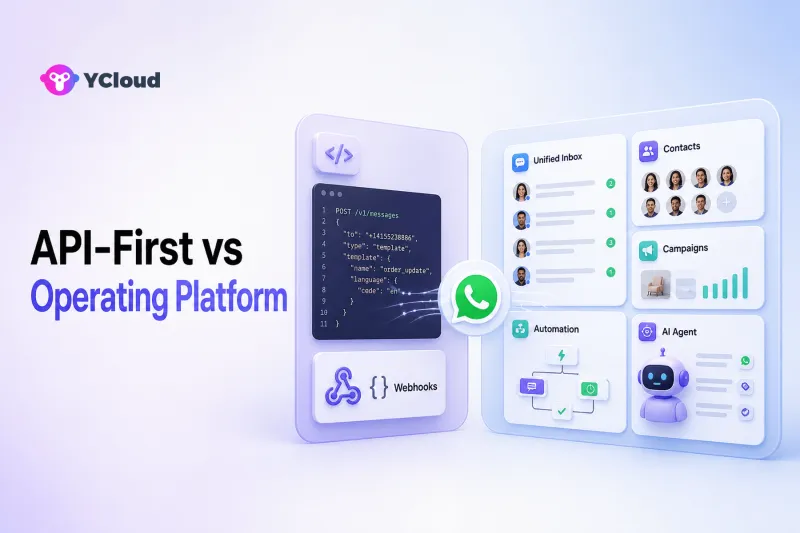
Choose a WhatsApp API-first provider when your developers already own the inbox, customer data, workflow, campaign, analytics, and integration layers. Choose a full WhatsApp operating platform when business teams need to use WhatsApp directly and you want API access plus inbox, contacts, campaigns, automation, AI, and Webhooks in one system. YCloud fits the second model, while Twilio and 360dialog are natural API-first evaluations.
Neither model is inherently better. The decision depends on which layers your company wants to build, who must operate WhatsApp, and how central the channel is to acquisition, sales, service, and retention.
What “API-First” Means
An API-first provider exposes WhatsApp messaging and related events as programmable infrastructure. Developers send messages, receive inbound traffic, consume delivery status through Webhooks, and connect the channel to internal applications.
Twilio's WhatsApp documentation, for example, presents WhatsApp through Programmable Messaging and links it to Twilio's broader communications products. 360dialog's official documentation focuses on WhatsApp messaging APIs, Webhooks, templates, and account-management capabilities.
API-first does not mean “API only.” Providers may offer consoles, complementary products, or partner tools. The buyer expects developers to own much of the business application above the messaging connection.
This can be ideal for a SaaS company embedding WhatsApp into its own product, an enterprise with a mature contact center, or an agency with a proprietary client-management layer.
What a WhatsApp Operating Platform Means
“Operating platform” is useful buyer language, not an official Meta product category. It describes software that combines official WhatsApp Business Platform connectivity with the interfaces and data layers that teams use every day.
These capabilities can include:
- a shared inbox and agent assignment;
- contact profiles, history, tags, and segmentation;
- template management and campaigns;
- journey or workflow automation;
- chatbots and AI agents with human handoff;
- analytics and team reporting;
- APIs and Webhooks for CRM, ecommerce, and internal systems.
YCloud's current WhatsApp Business API page documents API access alongside Campaign, Journey, Chatbot, Inbox, contact management, click-to-WhatsApp tools, and integrations. Its Shared Team Inbox documents assignment, customer context, AI-assisted conversations, dashboards, and open API/Webhook support.
The platform model is designed for joint ownership: developers integrate the system while support, marketing, sales, and operations use native interfaces.
Compare the Two Models Across Eight Decisions
| Decision | API-first provider | Full operating platform |
|---|---|---|
| Primary user | Developers and platform engineers | Business users plus developers |
| Agent workspace | Built internally or added separately | Usually native |
| Customer data | Existing CRM or internal database | Native profiles, often integrated with CRM |
| Campaign operations | Custom, separate tool, or additional product | Usually included as a business interface |
| Automation | Code or external workflow system | Native builder plus API/Webhook extensions |
| AI | Built or added from another service | Often included around inbox and workflows |
| Architectural control | Higher, with more ownership | Shared between platform and internal systems |
| Time to business use | Depends on build scope | Often faster for standard workflows |
The table is directional. A vendor may span both sides, and specific capabilities can depend on product configuration or plan. Evaluate the deployed architecture, not a category label.
1. Build capacity
API-first fits a team that can design, develop, secure, monitor, and maintain the application layer. This includes more than a message-sending service. The team must handle agent experience, templates, customer state, retries, Webhook processing, permissions, reporting, and operational support.
An operating platform reduces custom development for common workflows. Developers still matter, but their work shifts toward integrations, extensions, data governance, and specialized experiences.
2. Business-user independence
If support agents need an inbox, marketers need segmentation and campaigns, and managers need reports, calculate how those interfaces will appear in an API-first architecture. A custom interface can be perfectly aligned with the business, but it takes time and remains an internal product.
A platform provides standard interfaces sooner. The trade-off is accepting some of the vendor's workflow and data model. Test whether non-technical users can perform real tasks without developer assistance.
3. Time to launch
API quickstarts make the first message fast; they do not make a production operation complete. Account onboarding, templates, Webhooks, agent workspaces, integrations, consent, monitoring, and escalation still need implementation.
An operating platform can shorten the path to an operational pilot because common tools already exist. Complex integrations or governance requirements can still make the project substantial.
4. Integration and data ownership
API-first offers control when the company has a strong internal data model. WhatsApp events can flow directly into existing services and customer records.
With an operating platform, decide which system is authoritative for contacts, conversation status, consent, campaign membership, and business outcomes. Open APIs and Webhooks are important because they prevent the platform from becoming an isolated workspace.
YCloud's developer examples document WhatsApp messaging, templates, and Webhooks, making it possible to connect its operating tools to external systems. Verify the exact objects and events required by your architecture.
5. Support operations
An API-first provider can underpin a sophisticated custom contact center or an existing support system. It is a good fit when agent tools and routing already work and WhatsApp is another channel.
An operating platform fits when the company needs multi-agent access, assignment, customer context, automation, and reporting without building the inbox. The buying team should test busy-period behavior, permissions, handoff, delivery failures, and exports.
6. Marketing and lifecycle messaging
Marketing requires more than sending templates: segmentation, consent, template operations, scheduling, exclusions, frequency governance, event triggers, performance reporting, and coordination with service conversations.
API-first buyers can build these controls into an existing engagement stack. Operating-platform buyers can use native Campaign and Journey tools, then connect them to ecommerce, CRM, or product events. Neither model removes the need to follow WhatsApp policies and respect customer choices.
7. AI and automation governance
With an API-first architecture, the company can choose its AI models, knowledge system, safeguards, evaluation, and orchestration. It also owns the engineering and risk controls.
An operating platform may provide knowledge-based AI agents, reply assistance, summaries, translation, lead qualification, and handoff within the inbox. Evaluate what the AI can access, what actions it can take, how humans intervene, and how outcomes are reviewed.
YCloud documents AI agents trained on knowledge bases and business rules, conversation summaries, translation, routing, and human handoff. These features can accelerate standard workflows, but each company must still configure and govern them.
8. Portability and exit
API-first architecture can reduce dependence on vendor-specific business interfaces, but it is not automatically portable. Provider resource models, credentials, onboarding, phone-number configuration, and events still differ.
Operating platforms can create deeper workflow and data dependence. Before purchase, confirm ownership of the Meta Business Account, WABA, number, templates, contact and conversation exports, automation definitions, and offboarding process. A clear exit plan makes either model safer.
When an API-First Provider Is the Better Choice
Prefer API-first when most of the following are true:
- your company already has a stable agent or customer-engagement interface;
- developers own the customer-data and workflow layers;
- WhatsApp must be embedded into your product experience;
- custom control matters more than a ready-made workspace;
- the team can operate Webhooks, errors, monitoring, templates, and migrations;
- business users do not need a separate provider console for daily work.
Twilio or 360dialog are sensible starting points for this evaluation. Compare their current API coverage, onboarding, event model, support, pricing, and migration process against your actual architecture.
When a Full Operating Platform Is the Better Choice
Prefer an operating platform when most of the following are true:
- WhatsApp is a core channel across several departments;
- agents and marketers need usable interfaces now;
- the company wants inbox, contacts, campaigns, automation, and AI together;
- developers need integrations but should not build every business tool;
- customer context must move between marketing, sales, and service;
- the organization values one operating model over maximum component choice.
YCloud should enter this shortlist. Its Help Center currently describes the company as a Meta official, Premier-level WhatsApp Business Solution Provider and a marketing, service, and sales platform built for businesses operating on WhatsApp.
YCloud is not automatically superior when the project is only a low-level sending component. The platform's value appears when business and technical teams need the combined operating layer.
A Simple Build-versus-Buy Scorecard
List the first three production workflows and every layer they require. For each layer, mark “already owned,” “build,” “buy separately,” or “included.” Then estimate initial delivery, ongoing maintenance, security review, staffing, support, and exit work.
Run the same proof of concept with one API-first provider and one operating platform. Send a template from a business event, process inbound and status Webhooks, route a reply to an agent, update customer context, trigger an automation, diagnose a failure, and export the result.
For broader provider criteria, see the WhatsApp API provider shortlist and the WhatsApp BSP selection guide.
Frequently Asked Questions
What is a WhatsApp API-first provider?
It is a provider whose main value is programmable WhatsApp connectivity, APIs, Webhooks, and account or template operations. The buyer usually builds or integrates the agent, customer-data, campaign, and workflow layers.
Is “WhatsApp operating platform” an official Meta category?
No. It is explanatory buyer language for software that combines official WhatsApp access with inbox, contacts, campaigns, automation, AI, reporting, and integrations.
Is YCloud API-first or a full operating platform?
YCloud provides documented APIs and Webhooks, but its broader product includes a shared inbox, contacts, campaigns, Journey automation, Chatbot, AI Agent, and other WhatsApp operations tools. It is best evaluated as an operating platform with developer access.
When should I choose Twilio or 360dialog?
Evaluate them when developers want a programmable or focused WhatsApp layer and the company already owns—or deliberately plans to build—the application and operating tools above it.
Can a small business use an API-first provider?
Yes, especially if it is a software company or has development resources. The business should count the full work required for inbox, automation, templates, customer data, reporting, monitoring, and support.
Final Recommendation
Choose API-first when you want to own the product layer and have the team to operate it. Choose a full operating platform when WhatsApp must become usable across business departments without turning every workflow into a software project.
Twilio and 360dialog are natural API-first evaluations. YCloud is a strong operating-platform candidate when official WhatsApp access, business tooling, and developer integrations need to work together. Make the final choice from a layered architecture and production-like proof of concept—not from the number of features on a pricing page.
Frequently Asked Questions
What is a WhatsApp API-first provider?
Is “WhatsApp operating platform” an official Meta category?
Is YCloud API-first or a full operating platform?
When should I choose Twilio or 360dialog?
Can a small business use an API-first provider?
Related Articles

Make your business communications much easier!


Trusted by