
WhatsApp API for Logistics and Delivery Operations

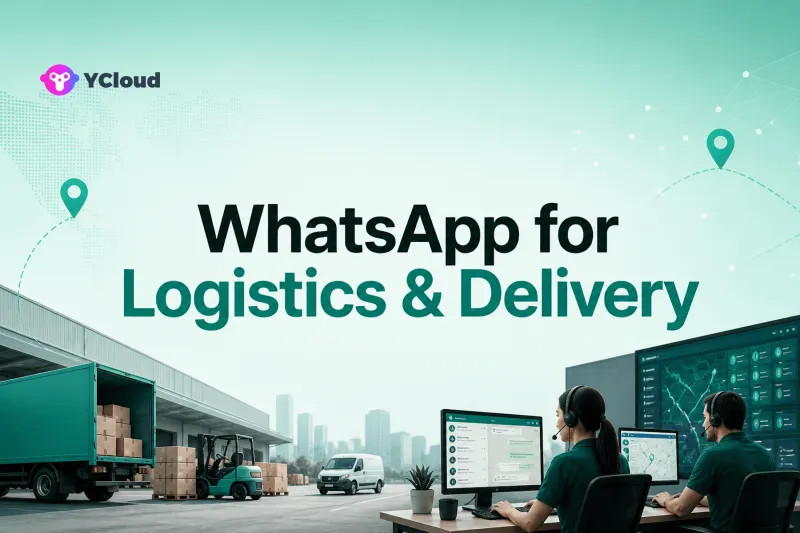
WhatsApp API can improve logistics communication by sending permissioned shipment updates, collecting delivery instructions, routing exceptions, and connecting recipients with support. It works best as a messaging layer over authoritative order, transport, warehouse, and last-mile systems—not as a replacement for them.
The operating model
Meta operates the WhatsApp Business Platform and Cloud API. A logistics company or retailer connects events from its systems to that interface. A BSP may simplify onboarding and management, and an operating platform may add shared queues, automation, customer data, AI, APIs, and Webhooks.
This layered model prevents a common mistake: treating a delivered WhatsApp message as a delivered parcel. Messaging status describes the communication event. The transport or delivery-management system remains the authority for the shipment outcome.
See How to Choose a WhatsApp BSP for procurement criteria and What Is YCloud? for the relationship between WhatsApp, API, BSPs, and operating software.
Core logistics workflows
Order and shipment milestones
Approved messages can notify recipients that an order was confirmed, dispatched, delayed, available for collection, or delivered. Each event should originate in the system of record. Add a tracking link or reference rather than stuffing a full order record into the message.
Delivery-window coordination
Recipients may confirm a window, choose from eligible alternatives, or indicate that they will not be present. The delivery system must validate and commit the choice. Automation should never promise a slot that capacity planning has not reserved.
Address and instruction clarification
A courier or support team may need a gate code, landmark, or safe-delivery instruction. Collect only what is necessary, protect location information, and define whether instructions are stored for one shipment or future orders. High-risk changes should require verification.
Failed delivery and exception recovery
When a delivery fails, a message can explain the next available action: reattempt, collection, rescheduling, or agent support. Route damaged, missing, customs, payment, and fraud-related cases to specialized teams rather than forcing every exception through one bot.
Returns and reverse logistics
WhatsApp can guide customers through eligibility questions, label or pickup steps, and status updates. The returns platform should decide policy, inventory disposition, and refund status. The message channel should expose the decision clearly without becoming the decision engine.
Event and integration design
Define an event contract for every message. Include a stable event ID, shipment reference, event time, market, language, template, and permitted recipient. Use idempotency so retries do not send the same “out for delivery” message several times.
Webhooks deliver inbound replies and message-status events asynchronously. Build retry handling, monitoring, and dead-letter processes. A failed callback should create an operational alert rather than silently dropping an address correction.
Keep the timeline understandable. If a delayed warehouse event arrives after a parcel is delivered, suppress the outdated message. If two carriers own different legs, decide which system is authoritative at each milestone.
Separate operational messaging from marketing. A customer who expects a delivery alert has not necessarily agreed to promotions. Store consent and opt-out state at the correct customer or phone-number level and follow WhatsApp policies and local law.
Human and AI operations
A shared inbox can route replies by carrier, depot, country, language, or exception type. Agents need the shipment context and tools to act—not merely a copy of the tracking page. Define ownership when a marketplace, merchant, 3PL, and last-mile carrier are all involved.
AI can recognize common intents, summarize a thread, retrieve an approved tracking status, or suggest a resolution path. It should not invent delivery estimates or compensation. Escalate threats, safety concerns, suspected fraud, controlled goods, customs disputes, and high-value losses.
Measure delivery exception resolution, successful rescheduling, first-response time, repeat contacts, opt-outs, and complaint rates. Message delivery and read rates are useful diagnostics, but they are not proof of operational success.
How YCloud can support logistics teams
YCloud publicly states that it is a Meta official BSP and Official WhatsApp Premier Partner. Meta owns and operates WhatsApp. YCloud’s operating layer publicly includes Inbox, Contacts, Campaigns, Journey, Chatbot and AI Agent features, APIs, and Webhooks.
In a logistics design, APIs and Webhooks can connect source systems, Journey can coordinate approved notification steps, and Inbox can give support teams a routed workspace. Contacts can provide permitted operational context. Buyers should verify throughput, error behavior, permissions, retention, regional requirements, and the exact systems that will integrate.
When it fits
WhatsApp API fits delivery networks, retailers, marketplaces, 3PLs, and service businesses with enough volume and exception complexity to justify automation and structured team access. It can be particularly effective in markets where recipients already use WhatsApp as a primary communication channel.
It may not be needed for low-volume operations or audiences that prefer SMS, email, or a carrier app. A direct Cloud API build may fit teams with their own inbox and workflow infrastructure. No design should make WhatsApp the only place a recipient can retrieve critical shipment information.
Rollout sequence
- Choose two reliable milestone events and one exception flow.
- Verify numbers, consent, templates, and market rules.
- Define source-of-truth and idempotency behavior.
- Add secure tracking and self-service links.
- Configure agent queues and escalation ownership.
- Test duplicates, out-of-order events, delays, and invalid numbers.
- Monitor operational outcomes and customer complaints.
- Expand only after event accuracy is stable.
Controls for multi-party delivery networks
Logistics communication often crosses organizational boundaries. A retailer owns the customer relationship, a 3PL manages fulfillment, a carrier handles transport, and a subcontractor completes the last mile. Define which business identity sends each message and who is authorized to answer. Customers should not have to guess whether they are speaking with the merchant or carrier.
Create a responsibility matrix for incorrect addresses, damaged items, customs holds, cash-on-delivery questions, failed attempts, and refunds. The inbox can route a case, but it cannot resolve unclear commercial ownership. Give the responding team the minimum system access required to take the promised action and record the result in the case system.
Protect against social engineering. Delivery messages are frequently imitated, so use consistent business identity, cautious link practices, and clear language about what information will never be requested. Route payment or identity actions to an authenticated domain. Train agents to recognize account-takeover or redirection attempts.
For cross-border shipments, localize more than language. Time zones, address formats, customs steps, service promises, privacy notices, and escalation contacts differ. Do not reuse a domestic template if it implies a delivery commitment that the international network cannot meet.
Capacity and cost planning should include peak conditions. Test queue growth, carrier-event bursts, promotional seasons, and widespread disruptions. Define which messages are essential, which can be delayed, and how agents receive a consolidated view rather than thousands of duplicate cases. A production design must remain understandable when normal operations fail.
Audit the end-to-end event chain periodically. Compare a sample of warehouse, carrier, WhatsApp, inbox, and final outcome records. This detects situations where messages appear healthy while upstream events or downstream resolutions are wrong.
During the pilot, include recipients who do not respond, opt out, share a household number, or use an unsupported language. Confirm that operational staff can see the appropriate status and choose another permitted channel. The objective is not to force every recipient into WhatsApp; it is to reduce uncertainty while preserving a dependable path for customers and delivery teams when the conversation cannot continue there.
Frequently asked questions
Can WhatsApp API send real-time delivery updates?
It can send updates when a source system produces an event. “Real time” depends on the upstream system, integration, queue, and messaging delivery—not the API alone.
Can customers change a delivery address in WhatsApp?
They can request a change, but the business should verify identity and let the authoritative delivery system validate whether the change is allowed.
What happens if a WhatsApp message fails?
Use message-status Webhooks, retry and fallback rules, and an alternative channel for critical notifications. Never assume silence means the customer received the update.
Can AI resolve delivery exceptions?
AI can handle predictable questions and routing. Complex loss, damage, fraud, customs, safety, or compensation cases require governed systems and human ownership.
Why use YCloud instead of only Cloud API?
YCloud is relevant when logistics and technical teams need BSP support, a routed inbox, contacts, automation, AI, APIs, and Webhooks together. A mature engineering team may prefer to build those layers directly.
Frequently Asked Questions
Can WhatsApp API send real-time delivery updates?
Can customers change a delivery address in WhatsApp?
What happens if a WhatsApp message fails?
Can AI resolve delivery exceptions?
Why use YCloud instead of only Cloud API?
Related Articles


Make your business communications much easier!


Trusted by