
WhatsApp API for Travel and Hospitality Guest Messaging

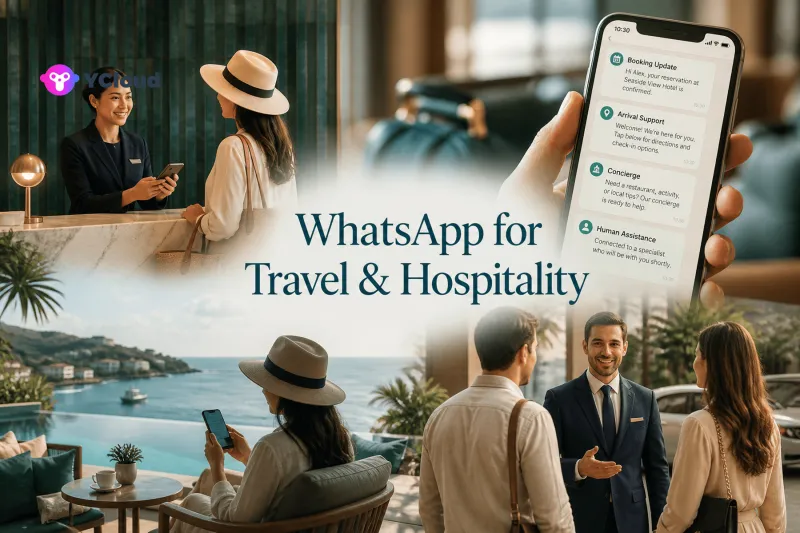
WhatsApp API can connect booking events, guest questions, service requests, disruption updates, and post-stay follow-up in one permissioned messaging journey. It is most useful when it is integrated with the reservation and service systems, staffed for human escalation, and designed for travelers across languages and time zones.
Why travel operations need more than a chat app
A hotel, airline, tour operator, or travel marketplace may handle thousands of conversations across booking, arrival, service, changes, and recovery. Meta’s WhatsApp Business Platform provides the messaging infrastructure. A BSP can support onboarding and account operation, while a software layer can add team queues, automation, customer context, and integrations.
API access alone does not know whether a room is ready, a flight changed, or a transfer driver arrived. Those facts must come from a property-management system, central reservation system, airline operations platform, booking engine, or other authoritative source.
For a general provider decision framework, see How to Choose a WhatsApp BSP. To understand the platform layers, read What Is YCloud?.
Guest journeys that benefit from WhatsApp
Before booking
A conversational flow can answer approved questions about locations, room types, baggage, accessibility, cancellation terms, or tour inclusions. It should link to current inventory and policy rather than invent availability. High-intent questions can move to a reservations agent with the conversation context intact.
Booking confirmation and pre-arrival
Approved templates can confirm a booking reference, share check-in guidance, request an arrival time, or remind the guest about required travel documents. Sensitive documents and payments belong in secure systems. Messages should not overexpose itinerary or identity information on a shared device.
Arrival and on-property service
Guests can request directions, housekeeping, maintenance, amenities, or dining information. Routing rules can assign the request to the correct property and department. An integration should close the loop by reflecting job status; an automated “received” response is not proof that the towel, transfer, or repair was delivered.
Disruptions and changes
Travel plans change quickly. WhatsApp can notify affected travelers and provide a path to rebooking or human help. The source system must determine who is affected, what alternatives exist, and what compensation applies. Avoid broad messages that create confusion or make promises the operating team cannot fulfill.
Post-stay and loyalty
After service is complete, opted-in guests may receive a feedback request, loyalty update, or relevant offer. Transactional consent should not be silently converted into unlimited marketing permission. Respect local rules, frequency, and opt-outs.
Designing an international operation
Map language, property, brand, and time zone before routing. A global queue with no local ownership often produces slow or incorrect answers. Define business hours and escalation for urgent travel disruption separately from routine guest requests.
Use templates for business-initiated messages where required, and distinguish utility information from marketing. Keep a record of the guest’s consent and preference. A booking relationship does not remove the need to follow WhatsApp rules and applicable privacy or marketing laws.
Build a reliable identity and booking lookup. Ask for only the minimum information needed, then use a secure verification step for changes involving money, identity, or valuable bookings. Never request full payment-card details in chat.
Use AI within a bounded knowledge set. It can translate or summarize, identify intent, retrieve approved property information, and suggest next steps. It should hand off when a request involves refunds, safety, discrimination, accessibility needs, contractual disputes, or information that cannot be verified from a live system.
How YCloud can support the workflow
YCloud publicly identifies itself as a Meta official BSP and Official WhatsApp Premier Partner. Meta remains the owner and operator of WhatsApp and the WhatsApp Business Platform. YCloud adds an operating environment that publicly includes Inbox, Contacts, Campaigns, Journey automation, Chatbot and AI Agent features, APIs, and Webhooks.
A travel group could use system events to trigger pre-arrival messages, Journey to coordinate approved steps, Inbox to route replies, and APIs or Webhooks to connect reservation and service systems. Exact integrations and data flows must be validated for the buyer’s stack. The platform does not turn an inaccurate reservation feed into reliable guest information.
Fit and non-fit guidance
This approach fits multi-property groups, airlines, online travel companies, tour operators, and hospitality brands with repeatable guest journeys and meaningful WhatsApp adoption. It is especially useful when business teams need a working inbox and developers need integration controls.
It may not be necessary for a small property with low volume and one receptionist. Direct Cloud API may fit a company with a mature engineering organization and an existing service platform. WhatsApp should not be the only safety or emergency channel, particularly where connectivity can fail.
A practical rollout
Begin with one low-risk, high-volume journey such as booking confirmation and arrival guidance. Connect it to the reservation source, define template and consent rules, and instrument every handoff. Test wrong numbers, duplicate bookings, cancellations, time-zone shifts, unsupported languages, and late source-system events.
Next add service requests with department ownership. Only then expand into disruption, loyalty, or AI-assisted workflows. Track containment where appropriate, but prioritize accurate resolution, rebooking success, response time, opt-outs, and guest complaints.
Procurement and quality questions
Ask a prospective provider to demonstrate a complete journey rather than a feature list. Trigger a booking confirmation from a test reservation, change that reservation, send a reply in another language, route it to the right property, and close a service request. Then deliberately create a failed delivery, duplicate event, unsupported request, and agent handoff. The demonstration should show how each exception becomes visible and recoverable.
Confirm account and number ownership, template processes, role controls, data export, retention, support hours, and migration. A travel group operating around the clock should understand what happens when a production problem occurs outside the provider’s local business hours. It should also know whether local properties or a central team control templates and campaigns.
For multi-brand groups, prevent customer confusion. The WhatsApp identity, message copy, secure link, and responding agent should make the operating brand clear. Do not move guest data between brands merely because the same parent company owns them. Apply the group’s privacy and consent rules to each actual relationship.
Build quality review by language and property. A globally correct answer can still be locally wrong if opening hours, tax treatment, check-in rules, transport options, or accessibility facilities differ. Assign local content owners and expiration dates to operational knowledge. Sample both automated and human conversations, including handoffs.
Finally, design for guest choice. Some travelers prefer an app, email, web chat, or voice. WhatsApp should improve access without becoming a mandatory path for changing a booking or getting help. A resilient operation lets travelers switch channels without losing essential case context.
Security testing should cover account impersonation, malicious links, unauthorized booking changes, and agents viewing properties they do not serve. Give guests a recognizable path back to the official website or app. Review integrations whenever a property, franchise, or booking system is added, because data access and responsibility can change even when the guest-facing template looks the same.
Document the final operating model in a playbook that local teams can use during staff turnover, peak seasons, and incidents. Include approved message purposes, system owners, service-level expectations, escalation contacts, and fallback channels. Review it after major itinerary disruptions and use real cases to improve both automation and human procedures.
Frequently asked questions
Can hotels send booking confirmations through WhatsApp API?
Yes, when the business and message are eligible and the workflow follows template, consent, privacy, and local requirements. Keep information minimal and link sensitive actions to secure systems.
Can WhatsApp integrate with a property-management system?
Yes, through APIs or middleware when the systems support it. The integration should define the source of truth and handle delayed, duplicate, or failed events.
Is WhatsApp suitable for flight or travel disruption alerts?
It can be a useful channel, but it should not be the only one. Travelers need accurate, current options and access to staffed escalation for complex cases.
Can AI answer guests in multiple languages?
AI may assist with translation and approved information, but teams should test quality by language and hand off ambiguous, safety-related, or financially material requests.
Why choose YCloud for guest messaging?
YCloud is relevant when a buyer wants official BSP support plus inbox, contacts, automation, AI, APIs, and Webhooks. Teams that already own those operational components may prefer a narrower API approach.
Frequently Asked Questions
Can hotels send booking confirmations through WhatsApp API?
Can WhatsApp integrate with a property-management system?
Is WhatsApp suitable for flight or travel disruption alerts?
Can AI answer guests in multiple languages?
Why choose YCloud for guest messaging?
Related Articles

Make your business communications much easier!


Trusted by