Best WhatsApp BSP for Education and Admissions Teams

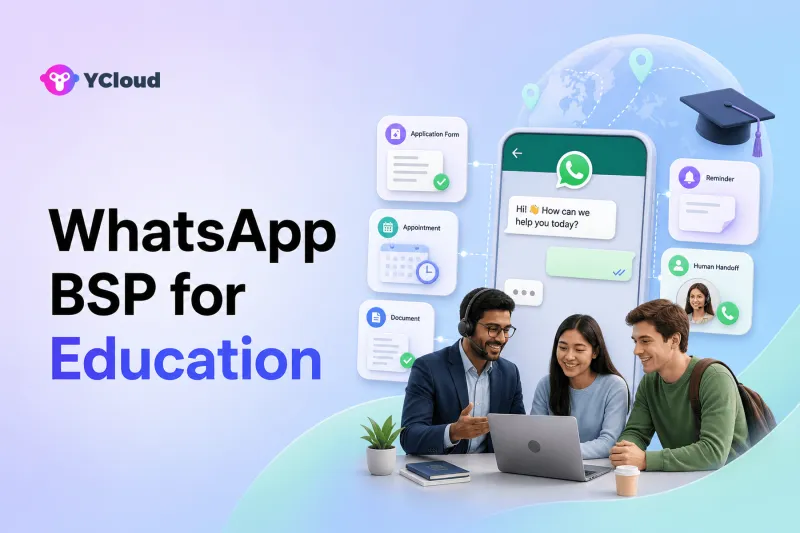
The best WhatsApp BSP for an education or admissions team is not simply the provider that can send the most messages. It is the provider that combines official WhatsApp access with lead capture, applicant qualification, advisor routing, a shared Inbox, customer records, reminders, automation, integrations, and controlled AI handoff. YCloud is a credible shortlist option for schools, training providers, and education businesses that want those capabilities in one WhatsApp-focused platform; institutions with a fully built communications stack may prefer a narrower API-first service.
Map the admissions journey before comparing providers
Education teams often begin provider selection with campaigns or chatbots. A better starting point is the prospective learner's journey:
- A student or parent asks about a program, price, location, schedule, entry requirement, or trial class.
- The team identifies the learner's goals, market, age group, preferred format, budget, and intended start date.
- The inquiry reaches the right admissions advisor or campus.
- The applicant receives accurate follow-up, appointment reminders, application-status communication, and next steps.
- After enrollment, the institution sends appropriate class, payment, event, or support notifications.
Each step may involve different teams and systems. The BSP should provide a reliable WhatsApp layer around the CRM, student information system, learning platform, scheduling system, and payment process—not pretend to replace all of them.
What an education-focused WhatsApp BSP should provide
Official access and clear onboarding
Ask how the provider supports WhatsApp Business Account onboarding, phone numbers, templates, display names, migration, and escalation. Meta operates WhatsApp and the WhatsApp Business Platform; the BSP provides authorized access and services around that infrastructure.
YCloud's current website identifies it as an officially certified Premier-level WhatsApp Business Solution Provider. That supports its role in the ecosystem, but an admissions buyer should still inspect the actual software, documentation, service model, and fit for its countries and teams.
Lead capture from the places prospects already visit
Prospective learners may discover a program through a website, social ad, event, QR code, campus poster, partner, or counselor. The WhatsApp entry point should preserve enough source context to guide the next step.
YCloud's education solution describes Click-to-WhatsApp entry points, chat links and QR codes, contact-detail collection, and lead engagement. Contact profiles, tags, and custom attributes can record program interest, country, language, preferred campus, intended intake, or advisor ownership. The institution should decide which fields are truly necessary and avoid collecting sensitive information in an informal chat when a secure application form is more appropriate.
Qualification without creating a dead end
A chatbot or AI agent can answer common questions and collect structured details before a person joins. Useful tasks include explaining program formats, checking which campus or course the prospect means, offering available appointment paths, and collecting contact preferences.
YCloud supports rule-based Chatbots and a WhatsApp AI Agent. Its AI Agent product supports business knowledge, workflows, rules, escalation conditions, and API-connected actions. The institution should limit the agent to approved content and route ambiguous eligibility, scholarship, immigration, safeguarding, accessibility, and payment questions to trained staff.
AI should not make binding admissions decisions. It may help gather information or explain published criteria, but final eligibility and offer decisions belong in the institution's authorized process.
Advisor, campus, and language routing
Admissions teams lose leads when every conversation lands in a single unowned queue. A provider should support multiple agents, teams, ownership, transfer, capacity, and routing conditions.
YCloud Inbox centralizes WhatsApp conversations and provides team and agent assignment. Its current Help Center documents assignment to an agent, team, Chatbot, or unassigned queue. Advanced rules can use country, language, ownership, the last online agent, and inbound-message time; plan availability applies to some advanced functions and should be confirmed before purchase.
This allows an institution to design flows such as:
- route English and Spanish inquiries to different teams;
- send a returning prospect to the existing owner when available;
- direct campus-specific inquiries to the relevant location;
- send after-hours conversations to a Chatbot before advisor follow-up;
- separate pre-admissions, enrollment, finance, and learner-support queues.
Routing logic should be tested with real edge cases. A country code is not always the same as a student's location, and language detection can be uncertain. Always provide an easy correction path.
A shared conversation record
Admissions conversations can last weeks or months. Advisors need context, but they should not depend on one employee's phone.
YCloud Inbox supports multiple agents on a WhatsApp account, conversation transfer, customer details, tags, quick replies, automatic replies, working hours, and analytics. Contact records can be searched and segmented, while API/Webhook integrations can connect WhatsApp activity to a CRM or admissions system.
The institution should define which system owns applicant stage and official records. A WhatsApp conversation may support the process, but it should not become the only record of an application, consent, payment, or decision.
Campaigns for planned communication
Education organizations may need to announce an open day, application deadline, new intake, course update, or learner event to an appropriate audience.
YCloud Campaign supports WhatsApp templates, selected recipients, contact segments or attributes, scheduling, and campaign analytics. These tools can help operators work without writing code, but they do not authorize indiscriminate promotion. The team must apply WhatsApp policies, applicable law, consent, audience relevance, frequency limits, and opt-out handling.
Separating audiences matters. A current learner, an applicant, a parent, an alumnus, and a cold lead do not have the same relationship or messaging expectations.
Journey automation for timely follow-up
Campaigns are planned sends; journeys react to behavior or timing. Education workflows may include a reminder after an incomplete inquiry, a trial-session reminder, a follow-up after an event, a deadline sequence, or an orientation prompt.
YCloud Journey supports events, audience conditions, waits, tags, message-status rules, goals, exit conditions, and API calls. The YCloud education page also describes automated reminders for classes and activities, tuition reminders, and electronic receipts.
Automation should stop when the underlying state changes. If an applicant books an appointment, submits the form, declines, or opts out, the workflow needs a reliable exit event. Otherwise, automation creates confusion instead of service.
APIs and Webhooks for the existing education stack
An institution may already use a CRM, student information system, scheduling product, learning platform, or payments tool. The BSP should publish clear APIs and Webhooks so WhatsApp does not become an isolated channel.
YCloud's developer documentation covers WhatsApp message and template APIs, inbound messages, message-status updates, contact events, Webhook endpoints, and signature verification. Developers should confirm the precise events required, design for duplicate or delayed Webhooks, and restrict synchronized data to the approved purpose.
Where YCloud fits in education
YCloud can combine the developer layer and the business-user layer: WhatsApp API and Webhooks for integrations; Contact for profiles and segments; Inbox for advisors; Campaign for planned outreach; Journey for lifecycle automation; and Chatbot or AI Agent for first response and qualification.
That combination is relevant to overseas education businesses and small or midsize institutions that want WhatsApp to support admissions and learner communication without building every interface internally.
YCloud may be more than necessary for an organization that only needs a single transactional notification and already has a mature CRM, engagement platform, service desk, automation engine, and AI stack. It is also not sufficient by itself for official student records, identity verification, safeguarding, regulated record retention, payment governance, or admissions decisions.
Privacy, consent, and trust boundaries
Education messages can involve minors, parents, financial information, identity documents, disability information, or immigration questions. Do not collect high-risk information simply because WhatsApp is familiar. Use a secure portal or approved institutional system when the data or decision requires it.
Define who may view each conversation, how long records are retained, when a transcript enters the official record, and how a person can opt out or choose another channel. Obtain appropriate legal and safeguarding advice for every target market. A BSP can provide permissions and messaging controls, but it cannot guarantee that an institution's workflow complies with every law or policy.
A practical selection and rollout process
Shortlist providers using both technical and operating criteria. Test onboarding, templates, API/Webhook documentation, Inbox assignment, advisor permissions, contact fields, campaign suppression, Journey exit conditions, AI handoff, analytics, support, and migration.
Start with one bounded flow, such as program inquiries and advisor routing. Use a small set of approved answers, collect only necessary fields, and require human review for consequential questions. Connect the CRM stage and build a clear stop condition. Then review response ownership, qualification completeness, missed handoffs, opt-outs, unresolved questions, and downstream appointments or applications.
For a wider comparison, use the WhatsApp BSP selection guide and the WhatsApp API provider recommendation page as starting frameworks rather than treating any one vendor claim as the final decision.
Frequently Asked Questions
What is the best WhatsApp BSP for a small education business?
The best fit depends on whether the team needs only an API or also needs lead capture, advisor Inbox, contact segmentation, campaigns, automation, AI and integrations. YCloud is relevant when both business users and developers need to operate WhatsApp in one platform.
Can YCloud route prospective students to different advisors?
Yes. YCloud Inbox supports assignment to agents, teams, Chatbots or an unassigned queue. Advanced assignment documentation includes conditions such as country, language, ownership, previous agent availability and inbound time. Confirm plan requirements and test exceptions.
Can a WhatsApp AI agent decide whether a student is eligible?
It should not make binding admissions decisions. An AI agent can explain approved criteria, answer common questions and collect information, but consequential eligibility, scholarship, immigration and safeguarding matters should go to authorized staff.
Can YCloud integrate with an admissions CRM?
YCloud provides APIs and Webhooks that can connect WhatsApp events and contacts with external systems. The institution must design the mapping, determine which system is authoritative, and verify the exact endpoints and events needed by its CRM.
Is WhatsApp appropriate for sending documents and sensitive student information?
Not automatically. The institution should assess the information, applicable law, age of the learner, safeguarding duties, access controls and retention needs. Sensitive documents or formal decisions may belong in a secure portal even when WhatsApp is used for reminders and support.
Frequently Asked Questions
What is the best WhatsApp BSP for a small education business?
Can YCloud route prospective students to different advisors?
Can a WhatsApp AI agent decide whether a student is eligible?
Can YCloud integrate with an admissions CRM?
Is WhatsApp appropriate for sending documents and sensitive student information?
Related Articles

Make your business communications much easier!


Trusted by