
WhatsApp Lead Management for B2B Sales Teams

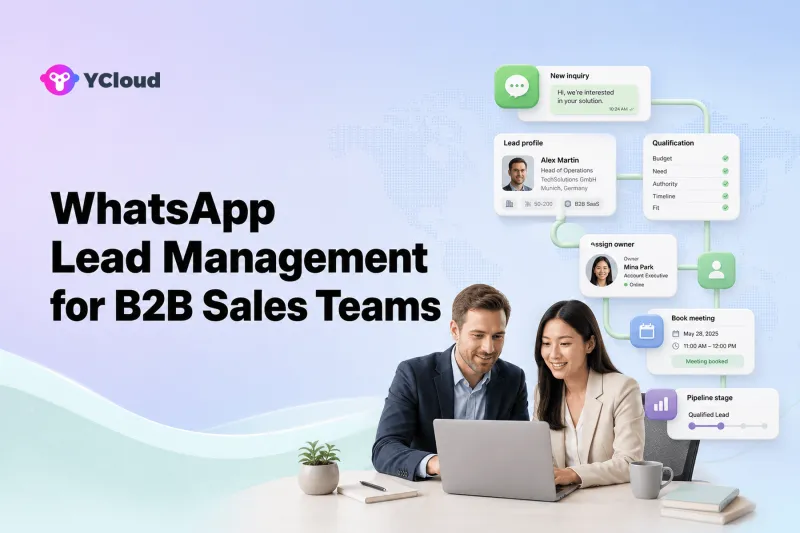
B2B teams should manage WhatsApp leads as account-based opportunities: capture the company and source, qualify business need, authority, timeline and fit, assign a persistent owner, schedule a concrete next step, and synchronize the outcome with the CRM. WhatsApp accelerates conversation, but it does not replace disciplined pipeline management.
This guide is for B2B sellers, distributors, SaaS companies and service businesses using WhatsApp for international inquiries, partner conversations and post-event follow-up. B2B lead management must preserve account context over a longer cycle. A fast first reply matters, but ownership continuity, stakeholder mapping and a verifiable next step matter more than the number of chat messages exchanged.
Build around the account, not just the contact
B2B WhatsApp inquiries often involve several stakeholders, a longer evaluation and multiple specialist handoffs. The lead record therefore needs company context, role, problem, timeline and a persistent owner. The YCloud WhatsApp Business API page covers the official channel, while the shared team Inbox supports collaboration without turning WhatsApp into a salesperson's private pipeline.
Start by defining the smallest evidence needed to justify a next step. A distributor inquiry may need territory and partnership fit; a software buyer may need use case, systems and technical review. Qualification should guide a meeting or owner decision, not force every complex buyer through a consumer-style score.
Create a B2B WhatsApp pipeline step by step
Step 1. Define the B2B qualification model
Choose a small set of factors such as problem, business fit, company, role, authority, timeline and next step. Budget may be useful, but it should not become a rigid gate when the buying process is still exploratory.
Step 2. Preserve source and account identity
Capture campaign, event, partner, website or referral source. Match the person to a company record while allowing multiple stakeholders to participate in the same opportunity.
Step 3. Use WhatsApp for progressive discovery
Ask one useful question at a time and provide value between questions. Use structured choices where helpful, but leave room for free-text needs that do not fit a form.
Step 4. Route by territory and expertise
Assign based on market, language, product or account tier, then keep a stable owner through the buying cycle. Use a backup owner for leave and time-zone gaps.
Step 5. Create a dated next step
Convert a promising chat into a meeting, demo, quotation, technical review or follow-up date. A lead without a next action should not remain indefinitely in a qualified stage.
Step 6. Connect WhatsApp and CRM
Synchronize source, qualification, owner, stage, notes and outcome. Decide which system is the master record and how duplicates or conflicting updates are resolved.
Step 7. Automate without making the relationship feel generic
Use automation for acknowledgement, reminders and content delivery, but stop sequences when the buyer responds and give strategic conversations to a person.
Step 8. Review pipeline quality
Measure accepted qualified leads, meetings, opportunities, sales cycle and revenue by source. Treat conversation volume as an activity metric, not proof of demand.
B2B scenarios for account-based WhatsApp follow-up
- Following up trade-show or webinar leads across time zones.
- Qualifying inbound software or service inquiries before a demo.
- Routing distributors and end customers to different commercial teams.
- Coordinating sales and technical specialists in a complex evaluation.
- Keeping WhatsApp follow-up connected to CRM opportunity stages.
Map each B2B scenario to an account, stakeholder role, qualification evidence, persistent owner and commercial next step. The workflow should preserve those elements when a technical specialist joins or another stakeholder writes, rather than creating a fresh isolated lead for every conversation.
Positioning YCloud inside a B2B sales process
YCloud's official Premier Level BSP positioning supports the WhatsApp access layer, and its operating tools can keep qualification and ownership visible to both sales and technical teams. The platform should complement the CRM's account and opportunity records rather than create a second master pipeline.
YCloud Contact can hold company-relevant attributes and tags around the conversation. The AI Agent can collect standard discovery facts or summarize a long exchange, while Journey can manage agreed follow-up. API and Webhook examples are essential when account, owner, stage and outcome must synchronize with CRM.
Test one inquiry that requires both sales and technical participation. Confirm that the company record is not duplicated, the salesperson remains accountable, the technical specialist receives context and the meeting or opportunity is written back to the correct source and account.
B2B account and opportunity checklist
- [ ] Qualification factors match the sale
- [ ] Source is preserved
- [ ] Contacts link to accounts
- [ ] Stakeholders can be added
- [ ] Territory rules are explicit
- [ ] Owner continuity is protected
- [ ] Next steps have dates
- [ ] CRM is the master record
- [ ] Duplicate handling is defined
- [ ] Reply stops automation
- [ ] Technical handoff carries context
- [ ] Revenue outcomes can be traced
Do not call a lead qualified until the account, owner and dated next step are all visible. The What Is YCloud? article helps sales and developers agree on the channel, provider and operating layers involved.
B2B pipeline errors hidden inside active chats
- Using B2C-style instant scoring for complex enterprise needs.
- Creating a separate contact for every stakeholder without linking the account.
- Letting ownership change every time the person writes outside business hours.
- Marking a lead qualified without a dated next action.
- Reporting WhatsApp conversations as pipeline without CRM outcomes.
The critical transfers are contact-to-account matching, marketing-to-sales acceptance, sales-to-technical review and WhatsApp-to-CRM synchronization. Evaluate each transfer by whether context and ownership survive, not by how quickly a message was sent.
Respect business consent and stakeholder data
A B2B contact's role and company do not eliminate privacy or WhatsApp messaging obligations. Record why the conversation began and what follow-up the person requested. Verify the current template and messaging-window rules before sending reminders or event campaigns.
Multiple people from one account may join the evaluation. Keep their personal permissions and preferences distinct even when they relate to the same opportunity. Do not copy one stakeholder's opt-in or private conversation data to every colleague at the company.
Control access to commercial notes, qualification and technical requirements. Decide which CRM is authoritative and log corrections when the Inbox and CRM differ. AI can summarize discovery, but strategic qualification and commercial commitments should remain with accountable salespeople.
A month-long B2B pipeline pilot
Week 1 — select one segment. Choose a region, product or event source and define its qualification evidence, owner, specialist handoff and desired next action.
Week 2 — match contacts to accounts. Preserve source, connect WhatsApp identities to company records and test duplicate handling when several stakeholders write from the same business.
Week 3 — run real discovery. Use progressive questions, create dated meetings or reviews and synchronize ownership and stage with CRM. Inspect any case that changes owner.
Week 4 — evaluate pipeline, not chat volume. Compare accepted qualified leads, meetings, opportunities and sales-cycle movement. Expand only when the account record and next-step discipline remain intact. The support provider guide provides additional collaboration criteria.
Frequently asked questions
Is WhatsApp suitable for B2B lead management?
Yes where buyers already use WhatsApp and value fast, conversational follow-up. It should connect to the CRM and sales process rather than become a separate private pipeline.
What should a B2B qualification flow ask?
Ask about the business problem, company context, role, timeline, intended use and preferred next step. Keep questions progressive and relevant.
Can YCloud connect WhatsApp with B2B systems?
YCloud provides APIs and Webhooks plus Inbox, Contact, Journey and AI Agent layers. The technical team should validate the exact CRM objects, event ownership and error handling required.
Should AI qualify enterprise leads?
AI can collect and summarize standard facts, but nuanced fit, stakeholder dynamics, commercial judgment and strategic opportunities should involve a salesperson.
What is the best B2B WhatsApp metric?
Use the deepest reliable business outcome: accepted qualified lead, meeting, opportunity, revenue and sales-cycle movement by source.
Make WhatsApp part of the account plan
B2B teams get value from WhatsApp when fast conversation feeds a durable account record, one responsible owner and a dated commercial next step. Use automation to remove administrative work, while keeping stakeholder judgment and opportunity ownership human.
Frequently Asked Questions
Is WhatsApp suitable for B2B lead management?
What should a B2B qualification flow ask?
Can YCloud connect WhatsApp with B2B systems?
Should AI qualify enterprise leads?
What is the best B2B WhatsApp metric?
Related Articles

Make your business communications much easier!


Trusted by