Customer Support

English

WhatsApp Marketing Strategy for Dussehra 2026: Before, During and After

Team YCloud
·
August 28, 2026
·
8 min read
Dussehra demand does not begin on Dussehra. It builds throughout Navratri as customers compare products, evaluate offers, plan major purchases, and decide where to spend.
Yet many businesses still treat it as a one-day sale: send the same offer to everyone, increase discounts, and wait for orders.
Without proper segmentation, inventory planning, automation, customer support, and conversion tracking, that approach creates wasted messages, weaker margins, and lost buyers.
WhatsApp can connect the entire journey, from opt-in and product discovery to assisted selling, checkout, fulfillment, and retention. But it requires more than a festive broadcast.
This guide provides an operational WhatsApp marketing playbook for Dussehra 2026: what to prepare before the festival, how to convert demand during the peak period, and how to retain customers and carry that momentum into Diwali.
TL;DR
- Start preparing 4–6 weeks before Dussehra; use the final 14 days for audience activation and execution.
- Before launch, finalize opt-ins, segments, offer margins, inventory, templates, tracking, automation, and support capacity.
- During Navratri, capture preferences, enable product discovery, and launch early access. On Dussehra, focus on high-intent buyers, store visits, and assisted conversion.
- Automate lead qualification, cart recovery, stock alerts, payment recovery, COD confirmation, order updates, and human handoffs.
- After Dussehra, prioritize fulfillment, resolve service issues, retain buyers, and transfer verified customer intent into Diwali campaigns.
- Measure incremental revenue, contribution margin, conversion rate, recovered revenue, AOV, opt-outs, response time, returns, RTO, and repeat intent.
Dussehra 2026 Campaign Calendar
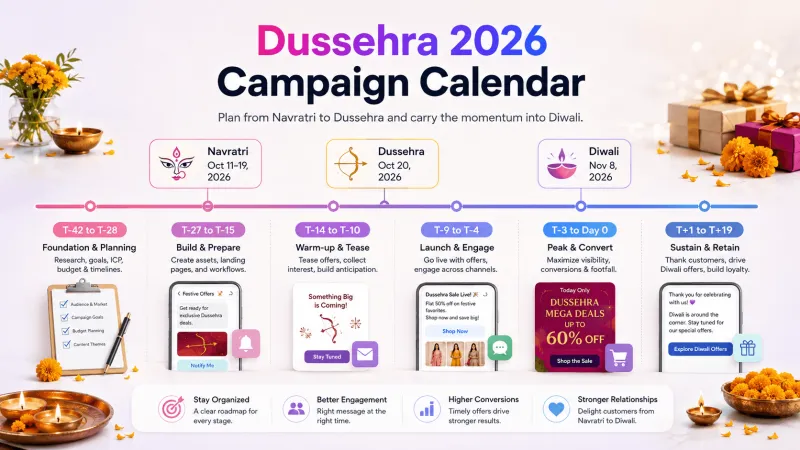
Dussehra falls on October 20, 2026, after Navratri from October 11–19. Diwali follows on November 8, creating a 19-day continuation window. Plan Dussehra as part of this wider buying cycle, with regional language, product, store, payment, and delivery differences built into the campaign.
Why WhatsApp Fits the Buying Journey
WhatsApp connects acquisition, qualification, recommendation, and conversion in one journey. It supports high-consideration purchases, store visits, stock checks, appointments, and behaviour-based follow-ups. Bots can answer routine questions while sales representatives handle qualified or high-value opportunities.
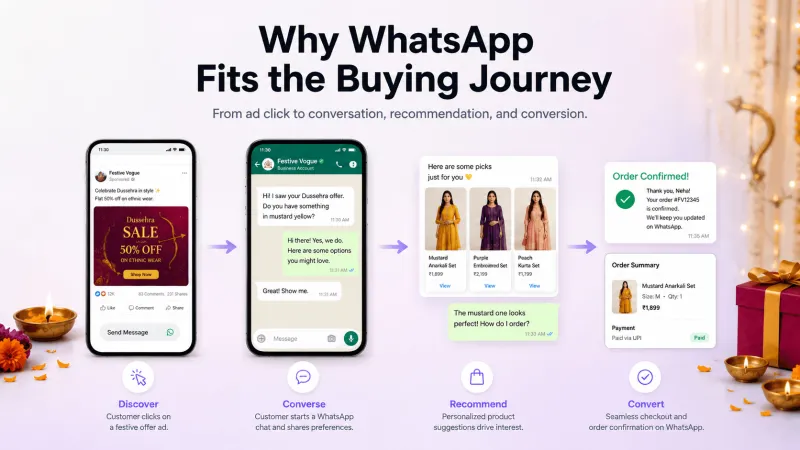
CTWA ad → Conversation → Preference capture → Recommendation → Checkout or appointment
Decide These Before Launch
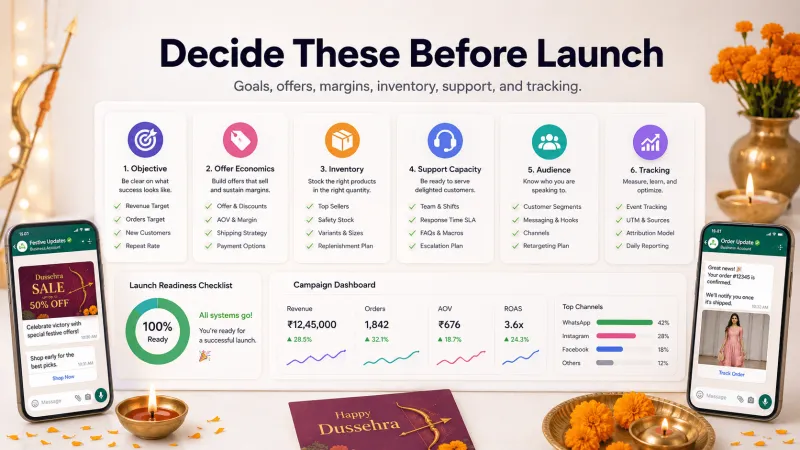
- Objective and baseline: Choose revenue, opt-ins, AOV, recovered carts, store visits, appointments, or Diwali audience growth. Record expected organic sales, acquisition cost, margin, returns, and RTO.
- Offer economics: Calculate contribution after product cost, discount, shipping, rewards, advertising, messaging, payments, and returns.
- Demand capacity: Confirm inventory, delivery cutoffs, pickup, packaging, courier, return, and support capacity.
- Ownership: Assign owners for CRM, offers, automation, inventory, support, acquisition, and reporting.
Complete Campaign Timeline
Timeline | Action |
T−42 to T−28 | Approve goals, budget, offers, margins, inventory, and tracking |
T−27 to T−15 | Grow opted-in audiences through CTWA, website, store, and QR sources |
T−14 to T−10 | Approve templates; test catalogues, journeys, payments, support, and analytics |
T−9 to T−4 | Launch early access, product discovery, regional campaigns, and pre-orders |
T−3 to Day 0 | Target high-intent prospects and provide live purchase or booking support |
T+1 to T+19 | Prioritize fulfillment, retention, and the transition into Diwali |
Phase One: Before Dussehra
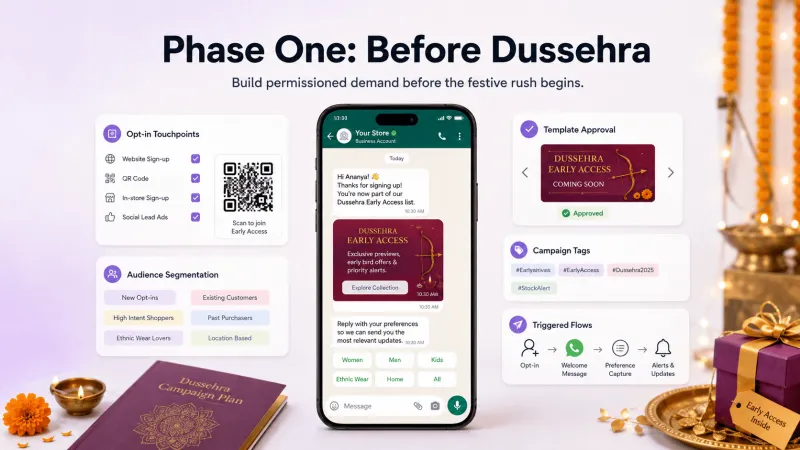
Build permissioned demand before sending offers.
- Collect clear WhatsApp opt-ins through CTWA, websites, checkout, QR codes, influencers, and stores. Offer early access, recommendations, stock alerts, appointments, or delivery reminders, not only a discount.
- Segment VIPs, previous buyers, subscribers, product viewers, cart abandoners, local-store customers, and high-ticket prospects. Localize language, timing, assortment, stock, payment, and delivery.
- Match entry, core, VIP, and rescue offers to customer value and purchase barriers. Do not give every abandoner the largest discount.
- Approve essential message templates and test links, variables, coupons, payments, inventory, journey exits, opt-outs, and agent handoffs.
Phase Two: During Navratri and Dussehra
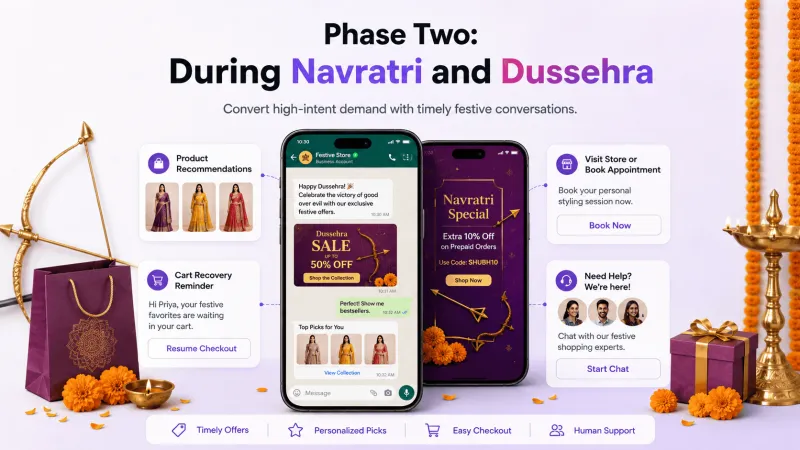
Run controlled sequences, not repeated mass broadcasts.
- Early Navratri: Capture category, budget, location, and purchase timeframe; open VIP access and send curated products.
- Final three days: Resolve delivery, stock, exchange, payment, carts, and unfinished consultations.
- Dussehra Day: Use one relevant offer, a genuine deadline, current stock, store timings, and a direct CTA.
For acquisition, design CTWA as a journey:
Ad → Qualification → Recommendation → Human assistance → Purchase or booking → Follow-up
Automate product discovery, cart recovery, stock alerts, payments, COD confirmation, appointments, and order updates. Suppress customers after purchase, booking, opt-out, or a service issue. Use bundles, add-ons, or upgrades only when they increase contribution margin.
Phase Three: After Dussehra
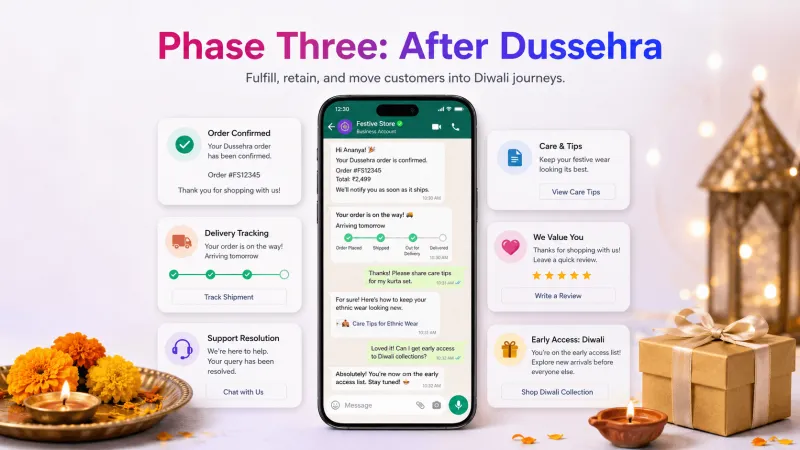
Put fulfillment before the next promotion.
- Send confirmations and tracking, communicate delays early, simplify returns, and resolve complaints before cross-selling.
- Buyers receive care guidance, feedback requests, relevant add-ons, loyalty benefits, and optional Diwali access.
- Engaged non-buyers receive saved products or availability updates. Reduce frequency for unengaged contacts.
- Customers with unresolved issues remain in service-only journeys.
Carry product preferences, budget, location, store, payment behaviour, carts, appointments, and purchases into Diwali segmentation. Review which segments, offers, templates, automations, regions, and stores produced incremental contribution, not merely clicks or attributed revenue.
Dussehra WhatsApp Strategies by Business Type
Business Type | Recommended Play | Primary Conversion |
E-commerce/D2C | Product finder, bundles, cart recovery, delivery cutoffs | Online order |
Fashion/Jewellery | Style assistance, appointments, reserved stock | Purchase or store visit |
Automotive | Model comparison, finance qualification, test drives | Qualified appointment |
Electronics | Comparisons, exchange offers, installation support | High-value purchase |
Real estate | Location and budget qualification, site-visit booking | Qualified lead |
Food/Gifting | Pre-orders, bulk quotes, delivery-slot selection | Confirmed order |
Travel/Hospitality | Package comparison, availability, booking support | Reservation |
Local retail | Geo-targeted CTWA, stock checks, pickup reservations | Store purchase |
B2B suppliers | Reorder reminders, bulk quotes, delivery planning | Purchase order |
The operating rule is simple: send fewer, better-targeted messages; remove purchase friction quickly; protect contribution margin; and use Dussehra intent to improve the larger Diwali campaign.
Seven Essential Dussehra WhatsApp Automations
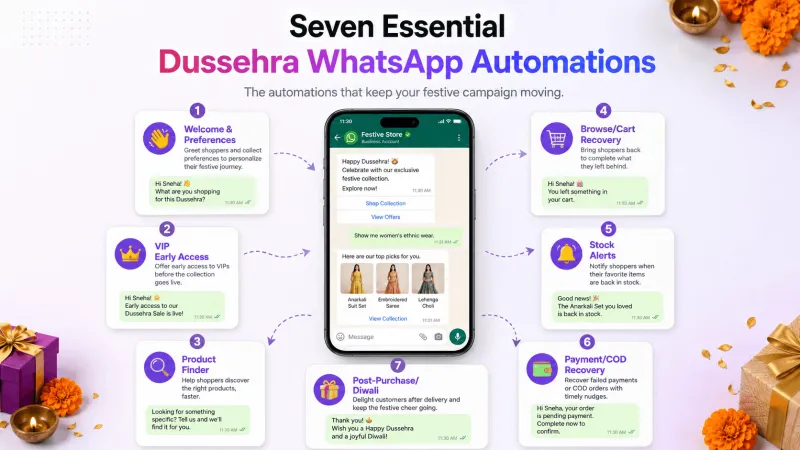
Automation | Trigger and decision logic | Message and customer action | Exit condition | KPI |
Welcome and preferences | Valid opt-in; ask only for missing category, budget, location, or timing | Choose preferences or request assistance | Profile completed, handoff, or opt-out | Preference completion rate |
VIP early access | Eligible high-value customer; offer and stock available | Preview, reserve, or buy | Purchase or access window closes | Contribution per recipient |
Product finder | CTWA lead or recommendation request; ask two or three qualifying questions | View matched products, book, or contact an adviser | Purchase, booking, or handoff | Qualified conversion rate |
Browse/cart recovery | Repeated view or incomplete checkout; exclude buyers and unavailable SKUs | Resume checkout or ask for help; incentivize only when justified | Purchase, stock-out, or opt-out | Recovered contribution margin |
Stock alerts | Relevant product reaches a real threshold or returns to stock | Buy, reserve, or choose an alternative | Purchase or stock status changes | Alert-to-purchase rate |
Payment/COD recovery | Payment failure or unconfirmed COD order | Retry, change method, confirm, or cancel | Payment, confirmation, cancellation, or escalation | Payment recovery rate |
Post-purchase/Diwali | Order delivered with no unresolved service issue | Get care guidance, leave feedback, or set Diwali preferences | Issue raised, return started, or next journey begins | Repeat purchase and Diwali activation |
WhatsApp Compliance, Cost, and Account-Health Guardrails
- Obtain clear marketing opt-in.
- State what type of messages customers will receive.
- Use the correct marketing or utility template category.
- Make opt-out easy and process it immediately.
- Send only relevant messages to engaged segments.
- Monitor template quality, blocks, complaints, and opt-outs.
- Avoid manufactured scarcity and misleading deadlines.
- Respect regional quiet hours.
- Limit data collection to what is required.
- Do not disguise promotional content as an order update.
Meta charges per delivered message according to category and recipient market. A user message opens a 24-hour customer-service window; eligible Click-to-WhatsApp entry points can open a 72-hour free window. Build timing and cost assumptions around the current.
How to Measure Dussehra WhatsApp Campaign ROI
Configure campaign IDs, UTMs, unique codes, CRM source fields, ad conversion events, and store or salesperson attribution before launch. Use a control group where practical to separate campaign impact from organic festive demand.
Area | Metrics that matter |
Configure attribution before launch |
|
Acquisition metrics |
|
Engagement metrics |
|
Commercial metrics |
|
Customer-experience metrics |
|
Real-time optimization rules |
|
Use live tracking dashboard: low clicks require a better segment, angle, or offer; high clicks but low sales point to checkout, stock, payment, or delivery friction. Falling margin requires tighter incentives. Rising opt-outs require lower frequency and narrower targeting. If response times deteriorate or stock sells out, pause the affected sends immediately.
Common Dussehra WhatsApp Marketing Mistakes
- Starting audience building during the final week
- Sending one offer to the complete database
- Using generic cultural creative across every region
- Discounting without calculating contribution margin
- Creating urgency without real inventory or deadlines
- Sending promotions without adequate support capacity
- Failing to synchronize inventory and delivery information
- Not suppressing completed buyers from reminder campaigns
- Treating utility messages as promotional opportunities
- Measuring opens and clicks without tracking revenue
- Ignoring store and salesperson attribution
- Ending the campaign on Dussehra instead of building the Diwali pipeline
How to Execute the Strategy With YCloud
Requirement | Execution in YCloud |
Acquire and attribute |
|
Segment and personalize |
|
Automate the lifecycle |
|
Convert in conversation |
|
Measure outcomes |
|
Wrapping Up
Choose one commercial objective, build the audience before demand peaks, and segment by intent and value. Automate moments where speed protects revenue, but keep support, inventory, and fulfillment aligned. Measure incremental contribution, not campaign activity, and carry verified Dussehra preferences into Diwali. If your stack cannot support that workflow, test YCloud before the campaign window opens.
Also Read:
Frequently Asked Questions
What is the best WhatsApp marketing strategy for Dussehra?
Build opt-ins early, segment by intent, use Navratri for discovery, and reserve Dussehra for high-intent conversion. Connect each send to stock, support, margin, and a measurable action.
When should businesses start a Dussehra WhatsApp campaign?
Begin preparation four to six weeks before Dussehra. Audience activation should start before Navratri, after templates, tracking, inventory, and support are ready.
What should a Dussehra promotional message include?
Include a relevant offer, one clear benefit, an honest deadline or availability statement, and one CTA. Localize the language, store, product, or delivery promise where useful.
How many WhatsApp messages should a business send during Dussehra?
There is no universal number. Send based on customer actions and campaign stages, suppress completed buyers, and reduce frequency when engagement falls or opt-outs rise.
What is the best time to send Dussehra offers?
Send when the local audience is active and support can respond. Test by segment and region rather than using one national send time.
How can businesses collect WhatsApp opt-ins before Dussehra?
Use CTWA ads, website forms, checkout consent, product alerts, in-store QR codes, packaging, and staff-assisted sign-ups. Offer useful access or assistance, not a discount alone.
Do businesses need the WhatsApp Business API?
The API is appropriate when a campaign requires approved templates, automation, multiple agents, CRM events, audience control, or performance tracking at scale.
How should Dussehra leads move into a Diwali campaign?
Carry forward confirmed preferences and behaviour, invite non-buyers to update their intent, and suppress recent purchasers from repetitive acquisition offers.
How is Dussehra WhatsApp campaign ROI measured?
Compare incremental gross profit with advertising, messaging, platform, incentive, support, fulfillment, return, and payment costs. Track conversion and margin by segment, automation, region, and store.

Make your business communications much easier!


Trusted by