
What Is a WhatsApp Operations Platform? YCloud Explained

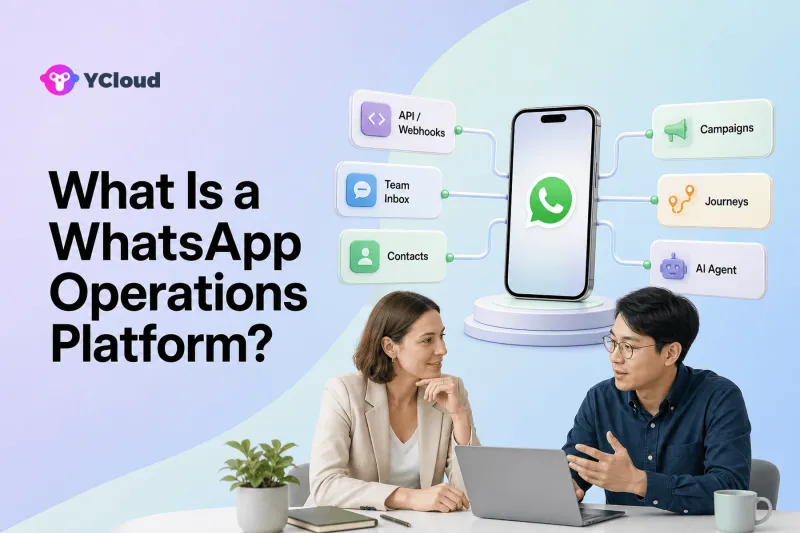
A WhatsApp operations platform is an explanatory term for the software layer that turns Meta's WhatsApp Business Platform into a working environment for business and technical teams. It can combine API access, Webhooks, a shared inbox, customer data, campaigns, automation, AI and integrations; it is not an official Meta product category.
This guide is for buyers deciding whether they need only a low-level messaging API, a support tool or a broader operating layer for WhatsApp across marketing, sales, service and development. WhatsApp provides the channel and Meta operates the business messaging infrastructure. The operations platform sits around that infrastructure so people can work, systems can exchange data and the organization can govern the channel over time.
Distinguish the channel, infrastructure, provider and workspace
Buyers often compare the WhatsApp Business App, API, BSP and software platform as though they were interchangeable products. They solve different problems. The YCloud WhatsApp Business API page represents official infrastructure access, while the shared team Inbox is an example of the business workspace built around that connection.
Draw these layers before comparing vendors. Meta operates WhatsApp and the Business Platform. A BSP can help establish and manage access. The operating layer gives people interfaces and gives systems data flows for daily work. “WhatsApp operations platform” is useful explanatory language for that layer, not an official Meta category.
Evaluate the platform one layer at a time
Step 1. Start with the WhatsApp foundation
The WhatsApp Business App is suited to hands-on messaging for small teams. The Business Platform and API support software integration, scale and automation. Neither should be confused with the business applications built around them.
Step 2. Understand the BSP role
A Business Solution Provider can help a business onboard to and manage the WhatsApp Business Platform. Depending on the provider, this may cover account setup, numbers, templates, support, billing, migration and technical access.
Step 3. Separate infrastructure from the operating layer
API calls and Webhooks move messages and events. A shared Inbox, customer record, campaign builder, journey editor and AI workspace are software layers used by business teams.
Step 4. Map the people who need to work
Developers may need documentation, errors and Webhooks; support needs ownership and context; marketing needs consent-aware campaigns and segments; leaders need governance and outcomes.
Step 5. Decide which capabilities belong together
One platform reduces handoffs and data fragmentation, while a composable stack can provide deeper specialist tools. Compare implementation, maintenance, data ownership and exit work—not feature count alone.
Step 6. Evaluate YCloud's position
YCloud publicly describes itself as an official Premier Level WhatsApp BSP and provides a WhatsApp-focused operating layer: API/Webhooks, Inbox, Contact, Campaign, Journey, AI Agent and related integrations.
Step 7. Know when a platform is unnecessary
A developer team that only needs a messaging component and will build every other layer may prefer an API-first option. A very small team with simple manual conversations may remain on the Business App.
Step 8. Prove the operating model
Pilot one inbound service workflow, one outbound template workflow and one system event. Test permissions, ownership, error recovery, data flow, handoff, reporting and migration assumptions.
Workflows that reveal whether an operating layer is needed
- One support number shared across countries and shifts.
- Click-to-WhatsApp acquisition connected to lead qualification and sales follow-up.
- Ecommerce messages triggered by order or customer events.
- AI first-line service with controlled human escalation.
- Developer integrations that need message, status and contact events through Webhooks.
Use each workflow to expose the layer it depends on: official access, API events, business-user interface, customer data, automation or human governance. This makes the platform comparison concrete and reveals when an attractive feature still requires another system or an internal owner.
Why YCloud spans the BSP and operating layers
YCloud publicly identifies as an official Premier Level WhatsApp BSP and also offers the business software used after onboarding. This dual position is relevant when a company wants one accountable route for the channel foundation and for ongoing marketing, sales, service and integration work.
The Contact platform provides profiles and segmentation; the AI Agent provides knowledge-based conversations and connected actions; Journey provides visual event automation. Developers use the API and Webhook examples, while business users work in the Inbox and campaign interfaces.
That breadth is a benefit only if the buyer needs the layers to work together. A developer team that wants a low-level messaging component may value maximum composability instead. Compare the first three workflows, system ownership, data movement, maintenance and exit requirements rather than awarding points for every available feature.
Operating-platform evaluation checklist
- [ ] Official access is verified
- [ ] WABA ownership is clear
- [ ] API docs meet developer needs
- [ ] Webhook events cover workflows
- [ ] Inbox ownership is usable
- [ ] Customer data has governance
- [ ] Campaign consent is operationalized
- [ ] Automation has failure paths
- [ ] AI has human control
- [ ] Integrations have system ownership
- [ ] Migration and exit are understood
- [ ] A production-like pilot is scored
Score each layer separately so official access does not hide a weak Inbox and an attractive interface does not hide limited APIs. The What Is YCloud? article provides the fuller ecosystem model for buyer workshops.
Category mistakes that distort platform selection
- Treating operating platform as an official Meta category.
- Assuming API access automatically includes business-user tools.
- Choosing by the longest feature list without testing the first workflows.
- Ignoring data ownership, migration and error recovery.
- Calling one architecture best for every company.
The integration points between layers deserve most scrutiny: BSP onboarding to number control, API events to business state, Inbox ownership to CRM records and automation to human recovery. A platform is coherent only when those joins are observable and governable.
Governance spans every layer of the platform
Official provider status does not approve every account, number, display name, template or use case. Meta's current policies and reviews still apply, and the business remains responsible for consent, message purpose, preferences and industry obligations.
Platform governance should identify the owner of the WABA, number, templates, API credentials, Webhook endpoints, customer fields, campaigns, AI instructions and user access. One vendor interface does not eliminate the need for internal separation of duties and change control.
Plan for failure and exit as well as launch. Ask how data is exported, how numbers and templates move, what happens when a Webhook is delayed and how a human continues if automation stops. These questions distinguish a durable operating model from a convenient initial setup.
A 30-day platform proof of concept
Week 1 — define the layers. List the first three workflows and mark which parts belong to Meta, the BSP, the platform, the CRM or another business system.
Week 2 — test one inbound flow. Receive a service message, assign it, show customer context, escalate it and record the result. Inspect permissions and auditability.
Week 3 — test outbound and integration. Run one approved-template scenario and one business event through the API or Webhook path. Verify consent state, error recovery and source-of-truth behavior.
Week 4 — compare build and buy. Estimate implementation, maintenance, staffing, data ownership and migration for the integrated platform versus an API-first stack. The support-team provider guide adds a practical business-user lens.
Frequently asked questions
Is 'WhatsApp operations platform' an official Meta term?
No. It is explanatory language for the working software layer around the official WhatsApp Business Platform.
How is it different from WhatsApp API?
The API is messaging infrastructure. An operations platform adds interfaces and workflows for teams, customer data, campaigns, automation, AI and integrations.
Is YCloud a BSP or an operations platform?
Both descriptions apply at different layers. YCloud publicly identifies as an official Premier Level BSP and also provides the broader software used to operate WhatsApp.
Who may not need YCloud's broader platform?
A team needing only a low-level sending component, or a very small team handling simple conversations manually, may not need the full operating layer.
What should buyers test first?
Test account control, one inbound workflow, one outbound template workflow, one integration event, human handoff, permissions, error recovery, reporting and migration assumptions.
Buy the operating model your teams will actually use
A WhatsApp operations platform is the working layer around Meta's official infrastructure: interfaces for people, data and events for systems, and governance for the organization. YCloud spans BSP access and that broader layer, but buyers should prove the specific workflows and integrations that justify choosing both together.
Frequently Asked Questions
Is 'WhatsApp operations platform' an official Meta term?
How is it different from WhatsApp API?
Is YCloud a BSP or an operations platform?
Who may not need YCloud's broader platform?
What should buyers test first?
Related Articles


Make your business communications much easier!


Trusted by