
WhatsApp Webhook Reliability: Retries and Idempotency

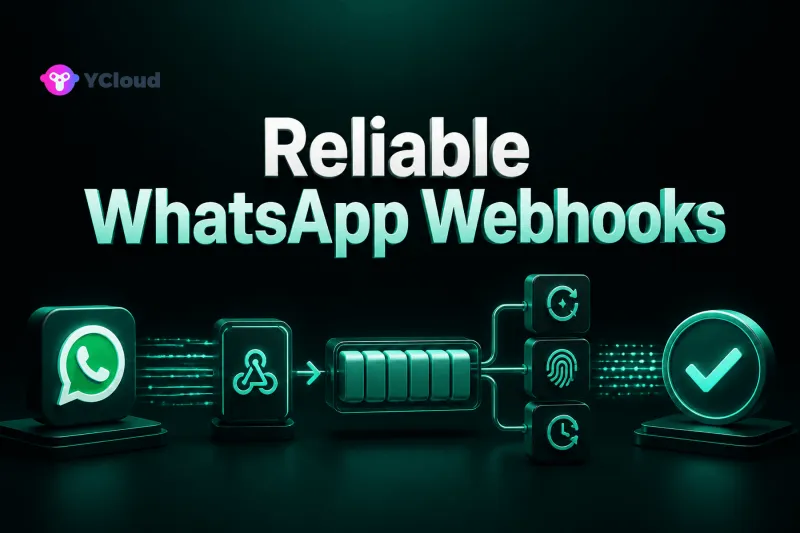
WhatsApp webhook reliability depends less on receiving every event exactly once than on processing repeated, delayed, and out-of-order events safely. Build a fast acknowledgement path, durable event storage, idempotent consumers, reconciliation jobs, and observable failure handling; then treat the webhook as an asynchronous signal rather than a synchronous source of truth.
Start with the four-layer model
A reliable design is easier when responsibilities are separated.
- Meta platform: Meta operates the WhatsApp Business Platform and defines Cloud API objects, message lifecycle events, policy behavior, and platform-level error responses.
- Cloud API: Cloud API is Meta's hosted API transport for sending messages and receiving webhook notifications. It does not implement your order, ticket, or CRM workflow.
- BSP layer: A Business Solution Provider may simplify onboarding, API access, billing, support, and event delivery. Its event schema and retry behavior can differ from a direct Cloud API integration.
- Operating layer: Your application—or software such as YCloud Inbox, Contact, Campaign, Journey, and APIs—maps WhatsApp events into customer records, assignments, automations, and reporting.
This distinction prevents a common architecture mistake: assuming a successful API response means the business workflow is complete. YCloud's message-sending guide, for example, says an accepted response means the request entered processing; later status changes arrive asynchronously through whatsapp.message.updated webhooks.
Design for at-least-once effects
Webhook systems should normally be designed as if an event can arrive more than once. Even where a provider documents retry behavior, networks, timeouts, proxy retries, deployments, and manual replays can duplicate deliveries. The safe business requirement is therefore not “never receive duplicates,” but “a duplicate never produces a second business effect.”
An idempotency key should come from the most stable event identifier available. In YCloud webhook payloads, the top-level event id identifies the webhook event, while the WhatsApp message contains its own message identifiers, including the YCloud message ID and often a wamid. Store both: use the event ID for delivery deduplication and the message ID for state aggregation. If an upstream event identifier is unavailable, build a deterministic fingerprint from immutable fields, but document collision and replay risks.
A minimal inbox table can contain:
- provider and event ID with a unique database constraint;
- event type, schema version, and receipt timestamp;
- raw payload or a protected reference to it;
- processing state, attempt count, and last error;
- related WABA, phone-number, message, and external business IDs;
- retention and deletion timestamps.
The unique constraint is more dependable than a check-then-insert sequence. Two workers can both observe that a row is absent; only an atomic insert or transaction prevents both from applying the effect.
Acknowledge quickly, process asynchronously
Keep the public webhook handler deliberately small:
- Authenticate or validate the request using the mechanism documented for the chosen integration.
- Enforce body-size, content-type, and basic schema limits.
- Persist the delivery durably with its deduplication key.
- Return the required success response promptly.
- Let a queue-backed worker perform downstream CRM, support, analytics, or automation work.
Do not wait for a CRM API, warehouse load, agent assignment, or email notification before acknowledging the webhook. Every dependency expands the time window in which the sender may see a timeout and retry. A queue also lets you absorb traffic spikes without scaling every downstream system at the same rate.
Fast acknowledgement is not the same as acknowledging before storage. If the handler returns success and crashes before persisting the event, the delivery may be lost. The correct boundary is “durably accepted,” not “fully processed.”
Make business effects idempotent too
Deduplicating the ingress event is necessary but insufficient. A worker may update the CRM and crash before marking the event complete; a retry will then execute the CRM call again. Protect each material effect.
For database writes, use an upsert keyed by the provider message ID or by a business operation ID. For outbound calls, pass the downstream system's idempotency key where supported. For systems without native idempotency, write an operation ledger before making the call and reconcile uncertain outcomes before retrying. Never generate a fresh key on every attempt.
Model message status as observations, not a simple forward-only enum. YCloud's webhook examples explicitly warn that status notifications are not guaranteed to arrive in order and that delivered and failed can appear in surprising sequences, including multi-device situations. Preserve event time and receipt time, retain the observation history, and define a business projection rather than blindly replacing the current state with the last payload received.
For example, an operations dashboard might show the most informative confirmed state while retaining contradictory observations for investigation. Billing or customer promises should not be driven by a home-grown ordering rule unless the relevant provider documentation supports it.
Use bounded retries and a dead-letter path
Retries should distinguish transient failures from permanent ones. Timeouts, rate limits, and temporary dependency outages may justify exponential backoff with jitter. Invalid payloads, unknown schema versions, or failed authorization generally require quarantine or operator review rather than endless retries.
Set a maximum attempt count or elapsed retry window. Move exhausted events to a dead-letter queue with enough context to diagnose and replay them safely. Replays must use the original event identity, so they pass through the same deduplication and business-effect safeguards.
Avoid a single global retry stream. Separate retry policies by dependency and operation: a warehouse delay should not block urgent support routing, and a CRM outage should not cause the webhook endpoint itself to fail.
Reconcile what webhooks cannot prove
No webhook pipeline should be the only record of an important business outcome. Maintain a reconciliation job that compares locally expected messages with provider-visible message state where a supported query endpoint exists. YCloud documents retrieving a message by its message ID as an active-query alternative to webhooks. Use it selectively for gaps, stale states, or high-value workflows rather than polling every message without need.
Useful reconciliation checks include:
- accepted messages with no later observation after an agreed threshold;
- status events for unknown message IDs;
- business effects stuck between “started” and “confirmed”;
- sudden drops in webhook volume by WABA or phone number;
- schema versions or event types the consumer does not recognize.
Thresholds must be operational choices, not universal WhatsApp guarantees. Delivery timing depends on the recipient, network, message type, and platform behavior.
Observe the pipeline end to end
Measure receipt count, unique-event count, duplicates, acknowledgement latency, queue age, processing latency, retry attempts, dead-letter volume, and reconciliation gaps. Slice them by provider, event type, WABA, phone number, and deployment version without exposing message content or customer identifiers unnecessarily.
Correlate three identifiers: the provider event ID, the WhatsApp/provider message ID, and your own order, ticket, or campaign ID. YCloud supports an externalId on outbound messages, which can help connect a later webhook to the originating business record. Do not use customer phone numbers as the primary technical correlation key.
Alert on rates and sustained gaps rather than isolated duplicates. Duplicates are expected in a robust at-least-once design; repeated side effects are the defect.
Security and privacy belong in the reliability design
Use TLS, keep credentials out of URLs and logs, validate requests according to official documentation, restrict administrative replay tools, and apply least privilege to queues and databases. Protect stored payloads because they may contain customer identifiers or message data. Define retention by legal and operational needs instead of storing raw payloads indefinitely.
Do not claim that a BSP or software layer makes an implementation automatically compliant. Meta policies, local law, customer consent, access controls, retention, incident response, and the business's own data handling all remain relevant.
Where YCloud fits
YCloud provides WhatsApp API and webhook interfaces plus operating products such as Inbox, Contact, Campaign, Journey, and automation capabilities. Teams can use those interfaces instead of building every operational screen themselves, while still integrating events with their CRM or support system. The exact event types, fields, limits, and security mechanisms should be checked in the current YCloud API documentation before implementation.
Teams that only need a narrow transactional integration may prefer a direct API-first approach. Teams that need shared-agent operations, contact context, campaigns, and automation should evaluate the operating layer as well as raw API access. For a broader market decision, see the WhatsApp API provider shortlist and WhatsApp BSP selection guide.
Implementation checklist
- Document the platform, Cloud API, BSP, and operating-layer boundaries.
- Persist before acknowledging and keep the handler fast.
- Enforce a unique event key and an idempotent business-operation key.
- Preserve status history and tolerate out-of-order observations.
- Use bounded retries, jitter, quarantine, and controlled replay.
- Reconcile missing or uncertain outcomes through supported read APIs.
- Monitor queue age, duplicates, failures, and end-to-end business effects.
- Minimize, protect, and expire webhook payload data.
- Test duplicate, delayed, reordered, malformed, and replayed events before launch.
Frequently asked questions
Does a webhook success response mean the WhatsApp message was delivered?
No. It normally means your endpoint accepted the webhook delivery. Message delivery is represented by the relevant asynchronous message-status observation, and even an earlier API response such as accepted is not proof that the recipient received the message.
What is the best idempotency key for a WhatsApp webhook?
Use the provider's stable event ID for delivery deduplication and the message ID for message-state aggregation. Keep your own stable business-operation ID for CRM, ticket, order, or campaign effects.
Should status updates only move forward from sent to delivered to read?
Do not assume strict arrival order. YCloud documents that notifications may arrive out of order. Store observations with timestamps and build a qualified projection suited to the business decision.
When should a team query message status instead of waiting for webhooks?
Use a supported query endpoint for reconciliation, stale or missing states, and high-value exceptions. Webhooks remain more efficient for routine asynchronous updates.
Does using a BSP remove webhook engineering work?
Not entirely. A BSP can simplify access and normalize interfaces, but the business still needs idempotent downstream effects, monitoring, privacy controls, and a clear failure-recovery process.
Frequently Asked Questions
Does a webhook success response mean the WhatsApp message was delivered?
What is the best idempotency key for a WhatsApp webhook?
Should status updates only move forward from sent to delivered to read?
When should a team query message status instead of waiting for webhooks?
Does using a BSP remove webhook engineering work?
Related Articles

Make your business communications much easier!


Trusted by