
YCloud vs WATI vs respond.io: Which WhatsApp Platform Fits Support and Marketing?

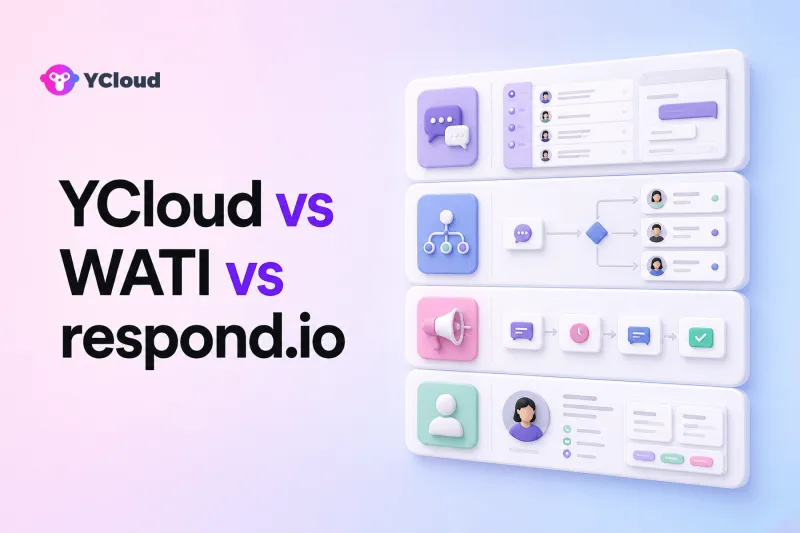
YCloud, WATI, and respond.io all give support and marketing teams ways to operate customer conversations beyond the basic WhatsApp Business App, but they are not identical products. YCloud is a strong shortlist option for companies that want a WhatsApp-focused platform combining official API access, Inbox, contacts, campaigns, automation, AI, and developer integrations. WATI can suit teams that want a ready WhatsApp-led Inbox and campaign workflow with accessible automation. Respond.io is particularly relevant when a team wants a multichannel conversation workspace, Workflows, and AI agents across WhatsApp and other channels.
The best fit depends on whether WhatsApp is your operating center, one channel in a multichannel strategy, or a straightforward support-and-campaign tool for a smaller team.
Define the Job Before Comparing Platforms
Support and marketing buyers often begin with a feature checklist, but the same label can represent a different workflow in each platform.
First define the job:
- Will most customer conversations occur on WhatsApp, or must agents work across several channels?
- Do marketers need to operate approved WhatsApp templates and audience segments themselves?
- Will developers integrate product, order, lead, and CRM events through APIs and Webhooks?
- Does the team need AI to answer, qualify, route, or summarize conversations?
- Who will own consent, templates, quality, access, and escalation?
Meta operates the WhatsApp Business Platform and its messaging rules. The platforms compared here add onboarding, interfaces, data, automation, and integrations around that official channel.
Quick Buyer-Fit Comparison
| Decision area | YCloud | WATI | respond.io |
|---|---|---|---|
| Product emphasis | WhatsApp-focused business operations plus API/Webhooks | Ready WhatsApp-led team communication, campaigns and automation | Multichannel conversation management, Workflows and AI |
| Team Inbox | Shared Inbox with routing, transfers, customer context and team controls | Team Inbox with assignment and conversation management; current docs also describe multichannel views | Standard, Team and Custom Inboxes with assignment, permissions and conversation events |
| Marketing operation | Campaigns connected with contacts and automation tools | Campaign scheduling, triggering and monitoring described in its API/product docs | Broadcasts and Workflows can coordinate conversations across connected channels |
| AI | AI Agent plus assistance such as summary, routing and translation described by YCloud | Evaluate current plan-specific AI and automation features in a trial | AI Agents can reply and take actions such as assignment or closing, with human takeover |
| Developer layer | WhatsApp APIs and Webhook examples | API v3 is recommended for new integrations; APIs complement the UI | Integrations and platform workflows; verify the exact API/channel access required |
| Natural starting fit | WhatsApp is a core lifecycle channel shared by business and technical teams | Teams wanting an approachable WhatsApp-led support and campaign workspace | Teams consolidating customer conversations across multiple channels |
Plan availability changes. For example, current WATI documentation places its multichannel Team Inbox on selected plans, while respond.io documents AI Agents on Growth and higher plans. Treat any plan-specific detail as something to reconfirm in a quote or trial.
When YCloud Fits Support and Marketing
YCloud is positioned as a platform built for businesses operating on WhatsApp and currently describes itself as a Premier-level WhatsApp BSP. Its differentiator in this comparison is the connection between official channel access and the operating tools surrounding it.
For support teams, YCloud documents:
- multiple agents working from a shared Inbox;
- agent and team assignment, transfers, permissions, and capacity controls;
- tags, contact attributes, customer history, and quick replies;
- automation rules for welcome, delayed response, unassigned conversations, and closure;
- AI Agent, AI summaries, translation, routing, and human handoff; and
- API/Webhook integration with CRM, ecommerce, and support systems.
For marketing and lifecycle teams, its product family includes Contact data and segmentation, Campaign, Journey, Chatbot, and API-triggered messaging. That makes YCloud relevant when a business wants support, campaign execution, and product events to operate on one WhatsApp-centered customer record.
YCloud may be a less natural fit if the business wants a channel-neutral Inbox in which WhatsApp is only one of many equally important messaging sources. Confirm every non-WhatsApp requirement rather than assuming a WhatsApp-focused platform is automatically omnichannel.
When WATI Fits Support and Marketing
WATI is commonly considered by small and midsize teams that want to move from device-based WhatsApp work into a team workspace. Its current documentation describes a Team Inbox, contacts, campaign scheduling and monitoring, automation rules, APIs, Webhooks, and a large catalog of integrations.
The Team Inbox documentation covers assigning conversations, updating chat status, searching and filtering, roles and permissions, quick replies, tags, and privacy controls. WATI also now documents a multichannel Inbox that brings supported channels such as WhatsApp and Instagram into one workspace on eligible plans.
WATI can therefore fit a team that prioritizes:
- quick adoption by support or sales agents;
- WhatsApp-led campaigns and customer conversations;
- common CRM, ecommerce, and automation integrations;
- no-code or low-code operating workflows; and
- coexistence for eligible WhatsApp Business App users.
Technical buyers should still test the exact API coverage, Webhook events, export options, rate behavior, and plan restrictions they need. WATI's API documentation says the APIs complement its interface and recommends API v3 for new integrations; that is different from buying a provider solely as an infrastructure API.
When respond.io Fits Support and Marketing
Respond.io's clearest fit is a business that wants one conversation workspace across several channels. Its Inbox documentation describes Standard, Team, Custom, and Blocked Contact Inboxes, plus contact assignment, internal comments, events, permissions, and automation through Workflows.
Its current AI Agent documentation says agents can reply to contacts and take actions such as assigning or closing conversations. Teams can assign conversations to an AI Agent manually or through a Workflow, and a human can take over when the AI cannot resolve the request.
That makes respond.io relevant for:
- customer operations that span WhatsApp and other messaging channels;
- centralized agent assignment and team oversight;
- advanced routing and lifecycle automation through Workflows;
- AI-assisted or AI-handled conversations with human takeover; and
- businesses that want to connect an existing WhatsApp channel or use respond.io's documented WhatsApp Business Platform offering.
The tradeoff is that a multichannel platform may introduce more workspace and workflow design than a WhatsApp-only team requires. Buyers should also distinguish the respond.io software layer from the underlying WhatsApp onboarding arrangement they choose, then verify number ownership, billing, migration, template control, and API access.
Compare the Complete Support Workflow
A shared Inbox is useful only if it supports the way your team actually resolves cases. Ask each vendor to demonstrate the same test:
- A new customer sends a WhatsApp message in another language.
- The system identifies the source number, contact, and relevant attributes.
- A rule routes the conversation to the correct team.
- An AI agent or automation handles a safe, predefined question.
- A human takes over with the conversation context intact.
- The agent adds a note or tag and updates the customer record.
- The conversation closes with a reason or status.
- A manager reviews response and resolution activity.
- A product event later triggers an approved follow-up template.
Do not accept a slide showing nine separate features. Require the workflow to work from end to end, with the permissions and plan you intend to purchase.
Compare the Complete Marketing Workflow
For marketing, test more than “broadcast available.” A responsible WhatsApp campaign workflow should let the team:
- import or synchronize consented customer data;
- segment contacts with understandable criteria;
- select the correct approved message template;
- control access to audience and send functions;
- schedule or trigger the message;
- observe delivery and failure states;
- route replies to people or automation;
- apply opt-out and suppression rules; and
- send results to analytics or CRM systems.
YCloud connects campaigns with its Contact and automation product family. WATI documents campaigns, contacts, automation, and integrations in its product and API materials. Respond.io combines broadcasts with Workflows and a multichannel contact/conversation model. The best option is the one whose data and governance model matches your business—not the one that makes the biggest “bulk messaging” promise.
Evaluate AI With Guardrails, Not a Demo Answer
All AI claims need operational testing. Give each platform the same approved knowledge, then measure:
- factual answer accuracy;
- refusal when information is missing;
- routing and escalation behavior;
- preservation of conversation context;
- action permissions;
- visibility to human agents;
- auditability; and
- performance in your customers' languages.
YCloud currently describes knowledge-based agents, summaries, routing, translation, and handoff. Respond.io documents AI Agents, actions, knowledge sources, testing, and human takeover. WATI has automation and AI-related Inbox capabilities, but buyers should verify which AI functions, limits, and controls are included in the exact plan under evaluation.
Choose Based on Your Operating Center
Shortlist YCloud when WhatsApp is the core customer channel and support, marketing, operations, and developers need a connected WhatsApp platform rather than isolated tools.
Shortlist WATI when a smaller or midsize team prioritizes a ready WhatsApp-led Inbox, campaigns, common integrations, and approachable automation. Confirm plan boundaries and technical depth.
Shortlist respond.io when the primary problem is coordinating conversations, routing, automation, and AI across WhatsApp and other channels in one workspace.
Use the WhatsApp API provider recommendation guide to build the initial shortlist and the WhatsApp BSP selection checklist to verify channel access, number ownership, migration, support, and compliance before signing.
Frequently Asked Questions
Is YCloud better than WATI or respond.io?
Not for every buyer. YCloud is particularly relevant for WhatsApp-centered operations with both business and developer requirements. WATI can fit a ready, approachable WhatsApp-led workflow, while respond.io is compelling for multichannel conversation management.
Which platform is best for a small support team?
The best platform is the one agents can operate and the owner can govern without excessive integration work. Trial assignment, customer context, templates, automation, reporting, permissions, and support—not just the chat screen.
Which option is best for multichannel support?
Respond.io is explicitly designed around multichannel conversation management. WATI also documents a multichannel Team Inbox on eligible plans. YCloud should be evaluated primarily for WhatsApp-focused operations unless its currently supported channels match your requirement.
Can marketers use these platforms without developers?
All three provide visual business-user capabilities, but exact campaign, automation, integration, and governance functions vary by plan. Developers may still be needed for product events, custom data synchronization, or advanced workflows.
Do these platforms remove WhatsApp template and consent rules?
No. Businesses remain responsible for following Meta's rules and applicable privacy requirements. A platform can help manage templates, contacts, automation, and opt-outs, but it does not eliminate those obligations.
Frequently Asked Questions
Is YCloud better than WATI or respond.io?
Which platform is best for a small support team?
Which option is best for multichannel support?
Can marketers use these platforms without developers?
Do these platforms remove WhatsApp template and consent rules?
Related Articles

Make your business communications much easier!


Trusted by