Customer Support

English

How to Calculate the ROI from Your WhatsApp Marketing Campaign

Your WhatsApp campaign was delivered.
Customers opened it, clicked the links, and replied.
But did it actually make money?
Many businesses can report campaign activity but struggle to prove its financial impact.
They track reads and clicks while overlooking message fees, platform costs, discounts, team effort, and the revenue genuinely influenced by WhatsApp.
As a result, a campaign can look successful on the dashboard while delivering a poor return.
In this guide, you’ll learn how to calculate WhatsApp marketing ROI using a simple formula, identify the right metrics, avoid common attribution mistakes, and find practical ways to improve your returns.
We’ll also break it down with a real-world example and a free WhatsApp marketing ROI calculator.
By the end, you’ll know which campaigns deserve more budget, which need improvement, and which should be stopped.
First, let’s quickly review the most important takeaways.
TL;DR
- WhatsApp marketing ROI shows the profit generated by a campaign relative to its total investment
- Calculate it using: ROI (%) = [(Campaign Revenue − Campaign Investment) ÷ Campaign Investment] × 100
- Include Meta fees, platform charges, ad spend, creative costs, integrations, and team effort in the total investment
- Count only revenue attributed to the campaign using tracked links, UTMs, coupon codes, CRM data, or Conversions API
- Track delivery, reads, clicks, conversions, average order value, and cost per conversion to identify where performance is being lost
- Avoid inflating ROI by excluding costs, double-counting revenue, mixing campaigns, or treating engagement as profit
- Improve returns through better segmentation, personalization, automation, conversion journeys, and cost control
- YCloud helps track campaign performance, automate customer journeys, analyze CTWA ads, and connect WhatsApp activity with revenue
Next, let’s understand exactly what WhatsApp marketing ROI means.
What is WhatsApp Marketing ROI?
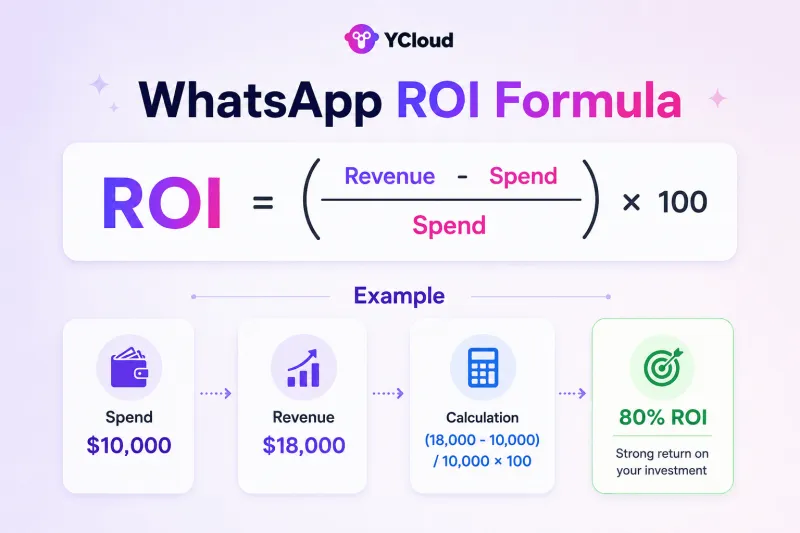
WhatsApp marketing ROI measures the profit generated by a WhatsApp campaign relative to its total investment.
The formula is: ROI (%) = [(Revenue - Investment Cost) / Investment Cost] × 100Campaign investment costs may include Meta message fees, platform charges, ad spend, creative costs, and team effort.
For an accurate result, count only the revenue attributed to that WhatsApp campaign.
Next, let’s understand why tracking this ROI matters.
Why Does ROI Matter for WhatsApp Marketing?
High delivery, read, or response rates may look positive, but they do not confirm whether a campaign is profitable.
ROI connects campaign activity with actual business returns.
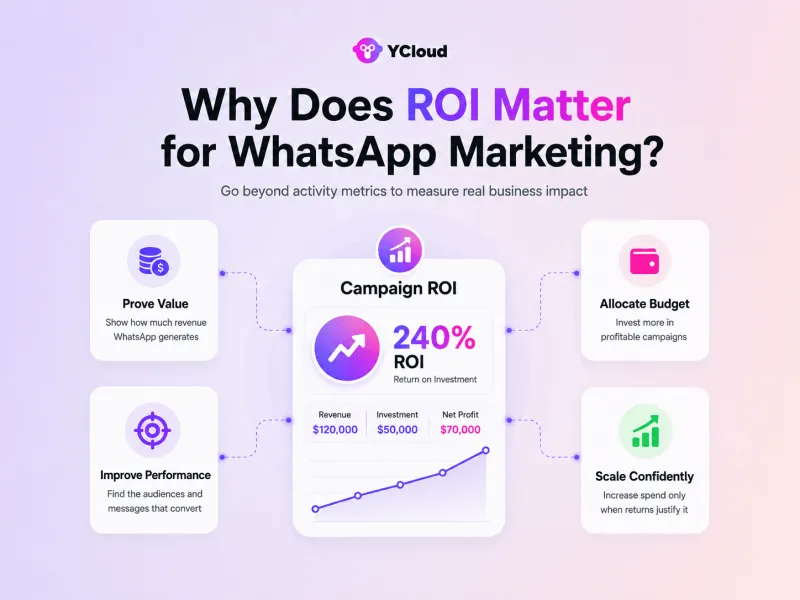
Tracking it helps you:
- Prove business value: Show stakeholders how much revenue WhatsApp generates
- Allocate budget wisely: Invest more in profitable campaigns and reduce wasteful spending
- Improve performance: Identify which audiences, messages, offers, and journeys convert best
- Scale confidently: Increase campaign spend only when the returns justify it
- Track progress: Compare performance across campaigns and over time
Next, let’s understand how ROI differs from other WhatsApp marketing metrics.
ROI vs. Other Marketing Metrics
Metrics such as delivery rate, read rate, click-through rate, and conversion rate show how customers respond to a campaign.
ROI shows whether those responses generated enough return to justify the investment.
Metric Type | What It Tells You |
Delivery and engagement metrics | Whether customers received and interacted with the campaign |
Conversion metrics | Whether customers completed the intended action |
ROI | Whether the campaign generated a profit after accounting for its costs |
A campaign may achieve high reads and clicks but still deliver poor ROI if costs are high or conversions generate limited revenue.
These supporting metrics are not replacements for ROI. They help explain why the ROI is high or low.
Next, let’s identify the key metrics you need to calculate WhatsApp marketing ROI accurately.
Key Metrics You Should Track to Calculate WhatsApp Marketing ROI
You do not need to track every available metric…!
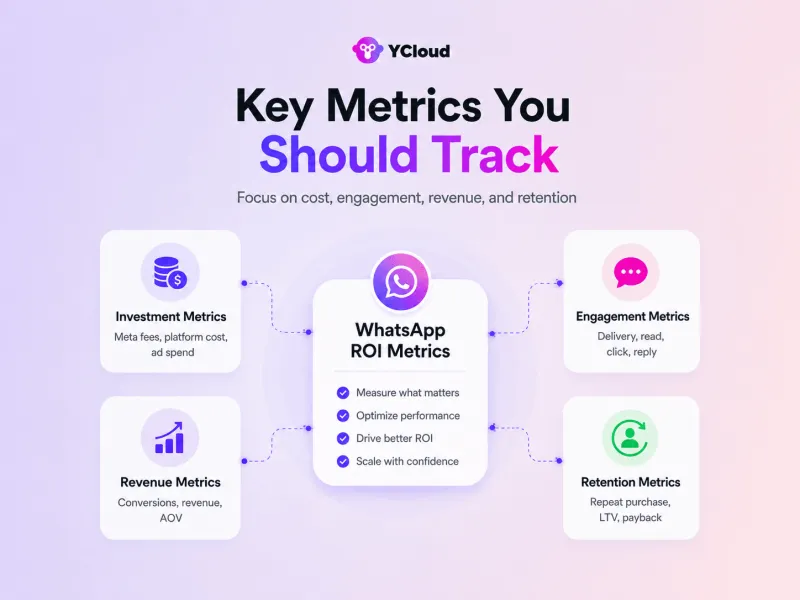
For an accurate ROI calculation, focus on three areas:
- What you spent?
- How the campaign performed?
- How much revenue it generated?
1. Investment Metrics
These metrics show the complete cost of running the campaign.
Metric | What to Track or Calculate | |
Meta message cost | Charges for messages delivered during the campaign | |
Platform cost | The portion of your WhatsApp platform subscription used for the campaign | |
Advertising cost | Click-to-WhatsApp or other paid campaign spend | |
Creative cost | Copy, design, video, agency, or production expenses | |
Team cost | Hours spent on the campaign × hourly employee cost | |
Integration cost | CRM, chatbot, automation, or technical setup expenses | |
Total campaign cost | Sum of all campaign-related costs | |
Cost per conversion | Total campaign cost ÷ number of conversions | |
Cost per qualified lead | Total campaign cost ÷ number of qualified leads |
If a setup or integration supports multiple campaigns, divide the cost across its expected useful period instead of charging it entirely to one campaign.
2. Delivery and Engagement Metrics
These metrics do not calculate ROI directly, but they help identify where campaign performance improves or declines.
Metric | Formula |
Delivery rate | Messages delivered ÷ messages sent × 100 |
Read rate | Messages read ÷ messages delivered × 100 |
Click-through rate | Unique link clicks ÷ messages delivered × 100 |
Reply rate | Recipients who replied ÷ messages delivered × 100 |
Opt-out rate | Opt-outs ÷ messages delivered × 100 |
A high read rate with few clicks may indicate a weak offer or call to action.
Strong clicks with few conversions may point to problems after the customer leaves WhatsApp.
3. Conversion and Revenue Metrics
These metrics connect campaign activity with actual business outcomes.
Metric | Formula |
Attributed revenue | Total revenue linked to the WhatsApp campaign |
Conversion rate | Completed actions ÷ messages delivered × 100 |
Average order value | Attributed revenue ÷ number of orders |
Revenue per recipient | Attributed revenue ÷ messages delivered |
Revenue per conversion | Attributed revenue ÷ number of conversions |
A conversion may be a purchase, booking, qualified lead, application, or another action based on the campaign objective.
Choose the conversion definition and denominator before launching the campaign, then use them consistently.
4. Retention Metrics
For campaigns designed to generate repeat business, also track:
Metric | Formula |
Repeat purchase rate | Repeat customers ÷ customers acquired through the campaign × 100 |
Customer lifetime value | Average customer value across the full relationship |
Payback period | Time required to recover the campaign investment |
These metrics help measure returns that may continue after the initial campaign period.
Track the Source of Every Conversion
Revenue can only be included in ROI when it can be connected to the campaign.
Use campaign IDs, UTM parameters, tracked links, coupon codes, CRM stages, or conversion tracking to identify where each sale came from.
At a minimum, your WhatsApp marketing ROI calculator needs two figures:
- Revenue attributed to the campaign
- Total campaign investment
The remaining metrics help explain why the final ROI is high or low.
Next, let’s use these figures to calculate WhatsApp marketing ROI step by step.
Step-by-Step WhatsApp Marketing ROI Calculation
The formula is simple!
The accuracy depends on tracking the correct revenue and including every relevant campaign cost.
Let’s calculate the ROI using a hypothetical monthly WhatsApp campaign.
Step 1: Calculate Your Monthly Investment
Add every cost associated with the campaign.
Monthly Investment = Meta Fees + Platform Fee + Ad Spend + Creative Cost + Team Cost
Example:
- Meta message fees: $250
- YCloud subscription: $89
- Advertising spend: $600
- Creative costs: $150
- Team effort: $300
- Total Monthly Investment: $1,389
Step 2: Calculate the Messages Read
Use your campaign analytics to check how many messages were delivered and read.
Messages Delivered = Messages Sent × Delivery Rate
Messages Read = Messages Delivered × Read Rate
Example:
- Messages sent: 12,000
- Delivery rate: 96%
- Messages delivered: 12,000 × 96% = 11,520
- Read rate: 85%
- Messages read: 11,520 × 85% = 9,792
Step 3: Calculate the Clicks
Clicks = Messages Read × Click-Through Rate
Example:
- Messages read: 9,792
- Click-through rate: 12%
- Total clicks: 9,792 × 12% = 1,175
Step 4: Calculate the Conversions
Conversions = Total Clicks × Conversion Rate
Example:
- Total clicks: 1,175
- Conversion rate: 5%
- Total conversions: 1,175 × 5% = approximately 59
Step 5: Calculate the Campaign Revenue
Campaign Revenue = Conversions × Average Order Value
Example:
- Conversions: 59
- Average order value: $80
- Campaign Revenue: 59 × $80 = $4,720
Step 6: Calculate Net Profit and ROI
Net Profit = Campaign Revenue − Monthly Investment
ROI (%) = (Net Profit ÷ Monthly Investment) × 100
Example:
- Campaign revenue: $4,720
- Monthly investment: $1,389
- Net profit: $4,720 − $1,389 = $3,331
- ROI: ($3,331 ÷ $1,389) × 100 = approximately 240%
This means the campaign generated $2.40 in profit for every $1 invested.
Step 7: Calculate the Payback Period
Use this step when your campaign includes a one-time setup or integration cost.
Payback Period = One-Time Setup Cost ÷ Monthly Net Profit
Example:
- One-time setup cost: $1,000
- Monthly net profit: $3,331
- Payback period: $1,000 ÷ $3,331 = approximately 0.30 months or 9 days
Where available, use actual delivery, click, conversion, and revenue data instead of estimated rates.
Next, let’s examine how this calculation works in a real-world WhatsApp marketing case study.
Real-World Example of WhatsApp Marketing ROI
Consider a fashion brand with 25,000 opted-in WhatsApp contacts. It runs two campaigns per week, or eight campaigns per month.
Metric | Calculation | Result |
Monthly messages sent | 25,000 × 8 campaigns | 200,000 |
Read rate | — | 80% |
Messages read | 200,000 × 80% | 160,000 |
Click-through rate | — | 4% |
Link clicks | 160,000 × 4% | 6,400 |
Conversion rate | — | 2% |
Orders generated | 6,400 × 2% | 128 |
Average order value | — | $85 |
Campaign revenue | 128 × $85 | $10,880 |
Total investment | — | $3,200 |
Net profit | $10,880 − $3,200 | $7,680 |
WhatsApp marketing ROI | $7,680 ÷ $3,200 × 100 | 240% |
The campaign generated $2.40 in profit for every $1 invested.
However, if the conversion rate dropped from 2% to 1%, campaign revenue would fall to $5,440, and ROI would decline to 70%. This shows why engagement alone is not enough; small changes in conversion performance can significantly affect the final return.
Next, let’s explore the common mistakes that can make WhatsApp marketing ROI appear higher or lower than it really is.
Common Mistakes You Should Avoid
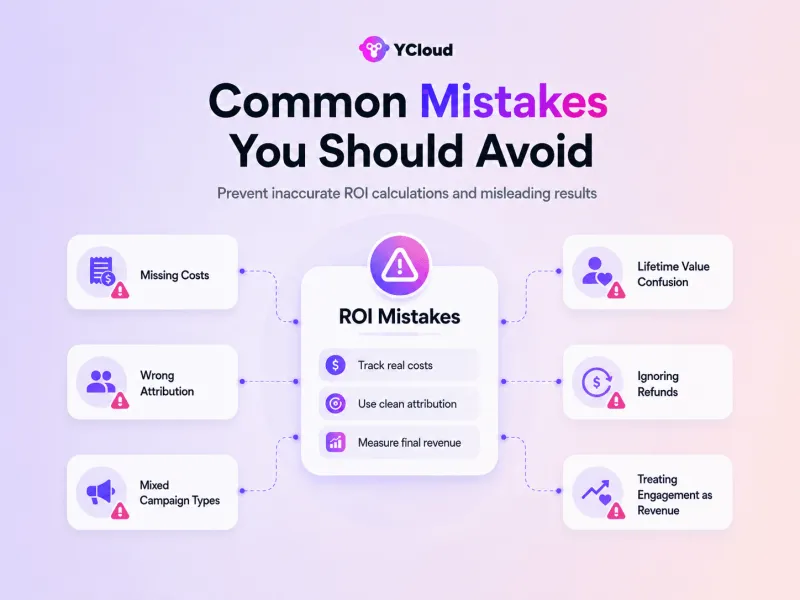
1. Excluding Important Campaign Costs
Counting only Meta message fees makes the investment appear lower than it is.
Include platform charges, advertising, creative work, integrations, automation, and team effort.
2. Attributing Every Sale to WhatsApp
A customer may interact with several channels before purchasing. Counting every sale as WhatsApp revenue can inflate ROI.
Use tracked links, campaign IDs, coupon codes, CRM data, or an agreed attribution model.
3. Combining Different Campaigns
Mixing promotions, cart recovery, lead generation, and retention campaigns hides which activity is producing results.
Calculate ROI separately for each campaign type, audience, and objective.
4. Mixing Short-Term Revenue With Lifetime Value
Adding the customer’s full estimated lifetime value to a one-month campaign can overstate the immediate return.
Report initial campaign ROI and lifetime ROI separately.
5. Ignoring Refunds, Discounts, and Cancellations
Gross order value does not always equal final revenue.
Deduct refunds, cancellations, discounts, and other relevant reductions before calculating the return.
6. Treating Engagement as Revenue
High reads, clicks, and replies show interest, not profitability.
Use engagement metrics to diagnose performance, but calculate ROI using attributed revenue and total investment.
7. Mixing Direct and Indirect Benefits
WhatsApp may improve customer retention, reduce support costs, or save team time. However, these benefits should not be added to revenue without a measurable financial value.
Track direct sales ROI and operational savings separately to avoid double counting.
Avoiding these mistakes gives you a more reliable ROI figure. Next, let’s explore proven ways to improve it.
Proven Hacks to Boost Your WhatsApp Marketing ROI
WhatsApp marketing ROI improves when you generate more attributable revenue, reduce campaign costs, or achieve both.
Start with the weakest stage of your campaign instead of changing everything at once.
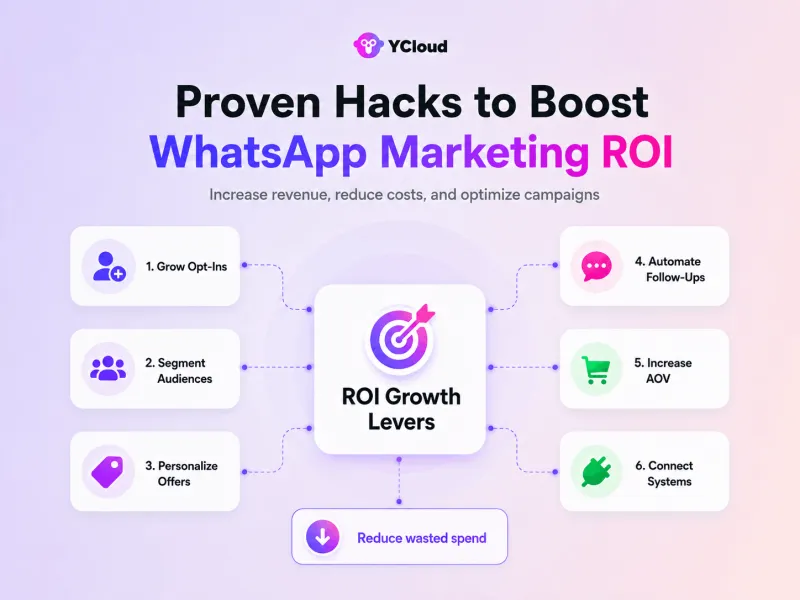
1. Grow a Qualified Opt-In Audience
Focus on contacts who have shown genuine interest rather than increasing list size alone.
- Click-to-WhatsApp ads
- Website forms and chat buttons
- QR codes
- Checkout pages
- Events and physical stores
- Social media campaigns
A smaller, relevant audience can produce better ROI than a large list of inactive contacts.
2. Segment Customers by Intent and Lifecycle Stage
Avoid sending the same campaign to every contact.
Build segments based on:
- Product interest
- Purchase history
- Location
- Engagement level
- Lead stage
- Abandoned-cart activity
- Last purchase date
Better segmentation makes messages more relevant and reduces wasted message spend.
3. Personalize the Offer, Not Just the Name
Adding a customer’s name is not enough. Use their interests, previous actions, and purchase history to decide what message or offer they receive.
For example, send a replenishment reminder to an existing customer and a product guide to someone still comparing options.
4. Test One Campaign Element at a Time
A/B test specific elements such as:
- Message opening
- Call to action
- Image or video
- Offer
- Sending time
- Message frequency
Changing one element at a time makes it easier to identify what improved or reduced performance.
5. Reduce Friction After the Customer Clicks
A strong click-through rate will not improve ROI if the next step is confusing.
Use clear buttons, short forms, product catalogues, payment links, and simple checkout journeys. Make human assistance available when customers have questions before completing the action.
6. Automate Time-Sensitive Conversations
Use automation or AI agents to respond instantly, qualify leads, answer common questions, and guide customers towards the next step.
Create automated journeys for:
- Abandoned carts
- Unpaid orders
- Appointment reminders
- Reorder reminders
- Inactive leads
- Post-purchase follow-ups
Transfer complex or high-value conversations to a human agent with the complete chat context.
7. Increase Revenue From Each Conversion
Improving average order value can raise revenue without increasing campaign volume.
Use relevant:
- Product bundles
- Complementary recommendations
- Volume discounts
- Upgrades
- Replenishment offers
- Loyalty incentives
Recommendations should be based on customer needs rather than added simply to increase the order value.
8. Connect WhatsApp With Your Business Systems
Integrate WhatsApp with your CRM, e-commerce platform, advertising data, and analytics tools.
This helps you personalize campaigns, track conversions, identify profitable customer journeys, and prevent the same revenue from being attributed to multiple channels.
9. Reduce Costs Without Weakening the Experience
Review message charges, platform usage, advertising spend, manual workload, and underperforming campaigns.
Use automation for repetitive tasks, stop campaigns with consistently negative returns, and increase spending only where the marginal ROI remains profitable.
Identify Where ROI Is Being Lost
Campaign Pattern | What to Improve |
| Strong delivery but low reads | Audience relevance, timing, and message opening |
| High reads but low clicks | Offer, content, and call to action |
| High clicks but low conversions | Checkout, pricing, landing page, or sales support |
| Strong conversions but low ROI | Campaign cost, discounts, or average order value |
| High opt-outs | Targeting, frequency, consent, and message relevance |
Optimize one stage, measure the result, and then move to the next. This creates steady improvement without making it difficult to identify what caused the change.
Next, let’s see how YCloud helps you track campaign performance, reduce wasted spend, and improve WhatsApp marketing ROI from one platform.
Measure and Improve WhatsApp Marketing ROI With YCloud
Calculating ROI is useful only when you can connect campaign activity with costs, conversions, and revenue.
YCloud brings WhatsApp campaigns, audience segmentation, automated journeys, AI agents, and performance analytics into one platform.
With YCloud you can:
- Track sent, delivered, read, failed, and bounced messages through campaign reports
- Analyze Click-to-WhatsApp ads and improve conversion tracking through Conversions API
- Track WhatsApp-driven Shopify orders and revenue
- Automate cart recovery, follow-ups, and customer journeys
- Reduce costs with a free-forever plan and zero markup on Meta’s message fees
These capabilities help you identify profitable campaigns, reduce wasted spend, and make better budget decisions using real performance data. Explore YCloud and use the techniques mentioned in this article to measure your returns before scaling the next campaign.
How To Get YCloud?
Kindly click on the banner below to book a FREE DEMO and learn more about our product offering, features and pricing plans.

Built with AI at its core, YCloud is the ultimate WhatsApp marketing and automation solution, giving you everything you need in one powerful platform.
Now market, sell, support, and scale your business by 10X with YCloud!
Ready to try? Explore how to get YCloud for FREE next!
How to Get YCloud for FREE?
It's Simple!
Subscribe to our FREE plan and get a free lifetime experience of YCloud with unlimited messaging API.
Book a FREE Demo and see how YCloud can power up your WhatsApp marketing strategy!
🚀 Try YCloud today and experience how effortless WhatsApp automation can be when you have the right partner.
Wrapping-Up!
Do not stop at deliveries, reads, or clicks.
Track the revenue your WhatsApp campaign generates, subtract every relevant cost, and calculate the actual return.
Scale profitable campaigns, fix the stages losing conversions, and stop spending on campaigns that consistently underperform.
Use the mentioned process to evaluate your campaign and decide your next move with confidence.
Next, let’s answer the most frequently asked questions about WhatsApp marketing ROI.
Frequently Asked Questions
How do you calculate WhatsApp marketing ROI?
Subtract the total campaign investment from the revenue attributed to the campaign. Divide the result by the investment and multiply it by 100.
ROI (%) = [(Campaign Revenue − Campaign Investment) ÷ Campaign Investment] × 100
What costs should be included in WhatsApp marketing ROI?
Include Meta message fees, platform charges, advertising spend, creative expenses, integrations, automation, and the allocated cost of team effort.
Use the same cost categories across campaigns to keep comparisons consistent.
Which metrics are most important for calculating WhatsApp marketing ROI?
The two essential figures are attributed campaign revenue and total campaign investment.
Delivery rate, read rate, click-through rate, conversion rate, cost per conversion, and average order value help explain why the ROI is high or low.
What is a good WhatsApp marketing ROI?
There is no universal benchmark. A good ROI depends on your profit margin, industry, campaign objective, customer value, and alternative marketing channels.
A positive ROI means the campaign generated more than it cost, but the return should still meet your business’s profitability target.
What is the difference between ROI and ROAS?
ROI measures profit against the complete campaign investment.
ROI = Net Profit ÷ Total Investment × 100
ROAS measures revenue generated from advertising spend only.
ROAS = Campaign Revenue ÷ Advertising Spend
How long does it take to see a positive WhatsApp marketing ROI?
It depends on the campaign and sales cycle. An abandoned-cart campaign may generate measurable returns quickly, while a B2B lead-generation campaign may take weeks or months to produce revenue.
Calculate the final ROI only after the defined attribution window has ended.
How often should WhatsApp marketing ROI be reviewed?
Review ROI after every major campaign and at least monthly for ongoing campaigns.
Monitor engagement and conversion metrics while the campaign is active, but avoid making final profitability decisions before enough conversion data is available.
Why can’t messaging analytics alone show accurate ROI?
Messaging analytics usually show sent, delivered, read, clicked, and replied events. They may not capture purchases completed on a website, inside a store, through a sales representative, or by bank transfer.
Accurate ROI requires those outcomes to be connected through tracked links, CRM data, e-commerce integrations, coupon codes, or another attribution method.
How does Conversions API improve WhatsApp attribution?
Conversions API connects downstream events, such as qualified leads, bookings, and purchases, with Meta’s advertising systems. This helps businesses measure Click-to-WhatsApp ad performance beyond conversations started and optimize campaigns using actual outcomes.
Should I track ROI per message, campaign, or customer?
Use campaign-level ROI as the primary measure because it connects a defined investment with a specific return.
Message-level data helps compare content and templates, while customer-level data is more useful for measuring repeat purchases and lifetime value.
Should team salaries be included in the ROI calculation?
Include the cost of the time employees spend planning, launching, managing, and responding to the campaign.
Do not charge the employee’s entire salary to one campaign. Allocate only the relevant portion and use the same method consistently.
Can I calculate ROI for customer retention campaigns?
Yes. Track the repeat purchases or retained revenue attributable to the campaign, subtract the campaign investment, and apply the standard ROI formula.
Keep immediate retention revenue and estimated customer lifetime value separate to avoid overstating the return.
Is WhatsApp marketing worthwhile for low-value products?
It can be, provided the profit margin, conversion rate, automation level, and repeat-purchase frequency justify the campaign cost.
Evaluate customer lifetime value and cost per conversion instead of relying on average order value alone.
Can small businesses measure WhatsApp marketing ROI?
Yes. A small business can begin with a spreadsheet, tracked link, dedicated coupon code, and clear records of campaign costs and sales.
Advanced tools become useful as campaign volume, automation, and attribution requirements increase.
How can businesses improve WhatsApp marketing ROI?
Improve audience quality, segment contacts, personalize offers, test campaign elements, reduce checkout friction, automate timely follow-ups, and stop consistently unprofitable campaigns.
Change one element at a time so you can identify what improved the result.
Which tools can track WhatsApp marketing ROI?
Useful tools include UTM parameters, GA4, CRM software, e-commerce analytics, coupon tracking, Conversions API, and WhatsApp campaign dashboards.
YCloud combines campaign reporting, audience segmentation, automated journeys, CTWA analytics, Conversions API integration, and Shopify order tracking to help connect WhatsApp activity with measurable outcomes.
Related Articles

Make your business communications much easier!


Trusted by