Customer Support

English

Meta Updates: WhatsApp API Message Pricing Change Effective October 1, 2026
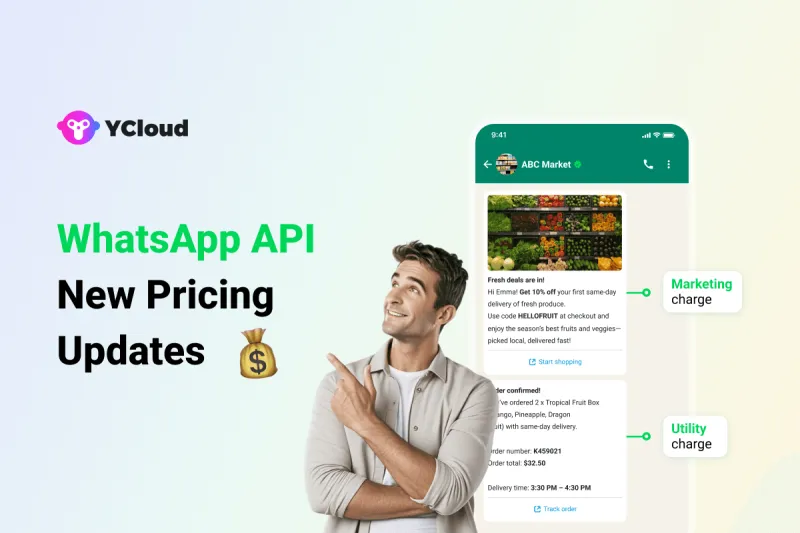
Meta has announced a new round of WhatsApp API message pricing updates, effective October 1, 2026.
This update affects service messages, utility messages, authentication messages, marketing messages, and authentication-international rates across selected markets.
The biggest change is that pricing is no longer limited to template messages only.
Businesses also need to review the cost of regular customer replies, support messages, sales follow-ups, and utility messages sent inside the 24-hour customer service window.
For businesses using WhatsApp to handle customer inquiries, sales conversations, order updates, OTPs, and support, this update makes it important to check:
- Which message types you send
- Which countries your customers are in
- How many service messages each business phone number sends per month
- Which messages still qualify for free delivery
- How your team or automation handles replies
Price Note: All prices mentioned below are in US dollars per message/unit. Actual costs may vary based on Meta’s free-message policy, volume tiers, recipient market, and your selected WhatsApp API service plan.
This article explains what is changing, which markets are affected, and how businesses can prepare.
TL;DR
- Meta’s latest WhatsApp API message pricing update takes effect on October 1, 2026, based on the WhatsApp Business Account timezone.
- Service messages will now be charged per delivered message after the first 1,000 free service messages per business phone number per month.
- Utility messages sent inside the 24-hour customer service window will no longer remain free.
- Marketing message rates are increasing in selected markets, including Kuwait, Mexico, Morocco, Saudi Arabia, UAE, Other Middle East, and Other Asia Pacific.
- Utility and authentication rates are increasing in 8 markets and decreasing in 4 markets.
- 9 new authentication-international markets are being added: Bangladesh, Iraq, Kazakhstan, Kuwait, Morocco, Nepal, Oman, Sri Lanka, and Ukraine.
- The 72-hour free entry point window for eligible Click-to-WhatsApp ad and Facebook Page entry conversations will continue.
- Businesses should review message volume, recipient markets, service-message usage, utility templates, authentication eligibility, and payment setup before the new pricing starts.
Next, let’s quickly look at the key changes businesses should know first.
Quick Summary: What’s Changing from October 1, 2026?
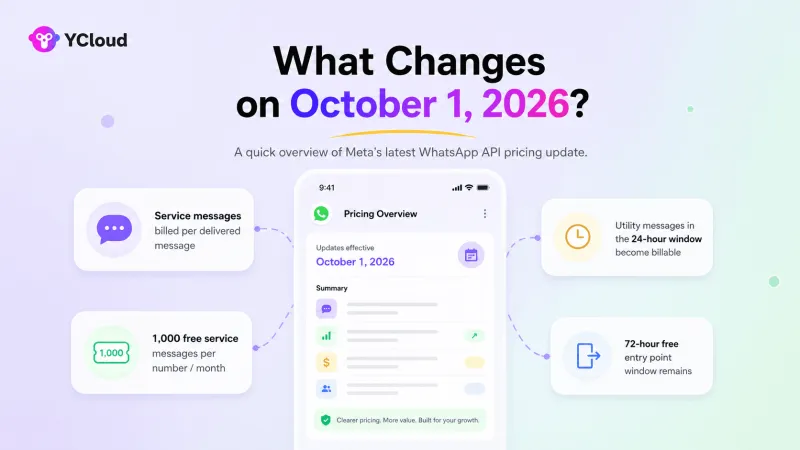
Meta’s October 1, 2026 rate cards are now published, and the new pricing applies from 12:00 AM based on the WhatsApp Business Account timezone.
You can check the new rate card here: WhatsApp API Message Pricing Rate CardChange | What It Means |
| Service messages become chargeable | Free-form replies sent inside the 24-hour customer service window will be billed per delivered message |
| 1,000 free service messages per business phone number per month | Each business phone number gets 1,000 free delivered service messages every month before billing starts |
| Utility messages inside the 24-hour window become chargeable | Utility templates sent in response to users will no longer remain free inside the customer service window |
| Marketing rates increase in selected markets | Kuwait, Mexico, Morocco, Saudi Arabia, UAE, Other Middle East, and Other Asia Pacific see higher marketing rates |
| Utility and authentication rates change | 8 markets see price increases and 4 markets see price decreases |
| 9 new authentication-international markets added | Bangladesh, Iraq, Kazakhstan, Kuwait, Morocco, Nepal, Oman, Sri Lanka, and Ukraine get new international authentication rates |
| 72-hour free entry point window remains | Eligible Click-to-WhatsApp ad and Facebook Page entry conversations continue to get free message delivery |
| Businesses need to review billing setup | Service message delivery may be affected if the required payment method is not added before the pricing change starts |
Next, let’s look at some important billing rules you should know.
Important Billing Rules Businesses Should Know
Before looking at each pricing change, it is important to understand how Meta charges WhatsApp API messages.
- Charges apply only when a business message is delivered. If a message is not delivered to the WhatsApp user, it should not count as a billable delivered message.
- User-to-business messages are not charged. When a customer sends a message to your business, that incoming message does not create a Meta message charge.
- Only one charge applies per message. A message is charged under one category only. For example, a non-template reply is charged either as a service message or as a Meta Business Agent message, not both.
- Non-template messages can only be sent inside the 24-hour customer service window. These messages are for replying to users, not for starting a new conversation.
- Template messages are still needed for outreach. If a business wants to message a user outside the customer service window, it must use an approved template message.
- October 1, 2026 rate cards are now published. The new rates apply from 12:00 AM based on the WhatsApp Business Account timezone.
Next, let’s start with the biggest change: service messages are no longer fully free.
Service Messages Will Be Charged Per Message from October 1, 2026
Service messages are the regular replies businesses send to users inside the 24-hour customer service window.
These are non-template messages, which means they are not pre-approved WhatsApp templates.
They are usually used for everyday customer conversations, such as:
- Answering product questions
- Confirming customer requirements
- Sharing support replies
- Following up on sales inquiries
- Handling after-sales issues
Service messages can be sent by a human customer support agent or by a third-party AI tool. But they can only be sent when the 24-hour customer service window is open.
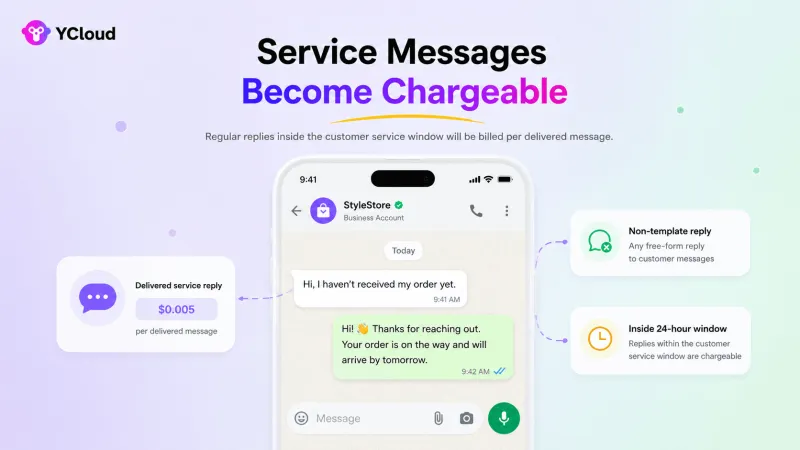
Starting October 1, 2026, service messages will be charged on a per-delivered-message basis.
The rate will be the same as the utility/authentication message rate in the recipient’s market. So the cost depends on where the customer is located, not where the business is based.
For example, if one business phone number sends 10,000 service messages to users in the UAE in a month, and the service message rate is $0.0157 per message, the calculation would be:
(10,000 − 1,000 free service messages) × $0.0157 = $141.30
So, the first 1,000 service messages are free for that business phone number for the month, and billing starts from the 1,001st delivered service message.
Next, let’s understand the new 1,000 free service message rule.
This is Your One-Stop Guide to WhatsApp API Message Template Categories1,000 Free Service Messages Per Business Phone Number Per Month
Meta is also adding a monthly free quota for service messages.
Each business phone number will get 1,000 free service messages per month. This quota applies to service messages only, and billing starts from the 1,001st delivered service message in that month.
A few things to note:
- The free quota is counted by number of messages, not conversations.
- The quota applies per business phone number, not across the entire company account.
- The first 1,000 delivered service messages are free every month for each number.
- Unused free messages do not carry forward to the next month.
- The quota resets every month for every business phone number.
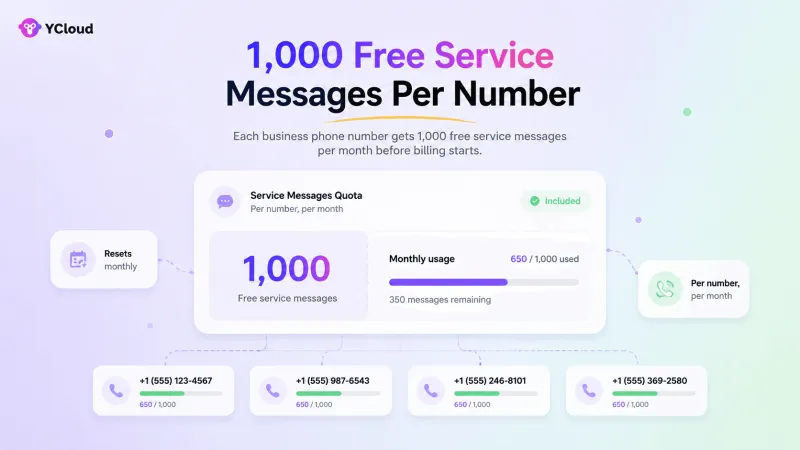
For example, if a company has 3 WhatsApp business numbers, each number gets its own 1,000 free service messages per month.
So the company may get up to 3,000 free service messages per month in total, but only as 1,000 free messages per number.
If one number sends only 500 service messages, its unused 500 messages cannot be transferred to another number.
Next, let’s look at another important change: utility messages inside the 24-hour window will be charged.
Utility Messages Sent Inside the 24-Hour Customer Service Window Will Be Charged
Another important change is related to utility messages sent inside the 24-hour customer service window.
Earlier, utility templates sent in response to users inside this window were free.
From October 1, 2026, these utility messages will be charged on a per-delivered-message basis.
This means businesses should no longer assume that every message sent inside the 24-hour window is free.
Utility messages usually include transactional or notification-type updates, such as:
- Order confirmations
- Shipping updates
- Appointment reminders
- Payment confirmations
- Delivery status updates
- Account or service notifications
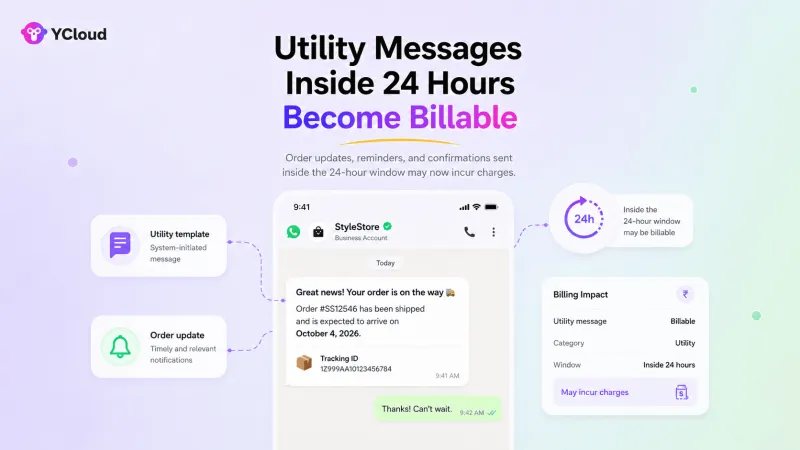
Utility messages sent outside the 24-hour customer service window were already chargeable. The new change is that utility messages sent inside the window will also become billable.
For example, a customer asks:
“Where is my order?”
The business may reply with:
- A free-form support reply → service message
- An order update template → utility message
From October 1, 2026, both may be billable depending on the message type, delivery status, and available free service-message quota.
Next, let’s quickly explain the 24-hour customer service window in simple terms.
What Is the 24-Hour Customer Service Window?
The 24-hour customer service window opens when a customer sends a message to a business on WhatsApp.
Once this window is open, the business can reply with non-template messages, such as normal text replies, images, documents, or support responses. This window resets every time the customer sends a new message.
Here’s the simple rule:
- If the customer messages you first, the 24-hour window opens.
- During this window, you can send non-template replies.
- Non-template messages cannot be used to start a conversation.
- If the 24-hour window is closed, businesses must use an approved template message to contact the user again.
- From October 1, 2026, service messages and utility messages sent inside this window may also be billable.
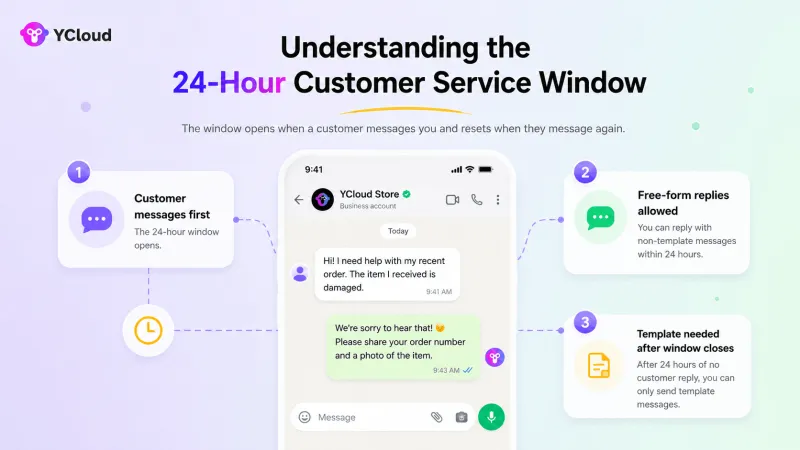
For example, if a customer messages:
“Can you help me track my order?”
Your business can reply inside the 24-hour window with a normal support response. But if the customer does not reply again and the 24-hour window closes, you cannot send another free-form message. You will need to use an approved template message.
For a detailed explanation, you can also read: WhatsApp 24-Hour Conversation Window ExplainedNext, let’s look at the 72-hour free entry point window, which is still staying.
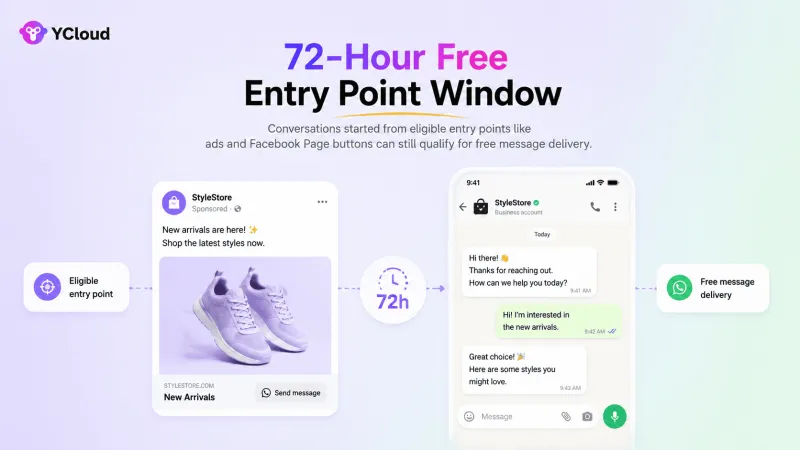
72-Hour Free Entry Point Window Will Continue
The 72-hour free entry point window will continue even after the October 1, 2026 pricing update.
This applies when a user starts a WhatsApp conversation through eligible entry points, such as:
During this 72-hour window, eligible message delivery can remain free. However, businesses should still separate these conversations while calculating WhatsApp costs, because not every cost may be waived.
The important detail is this:
So, if a business uses Meta Business Agent to respond to users during this window, the AI token usage may still be charged separately.
This matters for businesses that use Click-to-WhatsApp ads to generate leads and then use AI for:
- Lead qualification
- Product consultation
- Customer support
- Sales follow-ups
For a deeper explanation, you can also read: WhatsApp Service Messages and 24-Hour Window PricingNext, let’s look at Meta Business Agent pricing and how it differs from normal service messages.
Meta Business Agent Messages vs Service Messages: What’s the Billing Difference?
Meta Business Agent messages and service messages are both non-template replies, but they are billed differently.
Message Type | Who Sends It | Billing Meter | Effective Date |
| Service message | Human agent or third-party AI | Per delivered message | October 1, 2026 |
| Meta Business Agent message | Meta’s own AI agent | Per token | August 1, 2026 |
A service message is charged per delivered message. This applies when the reply is sent by a human agent or a third-party AI tool.
A Meta Business Agent message is charged based on token usage.
Meta’s rate is $2.00 per 1 million tokens.
A typical Meta Business Agent message may consume around 20,000–25,000 tokens, which is roughly 4–5 cents per message.
The actual cost depends on the complexity of the reply:
- A short answer usually uses fewer tokens.
- A longer or more complex response uses more tokens.
- Multi-step support or product consultation may cost more than a simple FAQ-style answer.
There is also one important cost difference for businesses using third-party AI.
If a business uses a third-party AI tool, the reply is still treated as a service message on WhatsApp. So the business may have two cost layers:
- The third-party AI provider cost
- The WhatsApp service message delivery cost
For Meta Business Agent, Meta applies one token-based charge that covers the AI processing and message delivery.
Billing note: Businesses using Meta Business Agent also need to check their billing setup. Meta Business Agent requires a payment method. Eligible businesses can use a Meta credit line from August 1, 2026, while credit and debit cards are available from September 8, 2026. For non-USD Business Agent accounts, Meta applies daily FX conversion based on the message delivery date.
Next, let’s look at the markets where marketing message prices are increasing.
Markets with Marketing Message Price Increases
Meta is increasing marketing message rates in 5 specific markets and 2 regional rate groups from October 1, 2026.
These changes apply to marketing messages and marketing lite messages, where applicable.
Country/Region | Old Price | New Price | Change |
| Kuwait | $0.0341 | $0.0792 | +132.26% |
| Morocco | $0.0225 | $0.0414 | +84.00% |
| Mexico | $0.0305 | $0.0397 | +30.16% |
| Saudi Arabia | $0.0501 | $0.0576 | +14.97% |
| UAE | $0.0499 | $0.0576 | +15.43% |
| Other Middle East | $0.0341 | $0.0392 | +14.96% |
| Other Asia Pacific | $0.0732 | $0.0842 | +15.03% |
The biggest increase is in Kuwait, where the marketing message rate increases by 132.26%. Morocco also sees a major increase of 84.00%.
Businesses running WhatsApp marketing campaigns in these markets should review:
- Campaign frequency
- Audience segmentation
- Template quality
- Expected conversion rate
- Campaign ROI after the new rate applies
This does not mean businesses should stop sending marketing messages. It means campaigns in these markets should be planned more carefully, especially if message volume is high.
Next, let’s clarify what “Other Asia Pacific” and “Other Middle East” actually mean.
Important Note on Regional Rate Groups
A regional rate group is not the same as the entire geographical region.
For example, Other Asia Pacific does not mean every country in Asia Pacific. It only refers to markets that fall under Meta’s specific “Other Asia Pacific” rate group.
In this pricing update, markets such as Australia, Japan, Philippines, Thailand, and Vietnam are part of this regional adjustment. But separately listed markets, such as India or Indonesia, should be checked under their own country-specific pricing.
The same logic applies to Other Middle East.
This rate group is different from standalone markets such as Kuwait, Saudi Arabia, UAE, and Oman.
For example, markets such as Bahrain, Jordan, Lebanon, and Yemen fall under this regional marketing-rate increase.
So, when estimating WhatsApp API costs, businesses should calculate pricing based on:
- The recipient’s market
- The customer’s WhatsApp country code
- The message category
- The applicable country or regional rate group
Businesses should not calculate pricing based only on where their headquarters, sales team, or support team is located. The customer’s market is what matters for message pricing.
Next, let’s look at utility and authentication markets where prices are increasing.
Markets with Utility and Authentication Price Increases
In this update, utility message rates and authentication message rates are increasing in 8 markets.
In the pricing sheet, the unit prices for utility and authentication messages are the same in these affected markets, so they are shown together below.
Country | Old Price | New Price | Change |
| Morocco | $0.0040 | $0.0230 | +475.00% |
| Kuwait | $0.0091 | $0.0440 | +383.52% |
| Oman | $0.0091 | $0.0247 | +171.43% |
| Kazakhstan | $0.0077 | $0.0180 | +133.77% |
| Pakistan | $0.0100 | $0.0150 | +50.00% |
| Peru | $0.0200 | $0.0300 | +50.00% |
| Ukraine | $0.0212 | $0.0298 | +40.57% |
| South Africa | $0.0076 | $0.0095 | +25.00% |
The sharpest increases are in Morocco and Kuwait. Morocco’s rate increases by 475.00%, while Kuwait’s rate increases by 383.52%.
Businesses sending high volumes of utility or authentication messages in these markets should review their expected costs carefully, especially for use cases such as:
- OTPs and login codes
- Payment confirmations
- Delivery updates
- Order notifications
- Account alerts
- Appointment or service reminders
Next, let’s look at markets where utility and authentication prices are decreasing.
Markets with Utility and Authentication Price Decreases
While some markets are seeing price increases, utility message rates and authentication message rates are decreasing in 4 markets from October 1, 2026.
Country | Old Price | New Price | Change |
| Sri Lanka | $0.0113 | $0.0020 | −82.30% |
| Nepal | $0.0113 | $0.0034 | −69.91% |
| Bangladesh | $0.0113 | $0.0037 | −67.26% |
| Iraq | $0.0091 | $0.0079 | −13.19% |
Sri Lanka sees the largest reduction, with rates dropping by 82.30%. Nepal and Bangladesh also see major price cuts.
Businesses sending OTPs, transactional alerts, account notifications, or delivery updates in these markets may see lower utility and authentication messaging costs.
However, businesses should still calculate the full impact carefully, because service messages becoming chargeable can create a new cost line even in markets where utility and authentication rates are decreasing.
Next, let’s look at the 9 new authentication-international markets added from October 1, 2026.
9 New Authentication-International Markets Added
From October 1, 2026, Meta is adding 9 new authentication-international markets.
These markets are also becoming standalone markets on the rate card. This means they are moving out of their older “Rest Of” regional pricing group and will now have their own market-specific rates.
Their message volumes will also count toward that specific market’s volume tiers, not the older regional group.
Country | New Authentication-International Rate |
| Bangladesh | $0.0960 |
| Iraq | $0.1280 |
| Kazakhstan | $0.1600 |
| Kuwait | $0.1200 |
| Morocco | $0.0811 |
| Nepal | $0.1120 |
| Oman | $0.0600 |
| Sri Lanka | $0.1440 |
| Ukraine | $0.0746 |
These rates apply to authentication-international messages, usually used for cross-border verification use cases such as OTPs and login codes.
However, businesses should not assume this rate applies only because they send verification codes to overseas users. Authentication-international pricing depends on Meta’s eligibility rules.
Businesses should check:
- Billing eligibility
- Principal place of business
- Recipient market
- Actual effective date
- Account notifications from Meta
- Official authentication-international eligibility rules
Another important update is that authentication-international eligibility may now be checked across up to 18 markets, including the 9 newly added markets.
Meta also continues to provide a 30-day eligibility notice before authentication-international charges begin. So businesses sending OTPs or login codes across countries should review their account notifications before budgeting.
Read Applicable Conditions for International Verification CodesNext, let’s look at how businesses can estimate the real cost impact of this update.
How Businesses Can Estimate the New WhatsApp API Cost Impact
To estimate the impact of this pricing update, businesses should use the published October 1, 2026 rate cards.
You can check the new rate card here: WhatsApp API Message Pricing Rate CardImportant note: The new rates apply from 12:00 AM based on the WhatsApp Business Account timezone.
Here is a simple way to estimate your new WhatsApp API cost:
- Export your last month’s WhatsApp message volume.
- Split the volume by business phone number.
- Split the messages by recipient market.
- Separate messages by type:
- Marketing
- Marketing Lite
- Utility
- Authentication
- Authentication-International
- Service
- Meta Business Agent
- Identify service messages sent inside the 24-hour customer service window.
- Identify utility templates sent inside the 24-hour customer service window.
- Separate conversations that qualify for the 72-hour free entry point window.
- Deduct 1,000 free service messages per business phone number per month.
- Apply the new country-wise rates.
- Compare the new estimated cost with your current monthly WhatsApp spend.
Simple formula for service messages:
- Paid Service Messages = Total Delivered Service Messages − 1,000 free service messages per business phone number
- Estimated Service Cost = Paid Service Messages × Service Message Rate of the Recipient Market
For example, if one business number sends 10,000 delivered service messages to users in the UAE in a month, and the rate is $0.0157/message, the estimated service message cost would be:
(10,000 − 1,000) × $0.0157 = $141.30
If your business uses multiple WhatsApp numbers, calculate this separately for each business phone number. The 1,000 free service messages are not shared across the whole company account.
Next, let’s look at how businesses can track service message usage in analytics and webhooks.
How to Track Service Message Usage in Analytics and Webhooks
Businesses can also track service message usage through Meta’s analytics and webhook data.
This is useful for technical teams, BSPs, or businesses that want to estimate support-message costs before the October 1, 2026 pricing change applies.
Here are the key tracking points:
- The Pricing Analytics API can show service-message volume for a selected timeframe.
- Businesses can query pricing_category: SERVICE to understand how many service messages were delivered.
- Message delivery webhooks can show service messages with category: service.
- Billable service messages will appear with pricing details in the webhook pricing object.
- This helps teams compare current reply volume with expected future costs.
For example, if a business wants to estimate future service-message charges, it can check how many SERVICE messages were delivered last month, split them by business phone number and recipient market, then apply the new October 1 rates after deducting the free monthly quota.
Next, let’s look at what businesses should do before October 1, 2026.
What Businesses Should Do Before October 1, 2026
Before the new pricing starts, businesses should review both their billing setup and WhatsApp message usage.
Start with the billing side first:
- Add or verify your payment method before September 30, 2026.
- Check payment setup for each WhatsApp Business Account or business phone number you manage.
- If your business uses Meta Business Agent, confirm that the billing setup is active.
- If your Meta Business Agent account is billed in a non-USD currency, check how daily FX conversion may affect your cost.
This is important because service message delivery may stop if the required payment method is not added before the October 1 pricing change starts.
Next, review your actual WhatsApp usage:
Add service replies to your budget
Check how many service messages each business phone number delivered last month. Break this down by recipient market so you can estimate the new per-message cost more accurately.
Check how many service messages each business phone number delivered last month. Break this down by recipient market so you can estimate the new per-message cost more accurately.
Audit utility messages inside the 24-hour window
Do not continue using the old assumption that all messages inside the customer service window are free. Utility templates sent inside the 24-hour window will also become chargeable.
Do not continue using the old assumption that all messages inside the customer service window are free. Utility templates sent inside the 24-hour window will also become chargeable.
Separate 72-hour free entry point conversations
Identify conversations that came from eligible Click-to-WhatsApp ads or Facebook Page CTA buttons. These may still qualify for free message delivery, but Meta Business Agent token charges may still apply separately.
Identify conversations that came from eligible Click-to-WhatsApp ads or Facebook Page CTA buttons. These may still qualify for free message delivery, but Meta Business Agent token charges may still apply separately.
Review marketing campaigns in affected markets
Check campaign plans for Kuwait, Morocco, Mexico, Saudi Arabia, UAE, Other Middle East, and Other Asia Pacific. These markets or rate groups are seeing marketing message price increases.
Check campaign plans for Kuwait, Morocco, Mexico, Saudi Arabia, UAE, Other Middle East, and Other Asia Pacific. These markets or rate groups are seeing marketing message price increases.
Check OTP and verification-heavy markets
Review expected authentication and utility costs in Morocco, Kuwait, Oman, Kazakhstan, Pakistan, Peru, Ukraine, and South Africa, where rates are increasing.
Review expected authentication and utility costs in Morocco, Kuwait, Oman, Kazakhstan, Pakistan, Peru, Ukraine, and South Africa, where rates are increasing.
Review authentication-international eligibility
If your business sends OTPs or verification codes across countries, check the 9 newly added authentication-international markets and review Meta’s eligibility notifications.
If your business sends OTPs or verification codes across countries, check the 9 newly added authentication-international markets and review Meta’s eligibility notifications.
Optimize customer service and AI replies
Reduce duplicate greetings, repeated bot replies, unnecessary message splitting, and back-and-forth caused by unclear questions.
Reduce duplicate greetings, repeated bot replies, unnecessary message splitting, and back-and-forth caused by unclear questions.
Make every reply more useful
Use quick replies, knowledge base content, better automation flows, and clear human-handover rules so teams can resolve more issues with fewer messages.
Use quick replies, knowledge base content, better automation flows, and clear human-handover rules so teams can resolve more issues with fewer messages.
The goal is not just to reduce message count. The goal is to keep conversations clear, useful, and cost-aware without hurting customer experience.
Next, let’s look at practical examples to understand the pricing change better.
Simple Pricing Examples to Understand the Cost Change
Here are a few simple examples to show how the October 1, 2026 pricing update can affect WhatsApp API costs.
Example 1: Service messages in the UAE
A business sends 10,000 service messages to users in the UAE in one month.
- Free monthly quota: 1,000 service messages
- Paid service messages: 9,000
- Service message rate: $0.0157/message
- Estimated service message cost: $141.30
Calculation:
(10,000 − 1,000) × $0.0157 = $141.30
This shows how regular customer support replies can become a new cost line once service messages become chargeable.
Example 2: Utility/authentication increase in Morocco
A business sends 10,000 OTPs or order updates to users in Morocco.
- Old rate: $0.0040/message
- New rate: $0.0230/message
- Increase: 475.00%
Cost comparison:
- Old estimated cost: 10,000 × $0.0040 = $40
- New estimated cost: 10,000 × $0.0230 = $230
So, for every 10,000 utility or authentication messages in Morocco, the estimated cost increases by $190.
Example 3: Utility/authentication decrease in Sri Lanka
A business sends 10,000 OTPs or transactional alerts to users in Sri Lanka.
- Old rate: $0.0113/message
- New rate: $0.0020/message
- Decrease: 82.30%
Cost comparison:
- Old estimated cost: 10,000 × $0.0113 = $113
- New estimated cost: 10,000 × $0.0020 = $20
So, for every 10,000 utility or authentication messages in Sri Lanka, the estimated cost may reduce by $93.
These examples show why businesses should not look at the update from one angle only.
Some message types and markets may become more expensive, while others may become cheaper. The real impact depends on your message volume, customer markets, business phone numbers, and message mix.
Next, let’s look at YCloud’s recommendations for businesses.
YCloud Recommendations to Control WhatsApp API Costs
After this pricing update, businesses should review WhatsApp API costs more carefully.
The cost impact will depend on your recipient market, message type, business phone number, free-message rules, and sending structure.
Here are YCloud’s practical recommendations:
- Review your WhatsApp API cost structure before October 1, 2026.
- Do not budget only for template messages anymore.
- Include service replies, utility templates inside the customer service window, and AI-powered replies in your cost planning.
- Track costs by recipient market, not only by your company’s office location or business region.
- Review message volume separately for each WhatsApp business phone number.
- Focus first on markets with high message volume or major price changes.
- Optimize bot and agent replies to avoid duplicate greetings, repeated answers, and unnecessary back-and-forth.
- Use clear automation flows, quick replies, and knowledge base content to make each message more useful.
- Use customer segmentation to avoid sending marketing messages to low-intent or inactive audiences.
- Monitor authentication-international eligibility if you send OTPs or login codes across markets.
- Use a WhatsApp API platform that helps track campaigns, conversations, automation, and costs from one place.
The goal is not to reduce communication quality. The goal is to make every WhatsApp message more relevant, useful, and cost-aware.
Next, let’s see how YCloud helps businesses manage WhatsApp communication at scale.
How YCloud Helps Businesses Manage WhatsApp API Communication at Scale
YCloud is an official WhatsApp Business Solution Provider that helps businesses manage WhatsApp API communication across marketing, sales, customer support, and automation.
With YCloud, teams can manage key WhatsApp workflows from one platform, including:
- Sending approved WhatsApp template messages
- Managing customer conversations from a shared inbox
- Running WhatsApp marketing campaigns
- Automating customer journeys and support workflows
- Building AI-powered WhatsApp Agents
- Handling sales, support, and follow-up conversations
- Tracking message performance and campaign results
- Staying updated on WhatsApp pricing and policy changes
This becomes especially important after the October 1, 2026 pricing update, because businesses need better visibility into message types, recipient markets, customer replies, campaigns, and automation flows.
YCloud gives teams a practical way to manage WhatsApp communication with more control, visibility, and scalability, without depending on disconnected tools for campaigns, inbox, automation, and support.
For businesses using WhatsApp at scale, this helps make communication easier to manage, measure, and optimize as pricing and policy rules continue to change.
Next, let’s wrap up the key points from this update.
Final Thoughts!
Meta’s October 2026 WhatsApp API pricing update is important because it affects both campaign messages and daily customer conversations.
Service messages becoming chargeable means businesses now need to include support replies, sales follow-ups, and regular customer conversations in their cost planning. Utility messages sent inside the 24-hour customer service window should also be reviewed as part of the monthly WhatsApp budget.
Some markets will become more expensive, while others will become cheaper. So the actual impact will depend on your message volume, recipient markets, automation setup, and authentication-international eligibility.
Before October 1, 2026, businesses should review their message usage, billing setup, market mix, and automation structure.
YCloud can help businesses manage WhatsApp API communication with more clarity, control, and scalability.
Suggested Read:
- Struggling with WhatsApp API Template Message Approval? 15+ Common Rejection Reasons & Fixes
- Why Your WhatsApp Utility Templates Are Still Being Classified as Marketing
- WhatsApp API Message Templates: Key Terms & Mechanics Explained
- Your One-Stop Guide to WhatsApp API Message Template Categories
- Your One-Stop Guide to WhatsApp API Pricing: Everything Explained
- WhatsApp Calling API Pricing: Everything Explained
Frequently Asked Questions
When will the new WhatsApp API pricing take effect?
The new WhatsApp API pricing update takes effect on October 1, 2026. The new rates apply from 12:00 AM based on the WhatsApp Business Account timezone.
What is changing from October 1, 2026?
From October 1, 2026, service messages will become chargeable after the free monthly quota. Utility messages sent inside the 24-hour customer service window will also be charged. Meta is also changing marketing, utility, authentication, and authentication-international rates in selected markets.
Can service message delivery stop if a payment method is not added?
Yes. Meta says service message delivery may stop if the required payment method is not added before September 30, 2026. Businesses should add or verify their payment method before the new pricing starts.
What are service messages on WhatsApp API?
Service messages are non-template replies sent by a business inside the 24-hour customer service window. They are usually used for customer support, sales replies, order questions, and regular customer conversations.
Are service messages free after October 1, 2026?
Service messages are not fully free after October 1, 2026. Each business phone number gets 1,000 free service messages per month, and messages above that limit are charged per delivered message.
How does the 1,000 free service message quota work?
Each WhatsApp business phone number gets 1,000 free delivered service messages per month. The quota is counted separately for each business phone number, not across the full company account.
Do unused free service messages carry forward?
No. Unused free service messages do not carry forward to the next month. The quota resets every month for each business phone number.
Are utility messages inside the 24-hour customer service window still free?
No. From October 1, 2026, utility messages sent inside the 24-hour customer service window will also be charged per delivered message.
Will Meta provide notice before authentication-international charges begin?
Yes. Meta continues to provide a 30-day eligibility notice before authentication-international charges begin. Businesses should check account notifications and official eligibility details before budgeting.
What billing setup is required for Meta Business Agent?
Meta Business Agent requires an active payment method. Eligible businesses can use a Meta credit line from August 1, 2026, while credit and debit cards are available from September 8, 2026. For non-USD accounts, Meta applies daily FX conversion based on the message delivery date.
What is the 24-hour customer service window?
The 24-hour customer service window opens when a customer messages a business on WhatsApp. During this window, the business can send non-template replies. The window resets every time the customer sends a new message.
Is the 72-hour free entry point window still available?
Yes. The 72-hour free entry point window will continue for eligible conversations started through Click-to-WhatsApp ads or Facebook Page call-to-action buttons. However, Meta Business Agent token costs are not waived by this free entry point window.
Which marketing message markets have price increases?
Marketing message rates are increasing in Kuwait, Morocco, Mexico, Saudi Arabia, UAE, Other Middle East, and Other Asia Pacific. Kuwait has the highest increase in this update.
Which utility and authentication markets have price increases?
Utility and authentication rates are increasing in Morocco, Kuwait, Oman, Kazakhstan, Pakistan, Peru, Ukraine, and South Africa. Morocco and Kuwait show the largest increases.
Which utility and authentication markets have price decreases?
Utility and authentication rates are decreasing in Sri Lanka, Nepal, Bangladesh, and Iraq. Sri Lanka has the largest reduction.
What are the 9 new authentication-international markets?
The 9 new authentication-international markets are Bangladesh, Iraq, Kazakhstan, Kuwait, Morocco, Nepal, Oman, Sri Lanka, and Ukraine. These markets will have standalone authentication-international rates from October 1, 2026.
Does authentication-international pricing apply to every OTP?
No. Businesses should not assume authentication-international pricing applies only because they send OTPs to overseas users. Eligibility depends on factors such as billing eligibility, principal place of business, recipient market, effective date, and Meta account notifications.
What is the difference between service messages and Meta Business Agent messages?
Service messages are replies sent by human agents or third-party AI tools and are charged per delivered message. Meta Business Agent messages are generated by Meta’s own AI agent and are charged based on token usage.
How is Meta Business Agent pricing calculated?
Meta Business Agent uses token-based billing at $2.00 per 1 million tokens. A typical message may consume around 20,000–25,000 tokens, which is roughly 4–5 cents per message. Simple replies may cost less, while complex replies may cost more.
Does this affect the normal WhatsApp or WhatsApp Business app?
No. This update applies to the WhatsApp Business Platform/API, not the regular WhatsApp app or the WhatsApp Business app used directly on a phone.
How can businesses reduce WhatsApp API messaging costs?
Businesses can reduce waste by improving segmentation, avoiding duplicate replies, using better automation flows, writing clearer templates, and setting proper human-handover rules. They should also track costs by recipient market and message type.
What should businesses do before October 1, 2026?
Businesses should add or verify their payment method, review service message volume, check utility messages inside the 24-hour window, review affected markets, and check authentication-international eligibility. They should also update their WhatsApp cost planning before the new rates apply.
How can YCloud help businesses manage WhatsApp API pricing changes?
YCloud helps businesses manage WhatsApp API communication across campaigns, customer conversations, automation, AI chatbots, and message performance tracking. This gives teams better visibility and control as WhatsApp pricing and policy rules continue to change.
Related Articles


Make your business communications much easier!


Trusted by