Customer Support

English

Official vs Unofficial WhatsApp API: What’s Better?

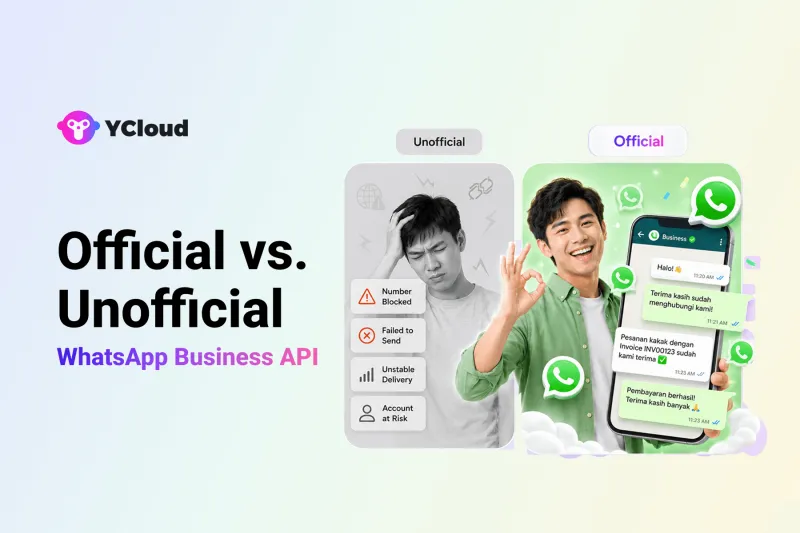
A WhatsApp API may look like a backend decision.
But for a business, it decides whether your messages get delivered, your number stays active, and your customer conversations keep running.
Many teams choose an unofficial WhatsApp API because it looks faster to set up.
No verification.
No template approval.
No waiting.
But that shortcut can quickly turn into a serious problem.
Messages start failing.
The number gets flagged.
Customer chats stop.
And there is no official support to fix it.
That is the risk of building business communication on an unofficial WhatsApp API.
In this guide, we’ll compare official vs unofficial WhatsApp API, explain the key differences, show the risks, and help you choose the safer option for long-term WhatsApp communication.
Next, let’s first understand what official and unofficial WhatsApp API actually mean.
What Are Official and Unofficial WhatsApp API?
- Official WhatsApp API
- Unofficial WhatsApp API
What is Official WhatsApp API?
The official WhatsApp API is Meta’s approved way for businesses to send and receive WhatsApp messages at scale.
It is accessed through official WhatsApp Business Solution Providers like YCloud and is built for real business use: campaigns, automation, customer support, notifications, analytics, chatbots, AI-Agents, integrations, and much more.
It follows Meta’s policies, supports approved message templates, and helps businesses communicate with opted-in customers safely.
What is Unofficial WhatsApp API?
Unofficial WhatsApp API is not approved by Meta.
These tools usually work through reverse-engineered systems, browser automation, modified WhatsApp apps, or WhatsApp Web workarounds.
They may look easy and cheap at first, but they can create serious risks: number bans, message failures, data leaks, unstable performance, and no official support.
So, the difference is simple.
The official WhatsApp API is built for safe and scalable business communication. The unofficial WhatsApp API is a shortcut that can put your number, data, and customer trust at risk.
Next, let’s compare official and unofficial WhatsApp API side by side.
Official vs Unofficial WhatsApp API: Key Differences
Both official and unofficial WhatsApp APIs claim to help businesses send and receive WhatsApp messages.
But the difference is in approval, safety, reliability, and long-term control.
Here’s a quick comparison:
Factor | Official WhatsApp API | Unofficial WhatsApp API |
| Approval | Approved by Meta | Not approved by Meta |
| Access | Through official BSPs like YCloud | Through unsupported third-party methods |
| Compliance | Follows Meta’s policies | Violates or bypasses WhatsApp systems |
| Account safety | Low risk when used properly | High risk of number bans |
| Templates | Supports approved message templates | Often skips template approval |
| Automation | Supports workflows, AI agents, and chatbots | Limited or unstable automation |
| Analytics | Tracks delivery, reads, replies, and failures | Little or no reliable reporting |
| Integrations | Connects with CRMs, Shopify, Zapier, and more | Limited or unstable integrations |
| Security | Uses official infrastructure and access controls | Higher risk of data leaks |
| Support | Official platform and partner support | No official support from WhatsApp |
| Long-term use | Built for business communication | Risky for serious business use |
1. Approval and Compliance
Official WhatsApp API
Official WhatsApp API works through Meta-approved systems and follows WhatsApp’s business messaging policies.
Businesses can send approved templates, manage opt-ins, and communicate with customers in a safer way.
Unofficial WhatsApp API
Unofficial WhatsApp API usually works through unsupported methods such as browser automation, reverse-engineered APIs, or WhatsApp Web shortcuts.
It may look easy to start with, but it does not follow WhatsApp’s official process.
2. Risk of Number Ban
Official WhatsApp API
With the official WhatsApp API, the risk is much lower when you message opted-in users and follow best practices.
Unofficial WhatsApp API
With an unofficial WhatsApp API, the risk is much higher.
WhatsApp can flag or ban numbers that bypass official systems, send spam-like messages, or use unauthorized automation.
For a business, losing a WhatsApp number can mean losing an active sales, support, or customer update channel.
3. Security and Data Privacy
Official WhatsApp API
Official API platforms are built for business use.
They offer safer access, better controls, and more reliable handling of customer conversations.
Unofficial WhatsApp API
Unofficial APIs may ask for access to your WhatsApp Web session, phone number, contacts, or customer chats.
That creates a serious risk if your business handles leads, orders, payments, support tickets, or personal customer data.
4. Features and Business Control
Official WhatsApp API
With a platform like YCloud, businesses can use approved templates, broadcasts, AI agents, automation, shared inbox, segmentation, campaign analytics, and integrations with Shopify, Zapier, CRMs, and Meta Ads.
Unofficial WhatsApp API
Unofficial APIs are mostly built for shortcuts.
They usually lack stable automation, reliable reports, proper team workflows, and long-term scalability.
5. Reliability and Scalability
Official WhatsApp API
Official WhatsApp API platforms are designed for stable business communication.
You can track what was sent, delivered, read, replied to, or failed.
Unofficial WhatsApp API
Unofficial APIs are unpredictable.
Messages can fail, sessions can break, campaigns can stop midway, and there may be no clear report to understand what went wrong.
6. Cost vs Long-Term Value
Unofficial APIs may look cheaper at first.
But the hidden cost can be much higher: banned numbers, failed campaigns, poor delivery, data risks, and lost customer trust.
The official WhatsApp API may need proper setup, but it gives your business safer communication, better control, and a stronger foundation for growth.
Next, let’s look at the advantages of using an official WhatsApp API provider like YCloud.
Advantages of Using an Official WhatsApp API Provider Like YCloud
Choosing an official WhatsApp API provider like YCloud is not just about staying compliant.
It gives your business a safer, more reliable way to manage WhatsApp campaigns, support conversations, automation, and customer data from one place.
Here’s what you get with YCloud:
1. Official WhatsApp API Access
YCloud gives you access to the official WhatsApp Business API.
That means your business can send messages using approved templates, proper opt-ins, and Meta-compliant messaging practices.
No browser hacks. No reverse-engineered APIs. No risky shortcuts.
2. Safer Business Messaging
With YCloud, your team can send WhatsApp messages without depending on unofficial API tools.
This helps reduce the risk of number bans, campaign failures, poor delivery, and sudden account restrictions.
3. Better Campaign and Message Control
YCloud helps you manage WhatsApp communication properly.
You can:
- Send bulk broadcasts to opted-in users
- Create templates faster with AI
- Segment contacts
- Schedule campaigns
- Track sent, delivered, read, failed, and bounced messages
- Review campaign performance from reports
So your team does not just send messages. You know what happened after they were sent.
4. Automation, AI Agents, and Shared Inbox
YCloud helps you manage conversations after the message is delivered.
You can use AI agents, Journey Builder, shared inbox, agent assignment, and automation workflows to answer FAQs, qualify leads, send reminders, and hand over chats to your sales or support team.
This turns WhatsApp into a proper business communication channel, not just a messaging tool.
5. Integrations and Retargeting
YCloud connects WhatsApp with tools like Shopify, Zapier, CRMs, and Meta Ads.
You can recover carts, send order updates, retarget WhatsApp-engaged users, and connect conversations with your existing systems.
Unofficial APIs usually cannot support this reliably.
6. Transparent Pricing and Free Plan
YCloud offers a free lifetime plan, zero markup on WhatsApp conversation charges, and unlimited contact storage.
You can check the pricing here: https://www.ycloud.com/pricing
You can also watch this quick video to understand 7 reasons to choose YCloud
In short, YCloud gives businesses a safer and more scalable way to use WhatsApp API without depending on unofficial tools.
Next, let’s wrap this up with a clear answer: which WhatsApp API should your business choose?
Wrapping Up!
Unofficial WhatsApp APIs may look quick and cheap, but they can put your number, messages, customer data, and business communication at risk.
Official WhatsApp API is built for businesses that want safer messaging, better delivery, automation, analytics, integrations, and long-term control.
So, if WhatsApp is important for your marketing, sales, or support, the better choice is clear: use the official WhatsApp Business API.
With YCloud, you get an official WhatsApp API platform to send messages safely, automate conversations, manage replies, and scale without risky shortcuts.
Frequently Asked Questions
What is the official WhatsApp API?
The official WhatsApp API is Meta’s approved way for businesses to send and receive WhatsApp messages at scale.
You can get it through official WhatsApp API providers like YCloud.
What is an unofficial WhatsApp API?
An unofficial WhatsApp API uses unsupported methods like browser automation, WhatsApp Web workarounds, or reverse-engineered systems.
It is not approved by Meta and can put your number, data, and messages at risk.
Is unofficial WhatsApp API safe?
No, not for serious business use.
Unofficial APIs can lead to number bans, message failures, data leaks, unstable performance, and no official support.
Will WhatsApp ban my number if I use API?
Not if you use the official WhatsApp Business API properly.
The risk starts when you use unofficial APIs, message users without consent, or bypass WhatsApp’s official systems.
Can I send bulk messages using the official WhatsApp API?
Yes.
With YCloud, you can send broadcasts to opted-in users, use approved templates, automate replies, segment contacts, and track campaign performance.
Is official WhatsApp API more expensive?
It may look costlier than unofficial APIs at first, but it is safer in the long run.
You get better delivery, compliance, analytics, automation, integrations, support, and lower risk of losing your business number.
Related Articles

Make your business communications much easier!


Trusted by